 Lynden Siding
 The Standard We Set Before We Ever Show Up
Every siding contractor in Whatcom County has to decide what they're willing to put their name behind. We made that decision a long time ago: James Hardie fiber cement, and nothing else. Not vinyl, not LP SmartSide, not primed spruce or cedar, not the off-brand fiber cement products that show up at the yard for less money. This page isn't a sales pitch dressed up as education — it's an honest explanation of what James Hardie is, why it holds up in Lynden's climate specifically, and what "correct installation" actually requires. If you're comparing siding options for a home anywhere between the Nooksack River and the Guide Meridian, this is the information we'd want you to have before you sign anything.
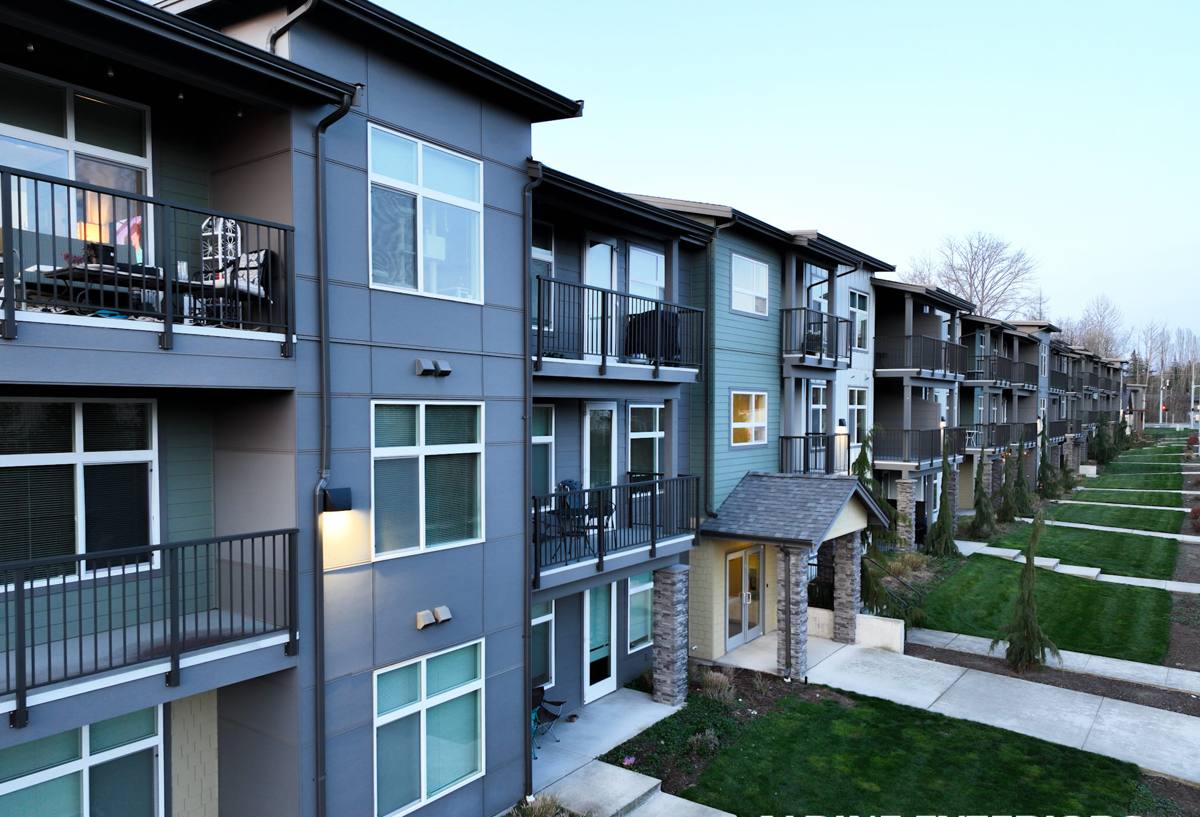
What James Hardie Fiber Cement Actually Is
Fiber cement siding is a composite of Portland cement, sand, cellulose fiber, and water, cured under controlled conditions into rigid boards and panels. It isn't a plastic product like vinyl, and it isn't a wood product like cedar or LP's engineered strand board. That distinction matters more than it sounds like it should, because it changes how the material behaves in three areas homeowners actually care about: fire, moisture, and dimensional stability.
Fiber cement is non-combustible. It won't ignite from embers or radiant heat the way wood-based sidings can. It doesn't absorb bulk water into its core structure the way wood fiber panel products do, so it doesn't swell, delaminate, or feed rot at cut edges and fastener points the same way. And it expands and contracts far less with temperature and humidity swings than either vinyl or wood, which means fewer cracked caulk joints and less buckling over the life of the siding. None of this makes it magic — installed wrong, any siding fails — but it starts from a materially different baseline than the alternatives.
Built for This Climate: Why HZ5 Matters in Lynden
James Hardie doesn't make one universal product. The company engineers its siding by climate zone — HZ5 (also called HZ10) is the formulation built for the Pacific Northwest, where the failure mode isn't heat and UV degradation the way it is in the Southwest, it's moisture. Lynden sits in a stretch of Whatcom County that gets a long wet season, persistent low-angle rain driven by wind off the Strait of Georgia, and enough salt-laden marine air moving inland that coastal-grade material choices aren't overkill even this far from open water. Add in a moss season that runs longer here than in most of the country, and you've got a climate that's genuinely hard on exterior building materials.
HZ5 fiber cement is formulated and tested for exactly this combination: sustained moisture exposure, freeze-thaw cycling, and the kind of driving rain that gets pushed sideways into wall assemblies during a real Whatcom County storm. It's not a marketing distinction — it's why we don't substitute a generic or southern-climate fiber cement product even when a customer is comparing price.
What "Driving Rain" Does to Siding You Didn't Choose Carefully
Wind-driven rain doesn't just wet a wall's surface — it pressurizes water against laps, seams, and penetrations, testing every joint in the siding system. Products that rely on caulk and paint film to stay watertight lose that fight gradually, one failed joint at a time, usually years before the homeowner notices anything visible. Fiber cement's rigidity and Hardie's engineered lap and joint details are built around that pressure, not just around keeping rain off in a light drizzle.
The ColorPlus Factory Finish
Most of what goes wrong with painted exterior siding happens at the finish, not the substrate. Field-applied paint on any siding material is only as good as the surface prep, the weather during application, and the number of coats — and it's the first thing to fail under UV and moisture stress. James Hardie's ColorPlus Technology bakes a multi-coat finish onto the board at the factory, under conditions no job site can replicate, before it ever gets exposed to weather.
The practical result is a finish that resists fading and chipping far longer than site-applied paint, plus a color-specific warranty on the finish itself, separate from the substrate warranty. Touch-up product is manufactured to match, so repairs after a repair or minor damage don't turn into a mismatched patch. Primed-only boards — the kind you'd need to paint yourself after installation — skip all of that and put the finish quality back in the hands of whoever paints it and whenever they get around to it.
The Hardie Product Lines We Install
James Hardie makes several distinct product lines, and picking the right one is part of the design conversation, not an afterthought. Here's how the lines we work with most often compare:
| Product | Look | Best Use |
|---|---|---|
| HardiePlank lap siding | Traditional horizontal lap, smooth or cedar-textured | Whole-home siding, the most common choice on Lynden farmhouses and traditional builds |
| HardiePanel vertical siding | Board-and-batten, smooth or stucco-textured | Modern facades, gable accents, shop and barn-style buildings |
| HardieShingle siding | Staggered or straight-edge shingle profile | Accent gables, dormers, craftsman-style detailing |
| HardieTrim boards | Smooth or rough-sawn trim stock | Corners, window and door surrounds, fascia |
Most projects we take on use HardiePlank as the primary field material, with HardieTrim and either HardieShingle or HardiePanel worked in for accents. That mix is what gives a lot of the newer builds and remodels around Lynden their layered, dimensional look, rather than a flat single-material wall.
What Correct Installation Actually Involves
Fiber cement's reputation depends entirely on installation quality — a good product installed wrong will fail early, and Hardie is explicit that improper installation can void the warranty. This is the part a lot of homeowners never get told, because it's not visible once the siding is up. Before we start a Hardie install, or when we inspect an existing one, this is what we're checking:
- Correct water-resistive barrier and weather-resistant house wrap installed and lapped properly behind the siding, not just a vapor barrier reused from another purpose
- Proper flashing at every window, door, and roof-to-wall transition — the majority of siding moisture failures start at flashing details, not the field of the wall
- Minimum clearance maintained between the bottom of the siding and grade, decks, patios, and roof lines, per Hardie's published specs
- Correct nail type, size, and placement — over-driven or under-driven fasteners are one of the most common causes of premature siding problems
- Proper joint treatment at butt joints and inside/outside corners, sealed to the manufacturer's detail rather than just caulked and hoped for
- Adequate gap and sealant at all penetrations — hose bibs, vents, light fixtures, and utility penetrations
None of this is exotic. It's disciplined, unglamorous work that has to happen the same way on every wall, every time. It's also exactly the kind of detail that's easy to shortcut when a crew is being paid by the square instead of by the job.
The Warranty, and What It Actually Covers
James Hardie backs its fiber cement products with a non-prorated limited warranty that's transferable to a subsequent homeowner if the house sells — a meaningful detail if you're thinking about resale, not just your own tenure in the home. ColorPlus-finished products carry a separate finish warranty covering fade and finish integrity, distinct from the substrate warranty on the board itself.
The part homeowners skip past: warranty coverage is conditioned on installation according to Hardie's published instructions. That's not boilerplate — it's the reason we treat the installation checklist above as non-negotiable rather than "best practice." A warranty is only worth what it can actually be claimed against, and improper installation is the single most common reason a fiber cement warranty claim gets denied industry-wide.
Cost Factors Worth Understanding Up Front
Fiber cement generally costs more up front than vinyl and is comparable to or somewhat less than engineered wood siding, depending on the product mix and trim detail. What that comparison misses is total cost of ownership. Here's the honest breakdown of what drives long-term cost with any siding choice:
| Factor | Why It Matters |
|---|---|
| Repainting cycle | ColorPlus finishes typically go far longer between repaints than field-painted materials, which is a real recurring cost avoided, not just a convenience |
| Moisture-driven repairs | Materials that trap or wick water tend to generate localized repair costs years before a full replacement is due |
| Insurance considerations | Non-combustible siding is increasingly relevant to insurers in wildfire-adjacent and wind-exposed regions |
| Resale positioning | Buyers and inspectors in this market increasingly recognize James Hardie by name, which can affect how a home shows |
Why We Don't Install Everything on the Market
We get asked, reasonably, why we don't offer vinyl or engineered wood siding as lower-cost options. The honest answer is that we'd rather stand fully behind one system we know performs in this climate than offer a menu of products with different failure modes, different maintenance demands, and different warranty structures we'd have to caveat differently every time. That's not a claim that every other siding product is defective — it's a statement about the standard we hold our own work to, and what we're willing to warranty our labor against. James Hardie, installed to spec, is the system that consistently meets that bar for us in Lynden's conditions.
If you're weighing siding options for a home in Lynden or elsewhere in Whatcom County, we're glad to walk the exterior with you, point out what we're seeing, and give you a straightforward estimate — no pressure, no upsell script. Use the form below to get started.