 Lynden Siding
 Cedar Has a Real Case For It — We're Not Pretending Otherwise
Cedar siding earns its reputation honestly. It's a genuine wood product with a warm, natural grain that no engineered material fully replicates. It smells right, it ages with character, and in a region as tied to timber as Whatcom County, there's a real emotional pull toward putting real wood on a home. We understand why homeowners ask for it, and we're not going to tell you cedar is a bad product. It isn't. What we will tell you, plainly, is why we stopped installing it and what we put on homes instead.
This page isn't a takedown of cedar. It's an explanation of a business decision — one built around what happens to cedar siding in this specific climate, over years, after the crew that installed it has moved on to the next job.
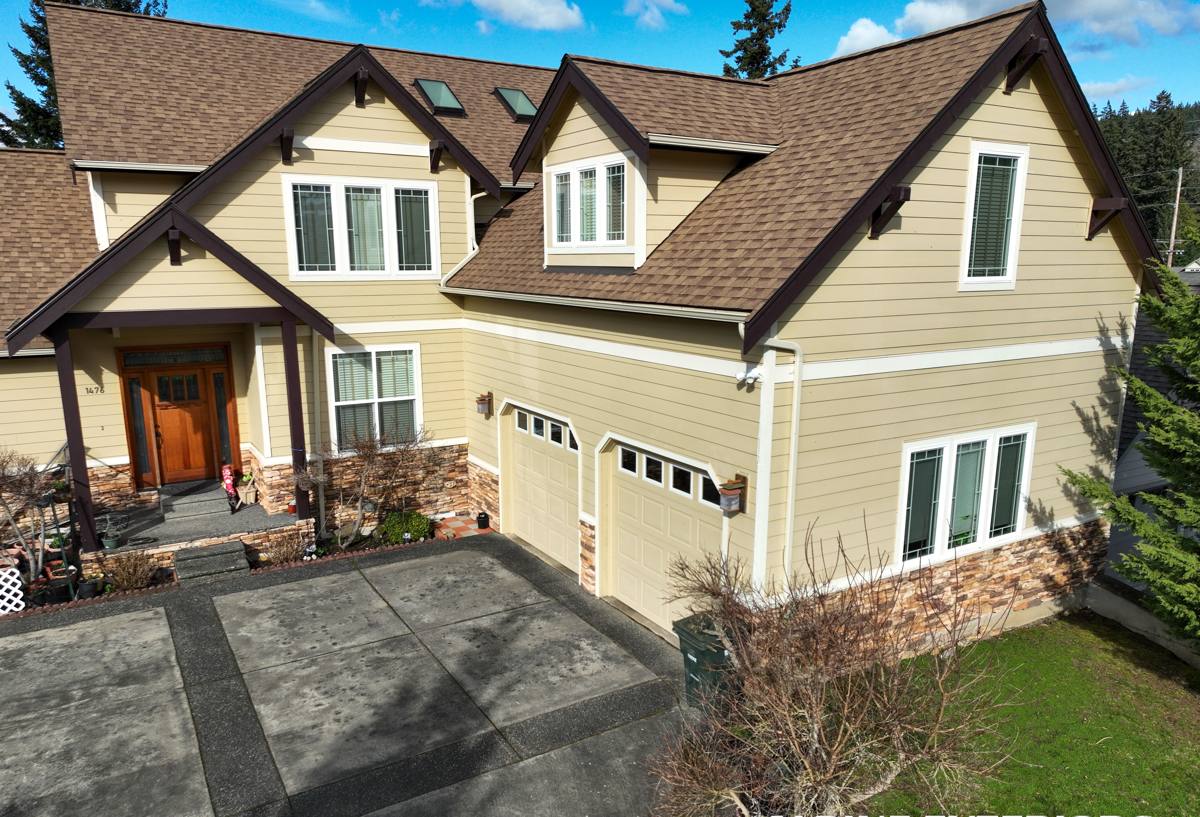
What Lynden's Climate Actually Does to Wood Siding
Whatcom County sits in a tough spot for exterior wood. We're close enough to the Salish Sea and Puget Sound that salt-laden air reaches inland on a regular basis, and Lynden gets driving rain off the marine weather systems that roll through most of the fall, winter, and spring. Add in the long, gray moss season — often five or six months where surfaces stay damp and shaded — and you have a near-perfect recipe for wood siding to struggle.
Cedar is naturally rot-resistant compared to other softwoods, which is exactly why it built its reputation. But "rot-resistant" is not the same as "rot-proof," and that resistance lives almost entirely in the heartwood. Once a board is milled, primed, painted, and nailed to a wall, it's exposed to UV, moisture cycling, and biological growth in ways the tree never experienced. Repeated wetting and drying — rain in the morning, sun in the afternoon, rain again that night — is what breaks wood siding down over time, and Lynden's weather pattern delivers that cycle constantly for a good chunk of the year.
Moss, Mildew, and the Shade Problem
Homes with tree cover, north-facing walls, or tight side yards — common in a lot of Lynden's older neighborhoods and newer developments backed up against farmland tree lines — don't get enough sun exposure to dry out fully between rain events. That's exactly the environment moss and mildew need. On cedar, that biological growth doesn't just sit on the surface; given enough time it works into the grain and finish, and once it's established, it keeps coming back no matter how many times it's cleaned off.
The Maintenance Burden Nobody Mentions at the Sales Pitch
Cedar siding is a maintenance product, full stop. To get anywhere near its potential lifespan, it needs:
- Refinishing (stain or paint) every 3-7 years depending on exposure, sun, and finish quality
- Regular washing to remove pollen, moss spores, and organic buildup before they take hold
- Caulk and sealant inspection at every joint, seam, and penetration on an annual basis
- Prompt replacement of any board showing soft spots, cupping, or checking — waiting lets rot spread to neighboring boards
- Careful attention to ground clearance, gutter overflow, and sprinkler overspray, all of which shorten cedar's life dramatically
None of that is unreasonable for a wood product — it's just the deal you sign up for. The problem is that most homeowners hear "cedar siding" and picture the photo from installation day, not the maintenance calendar that comes with it for the next 20-30 years. We'd rather tell you that up front than have you find out the hard way.
What Happens When Maintenance Slips
Life gets busy. A refinish gets pushed a year, then two. A gutter starts overflowing onto a wall and nobody notices until the paint starts bubbling. This is the normal way homes actually get maintained — not on a perfect schedule, but in fits and starts around everything else going on. Cedar is unforgiving of that pattern in a way few other siding materials are. A missed refinish cycle in a dry climate might just mean faded color. In Lynden's wet cycle, a missed refinish cycle means moisture getting into exposed wood grain during exactly the months it has the least chance to dry out.
Installation Sensitivity: Where a Lot of Cedar Failures Actually Start
A fair amount of what gets blamed on "cedar siding failing" is really cedar siding installed without the details that wood specifically requires. Wood siding needs back-priming (sealing the backside of every board, not just the face), rainscreen or proper drainage gaps behind it, correct fastener spacing that accounts for wood movement, and flashing details sized for a material that expands and contracts with humidity far more than fiber cement does. Skip any one of those details and you've built in a failure point that may not show up for a few years — long after the crew is gone.
This is part of our decision too. Cedar rewards a level of installation precision that's easy to shortcut and hard for a homeowner to verify after the fact. We'd rather install a product where correct installation is more forgiving and more verifiable, both for us and for you.
Cedar vs. James Hardie: A Straight Comparison
| Factor | Cedar Siding | James Hardie Fiber Cement |
|---|---|---|
| Refinishing schedule | Every 3-7 years | 15+ years with ColorPlus factory finish |
| Moisture/rot risk | Real risk if maintenance lapses | Not a wood product — no rot |
| Moss and mildew resistance | Requires active cleaning | Much more resistant to biological growth |
| Fire performance | Combustible | Non-combustible |
| Insect vulnerability | Susceptible (carpenter ants, etc.) | Not a food source for insects |
| Warranty | Varies by finish, largely on homeowner's maintenance | Manufacturer-backed, transferable |
| Upfront cost | Comparable to premium siding, varies by grade | Comparable to premium siding, varies by profile |
Why We Standardized on James Hardie
We install James Hardie fiber cement exclusively, and it's not because it's the only decent product on the market — it's because, after years of installing and later servicing wood siding in this exact climate, we wanted to put our name on something that performs the same way in year 20 as it did in year one, without asking homeowners to maintain it like a second part-time job.
Hardie's fiber cement is engineered from cement, sand, and cellulose fibers — it doesn't rot, it doesn't feed insects, and it's non-combustible, which matters more each year as wildfire smoke and ember exposure become a bigger part of Pacific Northwest summers. The ColorPlus factory-applied finish is baked on under controlled conditions, which gives it far better fade and wear resistance than field-applied paint or stain ever achieves — and it comes with its own finish warranty separate from the product warranty.
Built for This Specific Climate
Hardie also makes climate-engineered HZ product lines, and for a marine, high-moisture climate like Whatcom County, that engineering matters. The panels are formulated to handle the freeze-thaw and wet-dry cycling that's normal for our winters and shoulder seasons, without the swelling, cupping, or checking that wood siding is prone to under the same conditions.
A Warranty That Follows the Product, Not Just the Original Owner
James Hardie's warranty structure is transferable, which matters in a market where homes change hands. A cedar refinish schedule is essentially invisible to a buyer walking through during an open house — a transferable product warranty is not. It's one more thing that protects the value of the investment, not just the look of it.
What This Means If You Already Have Cedar Siding
If your Lynden home currently has cedar siding, none of this is an emergency message. Well-maintained cedar can look good and perform reasonably for a long time. What we'd tell any homeowner in that position is to be honest with yourself about the maintenance schedule going forward — and if you're already behind on refinishing, or you're seeing soft spots, moss buildup that won't come clean, or paint that's failing faster each cycle, that's a sign it's worth getting a professional opinion before those issues spread into the sheathing behind the siding.
Signs Cedar Siding Needs a Closer Look
- Boards that feel soft, spongy, or give slightly when pressed
- Paint or stain failing significantly faster than the previous cycle
- Moss or mildew that returns within weeks of cleaning
- Visible cupping, checking, or splitting along board faces
- Dark staining or discoloration around nail heads and joints
- Gaps opening up at butt joints or trim connections
Making the Right Call for Your Home
Every siding decision is really a trade-off between upfront look, long-term maintenance, and how much time and money you want to put into a home's exterior over the years you own it. Cedar isn't wrong for every homeowner — some genuinely enjoy the maintenance ritual and the natural material, and that's a legitimate choice. We've simply decided, based on what we see happen to wood siding in Lynden's specific combination of salt air, driving rain, and long wet moss season, that we'd rather install and stand behind a product that doesn't put that burden on our customers.
If you're weighing cedar against fiber cement for a Lynden home, we're glad to walk through your specific house — sun exposure, tree cover, wall orientation, all of it — and give you a straight answer about what will hold up best where you live. Reach out for a free, no-pressure estimate, and we'll tell you exactly what we'd do and why.