 Lynden Siding
 Why the Color Decision Deserves More Time Than Most Homeowners Give It
Most homeowners spend weeks comparing siding materials and about twenty minutes picking a color. That's backwards, especially in Lynden. Whatcom County's mix of coastal air moving up from Bellingham Bay, long wet winters, and a moss season that can run from October through April means your siding's finish works harder here than it would in a drier inland climate. The color and finish system you choose affects fading, dirt and mildew visibility, heat absorption, and how often you'll be looking at a ladder in ten years. With James Hardie's ColorPlus Technology, the finish is baked onto the board at the factory rather than applied by a painter on-site, which changes the whole conversation around color selection. This page walks through how ColorPlus works, how to think about color choice for a Lynden home specifically, and what questions to ask before you commit.
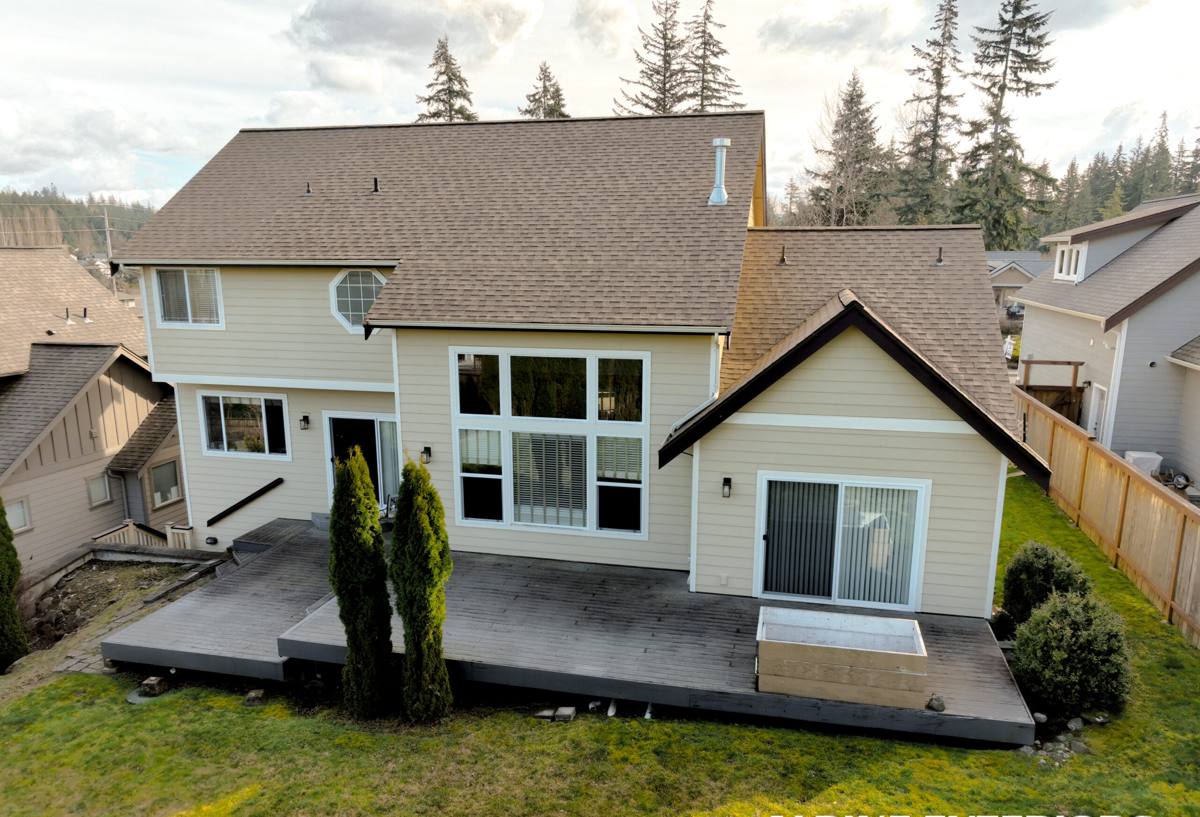
What ColorPlus Technology Actually Is
ColorPlus is not paint applied after installation. It's a multi-coat color finish baked onto the fiber cement in a controlled factory environment, cured before the boards ever leave the plant. That matters for a few practical reasons:
- The finish adheres more uniformly than field-applied paint, which depends on weather conditions during application.
- Color consistency from board to board is tighter, since it's not mixed and rolled on-site batch by batch.
- The factory finish is engineered to resist UV fading and moisture intrusion at the coating level, not just at the substrate level.
- Touch-up products are formulated to match, so small repairs (a scuff from a ladder, a nail hole from a mounted fixture) don't turn into a mismatched patch.
Standard primed Hardie boards can be field-painted in any color, and that's a legitimate option for homeowners who want a fully custom color outside the ColorPlus palette. But field-applied paint on fiber cement is only as good as the prep, primer, and paint quality used, and it will need repainting on a normal exterior paint cycle. ColorPlus is designed to go longer between refinishing under normal conditions, which is worth factoring in before you decide the extra cost is "just for convenience."
The ColorPlus Warranty Difference
James Hardie backs ColorPlus finishes with a separate, dedicated finish warranty in addition to the substrate warranty on the board itself. That two-part structure (product warranty plus finish warranty) is part of why we standardized on Hardie rather than mixing finish systems across a project. When a manufacturer stands behind both the board and the color on the board, the responsibility for a finish failure doesn't become a "was it installed wrong" or "was it the paint" argument years later.
The ColorPlus Palette: What's Actually Available
Hardie's ColorPlus lineup isn't one color chart — it's organized into curated collections meant to work together across siding, trim, and accent pieces (like shingle-style accents or fascia). Below is a general sense of how the categories break down. Exact names and availability shift over time and by region, so treat this as a framework for the conversation rather than a final list.
| Category | General Character | Where It Tends to Work Well |
|---|---|---|
| Deep neutrals (charcoals, dark grays, near-blacks) | Bold, modern contrast | Craftsman and modern farmhouse styles with white or black trim |
| Warm earth tones (tans, browns, warm grays) | Blends into wooded or rural settings | Common around Lynden's farmland-adjacent lots |
| Cool neutrals (soft blues, muted greens) | Reads calm against gray Pacific Northwest skies | Homes near open pasture or water-adjacent lots |
| Whites and off-whites | Classic, resells well | Traditional and Dutch Colonial-influenced homes, common in this area's original farmhouse stock |
| Accent-only tones | Meant for shakes, board-and-batten gables, shutters | Paired with a neutral field color for two-tone exteriors |
Within each category there are usually several shade options, so "warm gray" isn't one color — it's a range. This is where seeing physical color chips outdoors, in Lynden's actual daylight, matters more than any screen or brochure. Northwest cloud cover renders colors cooler and flatter than direct sun does, and a color that looks warm on a sunny showroom sample can read gray and cold under our typical overcast.
How Lynden's Climate Should Actually Influence Your Color Choice
Salt Air and Coastal Moisture
Lynden isn't oceanfront, but Whatcom County sits close enough to Puget Sound and Bellingham Bay that homes on north- and west-facing exposures pick up a measurable amount of salt-laden moisture in the air, especially during winter storm systems. Salt residue shows up more visibly on very dark, glossy-leaning finishes than on mid-tone matte finishes, simply because dust and mineral film contrast more against deep color. If your lot is on an exposed, wind-facing side, a mid-tone rather than the darkest option in a collection will show less surface residue between washings.
Driving Rain
Whatcom County's rain doesn't always fall straight down — wind-driven rain hits siding at an angle, which means water sheets down specific wall faces more than others. Over time this creates faint streaking patterns on any siding color, but it's most visible on very light colors (where mineral staining shows as gray streaks) and very dark colors (where the streak shows as a lighter "clean" trail against the dark field). Mid-range tones tend to hide this normal weathering pattern the longest between cleanings.
Moss Season
From roughly October through April, north-facing walls, shaded eaves, and anywhere tree canopy blocks direct sun are candidates for moss and algae growth on any siding material. Color doesn't prevent moss — that's a function of moisture, shade, and surface texture — but green-black moss staining is far more visually forgiving on a mid-to-dark neutral than on a bright white wall, where it reads immediately. If your lot has mature trees or a shaded north elevation, that's a legitimate factor in leaning your field color a shade or two darker than you might otherwise.
Matching Color to Lynden's Architecture
Lynden's building stock ranges from Dutch-heritage farmhouses and older agricultural-era homes to newer craftsman and modern-farmhouse construction on the town's growing edges. A few practical patterns:
- Dutch Colonial and traditional farmhouse styles generally read best in whites, soft warm grays, or muted blues, paired with a contrasting trim color — consistent with the area's historic character.
- Craftsman and modern farmhouse builds tend to use a two-tone approach: a deep neutral field color with a lighter or board-and-batten accent gable.
- Larger rural lots often do well in warm earth tones that sit comfortably against pasture and tree lines rather than a stark white that stands out from a distance.
None of this is a rule — it's a starting point for the conversation with your contractor, who should be looking at your actual roofline, stone or masonry accents, and neighboring homes before finalizing anything.
HZ5 Products and Why They Matter Locally
James Hardie engineers certain product lines for specific climate zones (HZ10 for the harshest conditions, HZ5 for cold, wet, moisture-heavy regions like ours). For Whatcom County, HZ5-engineered products are formulated with moisture resistance suited to freeze-thaw cycling and prolonged damp exposure — relevant background when you're also weighing which finish and color line to pair with the board. A ColorPlus finish is only as good as the board underneath it, and using the wrong climate-zone product under the right color doesn't solve the underlying moisture problem.
Cost Factors to Understand Before You Choose
| Factor | Why It Affects Cost or Value |
|---|---|
| ColorPlus vs. field-applied paint | ColorPlus carries a modest upfront premium over primed board but reduces or eliminates a repainting cycle |
| Two-tone or accent color designs | More cutting, more precise reveal lines, and more trim coordination than a single-color field |
| Custom (non-ColorPlus) colors | Requires field painting, which shifts warranty responsibility and future maintenance to the paint system, not the factory finish |
| Touch-up and repair supply matching | ColorPlus touch-up kits are formulated to the specific color, keeping future repairs invisible |
| Resale positioning | Neutral, well-matched color schemes tend to broaden buyer appeal more than highly personalized choices |
A Practical Checklist Before You Commit to a Color
- View physical color chips outdoors, on an overcast day and in direct sun, not just under indoor lighting.
- Hold the chip against your actual roof, stone, brick, or existing trim — not just imagined against them.
- Ask which elevation of your home faces the prevailing wind and rain, and weigh a mid-tone there if streaking is a concern.
- Identify shaded or tree-covered walls where moss is likely, and consider a slightly darker tone on those faces.
- Confirm in writing whether you're getting ColorPlus factory finish or a field-painted primed board — this changes your warranty coverage.
- Ask your contractor for the specific ColorPlus collection and shade names in the proposal, not just "gray" or "tan."
- Request the manufacturer's written finish warranty terms, not just a verbal summary.
Getting the Color Conversation Right the First Time
Color is one of the few siding decisions you'll live with every time you pull into your driveway, and it's also one of the hardest to change your mind about later — repainting or replacing panels after installation is a real cost, not a small tweak. Take the time to look at real samples on your actual house, in real Lynden weather, before signing off. A contractor who only installs James Hardie has no incentive to steer you toward a finish system that isn't backed by a real factory warranty, because that's the only system we put on homes.
If you're planning a siding project and want help working through color options against your home's exposure, architecture, and the realities of a Whatcom County winter, we're happy to walk the property with you and put together a free, no-pressure estimate.