 Lynden Siding
 A Lynden Crew That Knows Bellingham
Bellingham sits close enough to Lynden that we're on these streets often, and the exterior problems we see here follow a pattern that's a little different from what shows up further inland. Bellingham Bay puts salt-laden air into the mix, the terrain funnels wind-driven rain against west and south-facing walls, and the tree cover that makes so many Bellingham neighborhoods attractive also keeps roofs and siding shaded and damp for long stretches of the year. We handle siding, roofing, windows, and decks, and on a Bellingham home those four systems all have to work together to keep water out and keep the structure dry underneath.
We're not a national franchise dispatching whoever's available that week. We're based in Lynden, we work Whatcom County regularly, and we've seen what holds up here and what doesn't. That matters more than it sounds like it should, because a lot of exterior failure in this region isn't about bad materials — it's about materials and installation methods that were never suited to a marine climate in the first place.
What the Bellingham Climate Does to Exteriors
Salt Air and Marine Moisture
Proximity to Bellingham Bay means homes here deal with a low-grade but constant exposure to salt-carrying air, especially on days with onshore wind. Salt air accelerates corrosion on fasteners, flashing, and any metal component that isn't rated for coastal exposure, and it speeds up the breakdown of paint films and caulking. It's rarely dramatic — nobody notices salt air taking a toll in real time — but over years it shows up as chalking paint, rusted nail heads bleeding through siding, and caulk joints that fail earlier than they should.
Driving Rain and Wind-Driven Water
Whatcom County doesn't just get rain, it gets sideways rain, and Bellingham's mix of open exposure and hillside terrain means wind-driven water gets pushed hard against certain wall faces and window assemblies. This is the difference between a roof that just needs to shed water from above and a wall assembly that needs to resist water being driven horizontally into every seam, lap, and penetration. Siding laps, window flashing, and deck ledger connections are the places this kind of moisture finds its way in if they weren't detailed correctly.
Moss, Mildew, and the Shade Factor
Bellingham's tree canopy is part of what makes the area appealing, but shaded roofs and north-facing siding stay damp longer after every rain, and that's exactly the environment moss and mildew need to take hold. Moss on a roof isn't just cosmetic — it lifts shingle edges and holds moisture against the roof deck. On siding, sustained dampness in shaded areas is what turns a durable product into a maintenance headache and a vulnerable product into a failure point.
Siding for Bellingham Homes: Why We Only Install James Hardie
We install James Hardie fiber cement siding exclusively. We don't install vinyl, LP SmartSide, Cemplank, Allura, primed spruce, or cedar, and that's a deliberate call based on what actually performs in this climate over the long run, not a sales pitch.
The HZ Climate Engineering
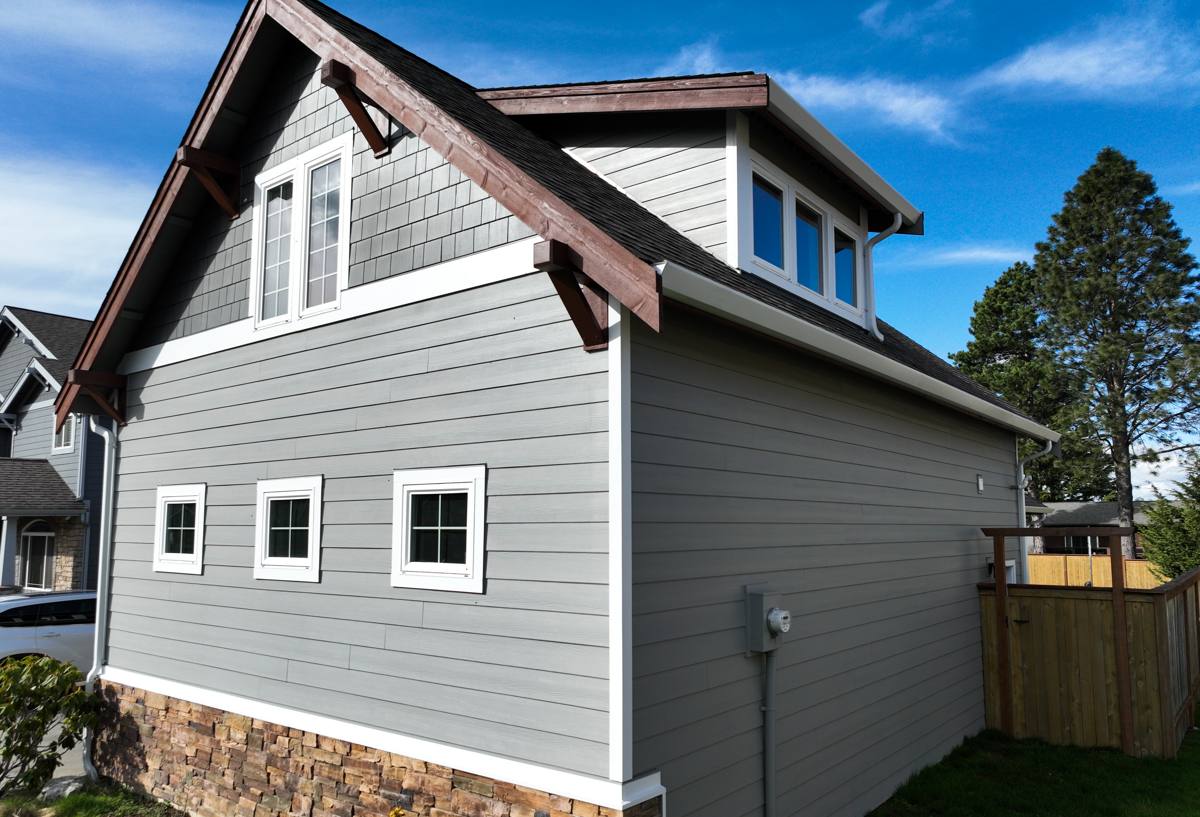
James Hardie engineers its siding in regional HZ formulations built for specific climate zones, and the Pacific Northwest formulation is built around the reality of sustained moisture exposure — the kind Bellingham gets for a good chunk of the year. Fiber cement itself doesn't swell, rot, or feed mold the way wood-based products can, which matters directly in a climate with a long moss and mildew season.
ColorPlus Factory Finish
Hardie's ColorPlus finish is baked on at the factory under controlled conditions, rather than sprayed or brushed on site. In a salt-air environment where field-applied paint tends to chalk and fade faster, a factory finish with a real, transferable warranty is a meaningful advantage — it's one less maintenance cycle you're on the hook for.
What We Don't Install, and Why
Vinyl siding can warp and its seams are a long-term weak point against wind-driven rain. LP SmartSide, Cemplank, Allura, primed spruce, and cedar are all wood-based or wood-derived at some level, which means moisture management and installation precision matter enormously — miss a detail and you're looking at swelling, rot, or repainting years sooner than expected. None of these are junk products in the right application. We simply won't put our name on installations we don't think hold up reliably to this specific climate, and fiber cement with a factory finish is what we've standardized on instead.
Roofing That Holds Up to Whatcom County Weather
A roof in Bellingham has to manage two things at once: shedding heavy, sustained rainfall and resisting moss growth in shaded sections. That means underlayment and flashing details matter as much as the shingle or roofing material itself — a roof can look fine from the ground while water is finding its way in at a poorly flashed valley or chimney. We pay particular attention to ventilation too, since a roof deck that can't breathe stays damp longer and ages faster, especially under tree cover.
Windows: Your First Line of Defense Against Driving Rain
Windows fail quietly. A window that looks fine can still be letting water past its flashing and into the wall cavity, and in a climate with regular wind-driven rain, that flashing detail is not optional. When we replace windows, the flashing and integration with the surrounding siding gets as much attention as the window unit itself — a good window installed without proper flashing will leak eventually, and a modest window installed correctly will outperform it. We also look at where condensation tends to collect on older single-pane or poorly sealed units, since that's often the first visible sign of a bigger moisture problem developing behind the wall.
Decks Built for Wet Winters
Decks in this area spend months of the year wet, and the ledger connection — where the deck attaches to the house — is the single most important detail for keeping water out of the structure behind it. We flash ledger connections properly and use fasteners and hardware suited to sustained moisture and salt-air exposure, rather than relying on standard hardware that corrodes faster here than it would inland. Decking material choice matters too, since a surface that holds standing water through a wet Whatcom County winter will show it in a few seasons, whether that's cupping, splitting, or fastener staining.
What Correct Exterior Installation Looks Like
Materials only perform as well as the installation behind them. On a Bellingham home, we're checking for:
- Proper flashing at every siding, window, and roof penetration — not just caulk covering a gap
- Correct fastener spacing and type for fiber cement siding, following manufacturer spec rather than shortcuts
- A drainage plane behind the siding that lets any moisture that does get in find its way back out
- Adequate roof ventilation to reduce sustained dampness on shaded roof sections
- Corrosion-resistant hardware on decks and any exposed metal, given the salt-air exposure
- Caulking and sealant used only where it belongs — as a backup, not the primary water barrier
Skipping any one of these doesn't usually cause an immediate problem. It shows up two, five, or ten years later as rot, moss intrusion, or a leak that's expensive to trace back to its source.
Cost Factors to Expect
Every Bellingham property is different, and we don't quote sight unseen, but these are the factors that most often move a project's scope and cost:
| Factor | Why It Matters Here |
|---|---|
| Existing siding or roofing condition | Hidden rot or moisture damage found during tear-off adds repair scope before new material goes on |
| Wall or roof exposure | West and south-facing sections catching driving rain often need more flashing detail than sheltered walls |
| Tree cover and shade | Heavily shaded sections may need additional moss treatment or ventilation work |
| Window count and flashing condition | Older or improperly flashed windows add integration work when siding is replaced around them |
| Deck size and ledger access | Ledger flashing repairs and hardware upgrades affect labor time more than square footage alone |
| Home access and site conditions | Sloped lots or tight setbacks common in some Bellingham neighborhoods can affect staging and labor |
Why Homeowners Choose a Local Crew
A crew that works Whatcom County regularly knows which details actually matter here — where driving rain tends to hit hardest, which neighborhoods deal with heavier moss, and what corrosion-resistant hardware is worth the upgrade near the bay. That local knowledge shows up in the small decisions made on-site, not just in the materials on the invoice. It also means we're not disappearing after the job — if a warranty question comes up or you want a second opinion on something down the road, we're still working in the area.
If you're weighing siding, roofing, windows, or a deck project on a Bellingham home, we're happy to take a look and give you a straight assessment — no pressure, no inflated scope. Use the form below to request a free estimate.