 Lynden Siding
 Homeowners in Lynden ask us about LP SmartSide more than almost any other product, and it's a fair question. It's a well-marketed engineered wood siding, it's cheaper than fiber cement in most bids, and plenty of contractors around Whatcom County install it every week. We don't. This page explains why, honestly, without pretending the product is worthless — it isn't — and without pretending we're neutral, because we're not. We install James Hardie fiber cement exclusively, and we think homeowners deserve to know the actual trade-offs behind that decision before they sign a contract with anyone.
What LP SmartSide Actually Is
LP SmartSide is an engineered wood product. At its core it's strand board — wood fibers bonded with resins under heat and pressure — that's then treated with a zinc borate preservative and coated with a resin-saturated overlay before finishing. It comes in lap siding, panels, and trim, and it's designed to look like traditional wood clapboard or board-and-batten at a lower installed cost than real cedar or fiber cement.
To LP's credit, the product has come a long way since the OSB siding failures of the 1990s that gave engineered wood a bad name industry-wide. Modern SmartSide carries a legitimate warranty, holds paint reasonably well when installed and maintained correctly, and is genuinely lighter and easier to cut than fiber cement, which is part of why installed pricing tends to run lower. For a lot of climates and a lot of homeowners, it's a reasonable product installed by a reasonable contractor.
Where It Performs Fine
In drier regions, or on homes with generous roof overhangs and good site drainage, SmartSide can perform for decades without major issues. The wood engineering and resin treatments genuinely reduce (not eliminate) the swelling and rot problems that plagued earlier wood-composite products. We're not disputing that.
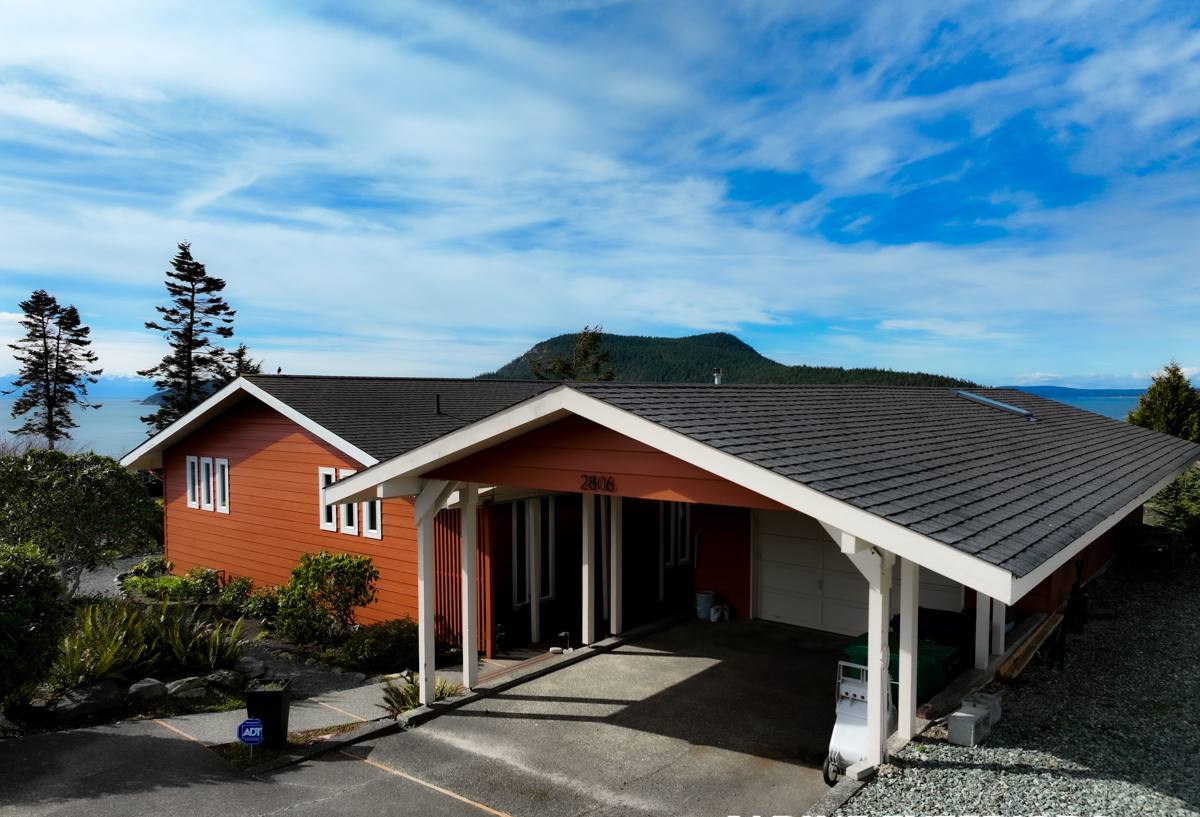
Why It's a Harder Sell in Lynden
Our decision isn't about the product in a vacuum — it's about the product here. Whatcom County sits under a marine-influenced weather pattern: long wet winters, driving rain off the Strait of Georgia and the Sound, salt-laden air moving inland, and a moss and mildew season that can run eight months of the year on north-facing walls and shaded elevations. That combination is specifically hard on any wood-based product, engineered or not.
LP SmartSide is still, at its core, wood. Wood-based siding's core vulnerability is edge and end-grain moisture intrusion — at butt joints, around window and door cuts, at inside corners, and anywhere a fastener or trim detail breaks the factory coating. Once moisture works into a cut edge or a poorly sealed joint, the strand board can swell, and swelling is very difficult to reverse. In a climate with occasional dry summer stretches, a wood-composite product gets a chance to dry out between wet cycles. In Lynden, with our rainfall spread across most of the year and humidity that lingers even between storms, that drying window is shorter, and the moss and algae that thrive in the shade of Cascade foothill lots hold moisture against the wall surface longer than it would sit on a home in a drier part of the state.
Salt Air and Coastal Exposure
Lynden isn't beachfront, but Whatcom County's proximity to Puget Sound and the Strait means salt-bearing air reaches inland further than people expect, especially on west-facing exposures. Salt accelerates the breakdown of coatings and finishes on any exterior material, and it's one more reason a product that depends entirely on an intact factory coating for its moisture resistance has less margin for error here than it would inland.
Installation Sensitivity Is the Real Issue
This is the part that matters most and gets talked about least. LP SmartSide's warranty and real-world performance are both extremely dependent on installation being done exactly to LP's specifications — correct fastener placement and spacing, proper caulking at every joint and penetration, correct clearance from grade, roof lines, and decks, and factory-cut edges primed or sealed before installation. Skip or rush any one of those steps and you've created a moisture entry point that may not show a problem for two or three years, by which time it's a repair, not a warranty claim.
Fiber cement has installation standards too, and doing it wrong causes its own problems. But because fiber cement isn't wood, a sealing lapse at a cut edge doesn't set off the same swelling and delamination failure mode. The material itself is far more forgiving of a less-than-perfect job. With a wood-based product, the margin between "installed correctly" and "installed adequately" is the difference between a 30-year wall and a 12-year wall, and we don't think that margin should rest entirely on how careful the install crew was on a rainy Tuesday.
Why We Won't Cut That Corner
We install one product because it lets us build one deep, consistent installation process instead of juggling different moisture-sensitivity rules for five product lines. That's a business decision as much as a technical one, and we're upfront about it.
Maintenance Reality Over Time
Every siding product needs some maintenance. The question is what kind, how often, and what happens if a homeowner falls behind on it.
- Caulking and joint inspection: SmartSide needs its caulked joints checked periodically and recaulked as they age, since those joints are the primary defense against moisture reaching the wood core.
- Repainting cycle: as a factory-primed (not factory-finished) product in most applications, SmartSide needs a homeowner-managed paint schedule to keep its protective coating intact.
- Moss and algae cleaning: shaded, north-facing walls in our climate need regular gentle cleaning to keep organic growth from holding moisture against the surface.
- Edge and corner inspection: cut ends and inside corners are the highest-risk spots and need periodic visual checks, especially after storms.
None of that maintenance is unreasonable on its own. But it adds up to an ongoing homeowner responsibility, and if it's deferred for a few years — which happens, life gets busy — a wood-based product's problems tend to compound quietly behind the coating until they're visible as swelling, cracking, or soft spots.
How This Compares to Fiber Cement
| Factor | LP SmartSide | James Hardie Fiber Cement |
|---|---|---|
| Core material | Engineered wood strand board | Cement, sand, and cellulose fiber |
| Moisture behavior | Can swell at exposed/damaged edges | Does not swell or rot; dimensionally stable when wet |
| Factory finish | Primed; field or shop paint typically required | ColorPlus factory finish available, baked-on and warranted separately |
| Fire behavior | Wood-based, combustible | Non-combustible |
| Installed cost | Generally lower | Generally higher |
| Repaint cycle | Typically needed within 7-10 years | ColorPlus finish rated well beyond that before repainting is needed |
| Installation sensitivity | High — moisture defense depends on sealing every cut and joint | Lower — material itself resists moisture damage even with minor lapses |
The cost gap is real and we don't dismiss it — fiber cement is a bigger investment up front. But the ongoing maintenance burden and the narrower margin for installation error are the parts of that comparison that don't show up on a quote, and they're the parts that matter most a decade in.
Why We Standardized on James Hardie
We made a decision a while back to install one siding system and get genuinely good at it, rather than offer five options and be mediocre across all of them. James Hardie fiber cement won that decision for a few specific reasons that hold up in our climate:
- Non-combustible core: cement-based siding doesn't burn, which matters more every wildfire season even here on the west side.
- Climate-engineered product lines: Hardie's HZ5 formulation is built specifically for regions with our freeze-thaw and moisture exposure profile, rather than a one-size-fits-all national product.
- ColorPlus factory finish: a baked-on finish applied under controlled conditions holds up longer than field-applied paint and carries its own finish warranty separate from the product warranty.
- Dimensional stability: fiber cement doesn't swell, cup, or rot the way any wood-based product can, which matters directly in a climate with our rainfall and moss exposure.
- Strong transferable warranty: Hardie's warranty structure is well-established and transfers to a new owner if the home sells, which matters for resale value.
What Correct Hardie Installation Actually Involves
Standardizing on one product also means we can hold ourselves to one exacting installation standard instead of relearning moisture details for each material: correct nailing patterns and fastener depth, proper clearance from rooflines, decks, and grade, factory-caulked or flashed joints at every seam, and rainscreen or drainage-plane detailing appropriate to our rainfall. We're not saying other contractors can't do this well with other products — we're saying we'd rather be excellent at one system than average at several.
Questions Worth Asking Any Siding Contractor
Whatever product you're considering, and whoever you hire, these are worth asking before you sign anything:
- Is the installer manufacturer-certified for the specific product being installed?
- What does the written warranty actually cover — material only, or labor too — and does it transfer if the home is sold?
- What's the manufacturer's minimum clearance requirement from grade, roofline, and decking, and will the crew follow it?
- Who is responsible for caulking and joint sealing at cut edges, and what product is used?
- What maintenance schedule does the manufacturer recommend, and is it in writing?
Making the Right Call for Your Home
We're not going to tell you LP SmartSide is a bad product, because that's not true — it's an engineered wood siding that performs adequately in a lot of situations when it's installed exactly to spec and maintained on schedule. What we will tell you is that our climate here in Lynden and across Whatcom County — the volume of rain, the moss season, the salt-tinged air moving in off the Sound — narrows the margin for error on any wood-based product more than it would in a drier region, and that narrower margin is exactly why we chose not to install it. We'd rather put one product on your home that we can stand behind fully than offer several and hope the install goes perfectly on the wood-based ones.
If you're weighing siding options for a home in Lynden or anywhere in Whatcom County, we're happy to walk your property, look at your exposures, and give you a straight comparison for your specific situation. Reach out for a free, no-pressure estimate — there's a form right below.