 Lynden Siding
 Exterior Work Built for Laurel's Climate
Laurel sits in the Nooksack River valley just outside Lynden, in a stretch of Whatcom County where farmland, mature tree cover, and older rural homesteads mix with newer construction. It's close enough to the Salish Sea that marine air pushes inland regularly, and far enough from downtown that homes here often sit on larger, shadier lots. Both of those things matter more to your siding, roofing, and trim than most homeowners realize until they're dealing with the damage.
Marine Air and Driving Rain
Whatcom County doesn't get hurricane-force weather, but it gets something arguably harder on a house: sustained, wind-driven rain that comes in sideways off the water for days at a stretch, carrying a faint salt content that speeds up corrosion on fasteners, flashing, and any exposed metal. Add wind gusts funneling down the valley and you get moisture pushed into every lap joint, corner, and seam on a home's exterior. Siding that isn't dimensionally stable, or that relies on caulked seams to stay watertight, tends to show problems within a handful of years in this kind of exposure.
Moss, Shade, and Moisture
Mature trees and long, mild, wet winters mean moss and algae have months at a time to establish themselves on north-facing walls, rooflines, and anything that doesn't get direct sun. On wood-based products, that sustained moisture contact is what starts rot from the outside in, usually years before it's visible. On roofs, moss lifts shingles and holds water against the deck. It's not a cosmetic issue — it's a slow, steady attack on whatever material is underneath it.
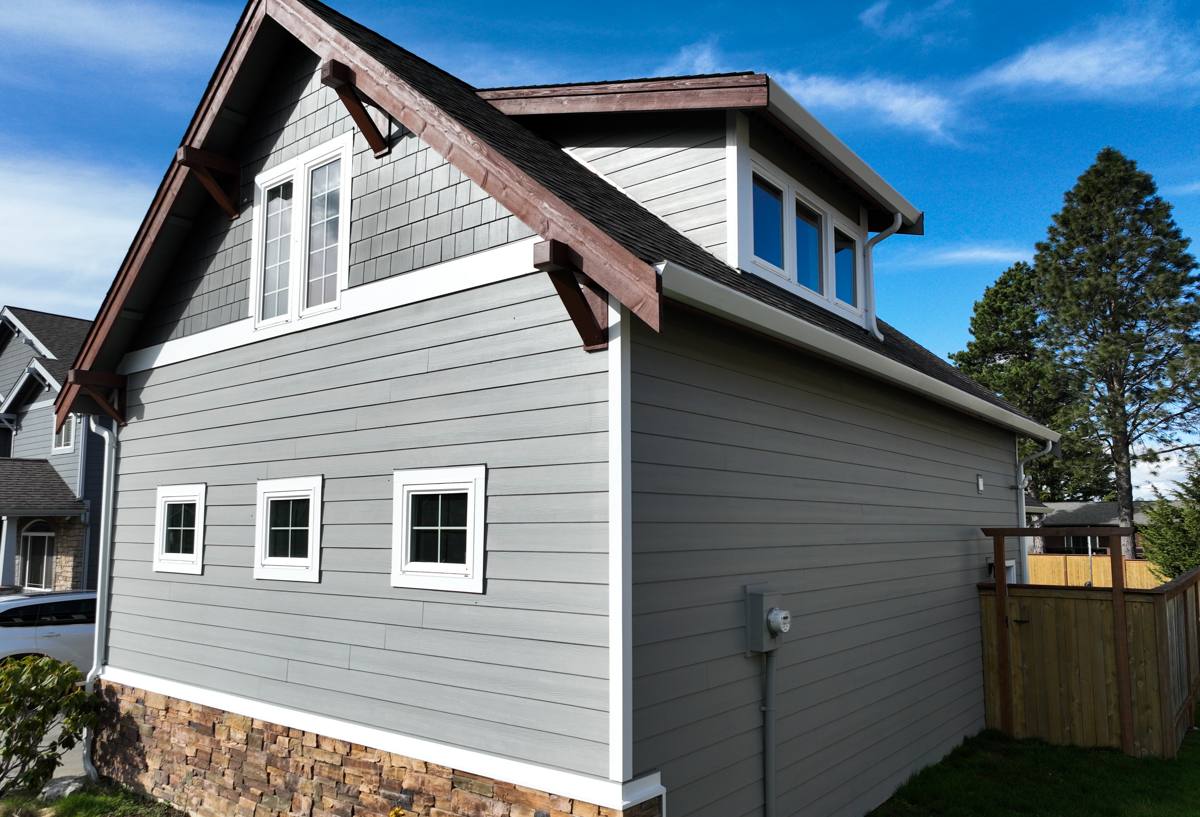
Why We Install Only James Hardie Siding
We made a deliberate decision to install James Hardie fiber cement siding exclusively. We don't install vinyl, LP SmartSide, Cemplank, Allura, primed spruce, or cedar. That's not a marketing position — it's a standard we hold because of what we've seen hold up in this climate and what tends to struggle.
What Hardie Gets Right for This Climate
Fiber cement is engineered from cement, sand, and cellulose fiber. It doesn't absorb water the way wood-based siding does, it won't rot, and it's non-combustible — a real consideration given how many Laurel properties border open field and agricultural land where burn debris and dry-season fire risk are part of rural life. James Hardie's HZ5 product line is specifically engineered for Pacific Northwest moisture conditions, and the ColorPlus factory finish is baked on under controlled conditions rather than field-applied, which matters enormously in a climate where you rarely get a long stretch of dry, moderate-temperature days for paint to cure properly.
Why We Don't Install Vinyl, LP SmartSide, or Cedar
Each of these products has legitimate strengths, and we're not going to pretend otherwise. Vinyl is inexpensive and low-maintenance in the sense that it never needs painting — but it expands and contracts significantly with temperature swings, can crack in cold snaps, and offers no fire resistance. LP SmartSide is a wood-strand product with a resin-saturated shell that performs reasonably well when installation and caulking are perfect and stay perfect for decades — a big ask in a climate this wet, since any breach lets moisture into the engineered wood core. Cedar is genuinely beautiful and has a long track record, but it's a natural wood product that requires ongoing refinishing, and in a moss-prone, shaded, high-moisture environment like Laurel, that maintenance schedule is demanding and unforgiving if it slips. We'd rather install one product we can stand behind completely than offer several we'd have to caveat.
The Hardie Product Lines We Use
Not every Hardie product fits every home. Part of our job is matching the right line to your home's style, sun exposure, and how much of the year it sits in shade or wind-driven rain.
| Product | Best Fit | Why It Works Here |
|---|---|---|
| HardiePlank Lap Siding | Farmhouses, traditional homes, most Laurel properties | Classic lap profile, HZ5 formulation resists moisture and freeze-thaw cycling |
| HardiePanel Vertical Siding | Barns, outbuildings, modern accents | Sheds water fast on steep or vertical runs, common on rural outbuildings |
| HardieShingle Siding | Gables, accent walls, cottage-style homes | Textured look without the moisture uptake of cedar shingle |
| HardieTrim Boards | Corners, fascia, window and door trim | Won't rot or split the way primed wood trim does under sustained wet exposure |
Roofing, Windows, and Decks — The Whole Envelope
Siding is only one piece of what keeps a Laurel home dry and sound. We also handle roofing, windows, and decks, because a house's exterior only performs as well as its weakest component. A new siding job on a roof that's shedding granules or holding moss doesn't solve the underlying moisture problem — it just moves it. Same with windows: even the best siding installation can't compensate for flashing gaps or failed seals around old window units, which is one of the most common hidden water-entry points we find during siding tear-offs.
Decks in this climate take their own beating. Ground-level and elevated decks alike sit under the same driving rain and moss exposure as the rest of the house, and they get direct foot traffic and standing water on top of it. When we're already on site for siding or roofing, it's often efficient to address deck condition at the same time rather than as a separate project down the road.
What a Siding Project Looks Like in Laurel
Inspection and Moisture Check
Every project starts with a walk of the exterior, checking for soft spots, existing moss or algae growth, flashing condition around windows and rooflines, and any signs of moisture already in the wall assembly. On older Laurel homes, this step often turns up issues that predate the current siding — old caulk failures, undersized overhangs, or trim that's been slowly absorbing water for years.
Installation to Manufacturer Spec
James Hardie's warranty is only as good as the installation behind it, which is why correct fastening, clearances, and flashing details matter as much as the product itself. That includes proper nail placement (not too shallow, not too deep), correct gaps at butt joints, weather-resistant barrier integration, and flashing at every penetration — details that are easy to shortcut and hard to inspect once the siding is up.
Cost Factors for Laurel Homeowners
Pricing on any exterior project depends on the specifics of your home, but a few factors consistently move the number up or down.
| Factor | Impact |
|---|---|
| Home size and wall complexity | More corners, gables, and dormers mean more cutting, trim, and labor time |
| Tear-off vs. new construction | Removing old siding and repairing any hidden damage underneath adds time and cost |
| Story height and access | Second-story and steep-lot homes require more scaffolding and staging |
| Trim and accent detail | Shingle accents, board-and-batten sections, and custom trim add labor |
| Bundling with roofing or windows | Combined projects can reduce redundant setup and access costs |
Why a Local Crew Matters
Whatcom County's exterior climate isn't uniform — a home a mile from the water behaves differently than one further inland, and shaded, tree-lined lots common around Laurel need different attention to ventilation and moss management than an open, sun-exposed property. A crew that works this county regularly knows which details actually matter here: how much overhang clearance to leave, where moss tends to establish first, and which flashing details fail fastest in this rain pattern. That's knowledge you don't get from a national installer working off a generic spec sheet.
Maintenance Checklist for Whatcom County Homes
Good installation reduces maintenance — it doesn't eliminate it. A few habits go a long way toward protecting the investment:
- Rinse siding and roofing surfaces annually to clear moss and algae buildup before it establishes
- Keep gutters clear so water isn't overflowing onto siding or pooling near the foundation
- Trim back tree limbs and shrubs that keep siding shaded and damp
- Walk the exterior each fall and spring checking caulk lines, trim, and flashing for gaps
- Address any soft decking boards or discoloration early, before moisture spreads underneath
- Check window seals and flashing periodically, since failures here often show up first as siding or interior damage
If you're weighing a siding, roofing, window, or deck project for a home in Laurel, we're happy to take a look and walk you through what we're seeing and what it would take to fix it right. There's no cost and no pressure to get a straight answer — just fill out the form below to schedule a free estimate.