 Lynden Siding
 Birch Bay's Climate Is Harder on Siding Than Most Homeowners Realize
Birch Bay sits right on the Salish Sea, and that waterfront location changes the math on siding maintenance. Homes just a few miles inland in Lynden deal with plenty of Pacific Northwest rain, but Birch Bay properties also take on salt-laden air, near-constant wind off the water, and a moss season that can run most of the year on shaded, north-facing walls. Siding that would coast along fine in a drier, more sheltered part of Whatcom County can start showing real problems here within a decade if it wasn't installed — or repaired — with that exposure in mind.
Salt air is corrosive to exposed metal fasteners, trim flashing, and hardware. Driving rain, pushed sideways by wind off the bay, finds any gap in a lap seam, a butt joint, or a penetration around a vent or light fixture and drives moisture behind the siding rather than letting it run off the surface. And moss and algae, which thrive in the damp, shaded microclimates common around Birch Bay's tree-lined lots, hold moisture against the wall assembly long after a storm has passed. None of these forces cause damage overnight. They cause it slowly, in the places homeowners don't look — behind trim, under laps, at the bottom courses closest to grade and salt spray.
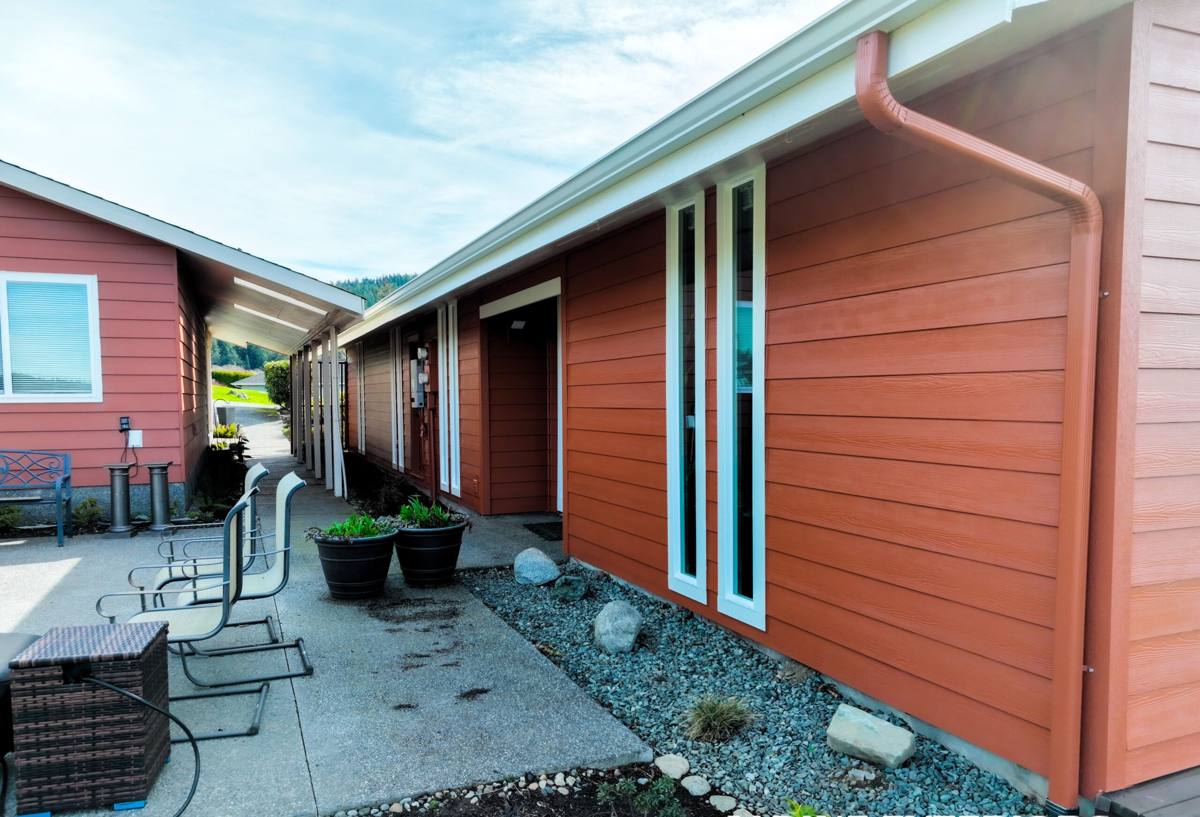
Signs a Birch Bay Home Needs Siding Repair
Most calls we get from Birch Bay start with something small that a homeowner noticed while doing yard work or washing windows. Catching these early is what keeps a repair a repair, instead of turning it into a full re-side.
What to look for
- Soft or spongy spots when you press on the siding, especially near the bottom courses or below windows
- Paint or finish that's bubbling, peeling, or chalking unevenly in one section but not others
- Streaking, dark staining, or thick moss growth concentrated on one wall or under eave overhangs
- Visible cracking, splitting, or warping in individual boards or panels
- Rust streaks running down from nail heads or trim fasteners
- Gaps opening up at seams, corners, or where siding meets window and door trim
- A musty smell or visible staining on interior walls that share an exterior with a suspect area
Any one of these on its own might be minor. Several showing up on the same wall, particularly a wall that faces prevailing wind and rain off the bay, usually means moisture has been getting behind the siding for a while.
What a Correct Siding Repair Actually Involves
A siding repair that just covers up a damaged board without understanding why it failed tends to fail again in the same spot. We treat every repair call as a diagnostic job first and a materials job second.
Diagnosis before demolition
Before we pull a single board, we're checking the extent of the damage — is it cosmetic surface wear, or has moisture gotten into the sheathing and framing behind it? We look at the flashing details around windows, doors, and any wall penetrations, since a huge share of the repair calls we run in coastal Whatcom County trace back to a flashing or sealant failure rather than a problem with the siding material itself. We'll check house wrap or building paper where it's exposed, look for signs of rot in the sheathing, and confirm whether the damage is isolated or has spread laterally behind adjacent boards.
Fixing the cause, not just the symptom
If we find a flashing gap, a failed kick-out flashing, or a sealant joint that's given up, that gets corrected as part of the repair — not left in place under new siding to cause the same failure again in a few years. Rotted sheathing gets replaced, not painted over. Fasteners showing corrosion get swapped for corrosion-resistant hardware appropriate for a salt-air environment. This is the difference between a repair that lasts and one that's a temporary patch.
Matching materials correctly
Once the cause is addressed, replacement siding needs to match the existing wall in profile, exposure, and finish so the repair doesn't stand out as an obvious patch. This is where the siding brand on your house matters a lot — some products are much easier to source and match years after the original install than others.
Repair or Replace? How We Help You Decide
Not every damaged section needs a full re-side, and not every "small repair" is actually small once we're behind the wall. We walk homeowners through the honest trade-offs rather than defaulting to the bigger job.
| Factor | Leans Toward Repair | Leans Toward Full Re-Side |
|---|---|---|
| Extent of damage | Isolated to one wall or a few boards | Present on multiple walls or elevations |
| Underlying sheathing | Dry, solid when probed | Soft, delaminated, or visibly rotted |
| Siding material | Still available or closely matchable | Discontinued or badly faded/chalked overall |
| Age of existing siding | Under 10-15 years, otherwise sound | Original siding is decades old, near end of service life |
| Cause of failure | A single, fixable flashing or sealant issue | Systemic issue — repeated failures across the house |
Birch Bay's exposure pushes some of these factors harder than an inland Lynden property would see. A wall facing open water with years of salt spray and driving rain is more likely to show damage spread across a wider area than a single isolated spot, which is part of why we always inspect adjacent sections, not just the board the homeowner called about.
Why We Repair — and Replace — With James Hardie Fiber Cement
Lynden Siding Company installs James Hardie fiber cement exclusively. We don't install LP SmartSide, vinyl, Cemplank, Allura, primed spruce, or cedar, and that standard applies to repair work too. When a repair calls for new material, we're either matching into existing Hardie siding or, where the existing product has failed repeatedly and a homeowner decides to replace a wall or the whole house, recommending Hardie as the material going in.
Why this matters specifically for a coastal repair
Fiber cement doesn't rot, and it isn't a food source for the moss and algae that thrive in Birch Bay's damp, shaded spots — it resists that growth far better than wood-based products. It's also non-combustible, which matters as much here as anywhere. James Hardie's HZ5 product line is engineered for the kind of wet, wind-driven climate zones that include Western Washington's coastline, and the factory-applied ColorPlus finish is baked on under controlled conditions, so it holds up to UV and moisture exposure better than a field-applied paint job — and touch-up or replacement boards can be matched to that finish far more reliably than trying to color-match a faded, hand-painted product years later.
We won't tell you every other siding product on the market is worthless — some of them do a fine job in the right setting. But in a salt-air, high-moisture, moss-prone environment like Birch Bay, we've seen where wood-based and vinyl products struggle over time: wood needs ongoing paint and moisture maintenance to keep performing, and vinyl can become brittle and prone to cracking in the temperature swings and wind loads a waterfront property sees. That's the honest trade-off calculation behind why we standardized on Hardie, and why our repair work uses it too.
Our Siding Repair Process for Birch Bay Homes
1. On-site inspection
We walk the exterior with you, look at the specific area you called about, and check adjacent walls and common trouble spots — window and door flashing, corner trim, and any wall penetrations.
2. Moisture and damage assessment
Where damage looks like it may go beyond the surface, we check the sheathing and framing behind the siding before quoting a fix, so you're not paying for a repair that has to be redone in a year.
3. A clear, written repair plan
You get a straightforward explanation of what failed, why, and what the repair involves — including whether we're recommending a patch repair or think a broader replacement makes more sense for the money.
4. The repair itself
Damaged material and any compromised sheathing come out, the underlying cause gets corrected, and new material goes in matched to your existing siding's profile, exposure, and finish wherever possible.
5. Final check
We confirm the repaired area sheds water correctly and blends with the surrounding siding before we consider the job done.
Why Hiring a Crew That Already Works Birch Bay Matters
Siding repair isn't identical everywhere in Whatcom County, and a crew that mostly works drier, more sheltered inland neighborhoods can miss things that are second nature to a crew that regularly works this stretch of coastline. Knowing which elevations take the worst of the wind-driven rain, how aggressively moss establishes itself on shaded coastal lots, and how quickly salt air can compromise unprotected fasteners changes how we diagnose and repair a wall. It also means we're not learning Whatcom County's permitting and building requirements on your project — we already know what's expected for exterior work in the area.
A repair crew unfamiliar with coastal exposure might replace the visible damaged board and call it done, without checking whether the flashing behind it is the real problem or whether the same failure is quietly starting on the wall next to it. That's how homeowners end up paying for the same repair twice.
Simple Maintenance That Extends the Life of a Repair
A correct repair is only half the equation — a bit of regular upkeep afterward goes a long way in Birch Bay's environment.
- Rinse salt residue and grime off exterior walls periodically, especially on the side facing the water
- Keep gutters clear so water isn't overflowing down the siding face
- Trim back vegetation and tree cover that keeps a wall shaded and damp, encouraging moss growth
- Have caulking around windows, doors, and trim checked every couple of years and refreshed before it fails
- Walk the exterior after major windstorms and check for anything loose, cracked, or newly stained
- Address small issues — a cracked board, a lifted piece of trim — before the next wet season, not after
Get an Honest Look at Your Siding
If you're seeing soft spots, staining, cracking, or persistent moss on your Birch Bay home's siding, it's worth having someone look at it before the next storm season adds to the problem. We'll give you a straightforward assessment of what's actually going on, what it will take to fix it correctly, and whether a targeted repair or a broader replacement makes the most sense for your home. Reach out for a free, no-pressure estimate using the form below.