 Lynden Siding
 Fiber Cement Siding for Deming Homes
Deming sits east of Lynden in the foothill country along the Nooksack River corridor, a shift in setting from the open farmland closer to town toward heavier tree cover and a more forested, valley-and-foothill feel as the land climbs toward Mount Baker. That change in terrain matters for siding. A tree-sheltered lot dries out on a completely different schedule than an open field, and a home tucked against a wooded slope holds onto moisture, shade, and moss pressure longer than one sitting in the open. We work Deming regularly out of our Lynden base, and fiber cement siding is the one material we've found actually holds up against what this specific setting does to a wall over twenty or thirty years.
This page focuses on one thing: James Hardie fiber cement siding, installed correctly, on a Deming property. Not a general siding overview — the specific material, the specific climate pressures of this area, and what a correct installation and a locally-based crew actually add to the outcome.
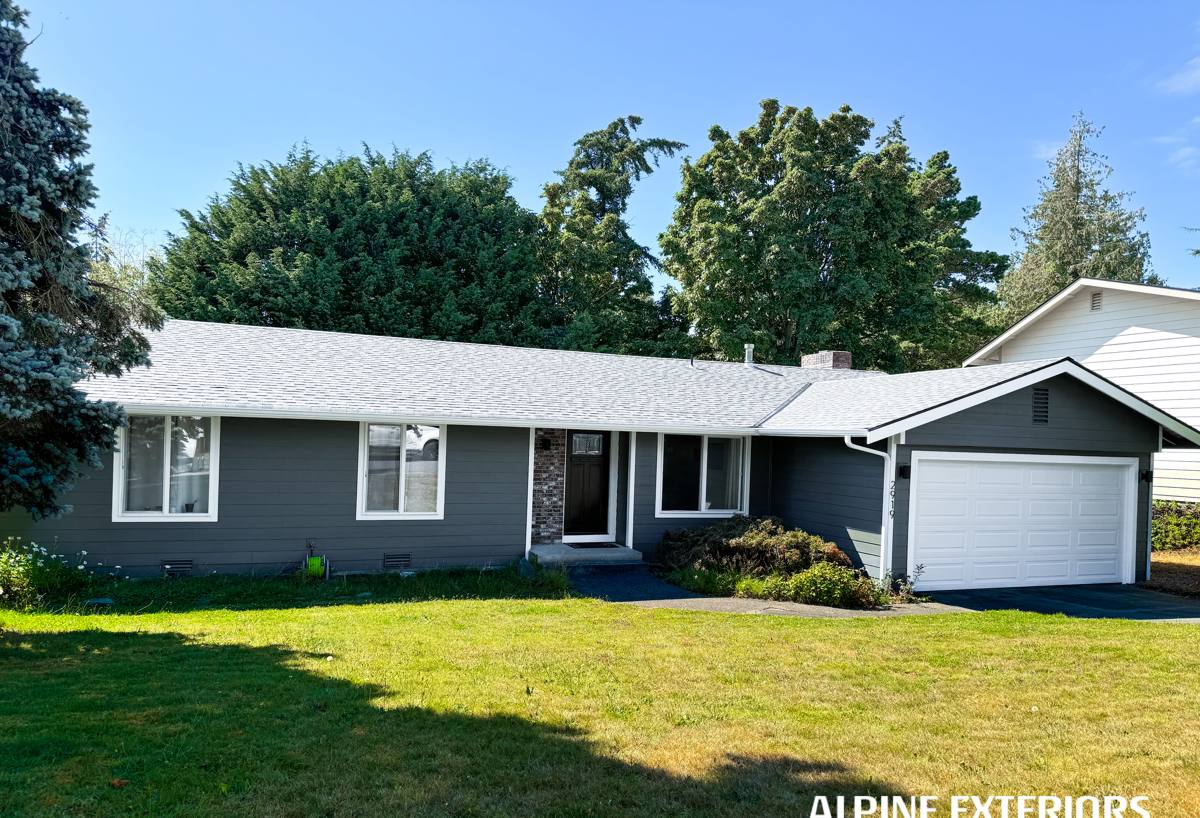
What Deming's Climate Puts Fiber Cement Siding Through
Salt Air, Still Present This Far Inland
Deming is well inland from the coastline, but marine air off the Sound moves across this whole part of Whatcom County and reaches even the foothill communities. It's a slower, quieter effect out here than at the immediate shoreline, but it still works on fasteners, flashing, and lower-grade trim hardware over time. Fiber cement itself doesn't corrode, but the fastener heads, flashing metal, and any trim hardware around it need to be specified with that reality in mind, not treated as if the property were sitting in a dry inland climate.
Driving Rain in a Foothill Setting
Rain through fall and winter rarely falls straight down in this part of the county, and Deming's position closer to the higher ground east of Lynden means storms often arrive with more force and more sustained wind-driven rain than properties further out on the flats. That sideways rain load is what finds every weak seam, gap, or poorly flashed joint in a wall assembly. Fiber cement is dimensionally stable and resists that kind of moisture intrusion far better than porous or wood-based materials, but only if the flashing and joint details behind it are done right — the material doesn't fix a bad installation underneath it.
A Long Moss Season Under Heavier Tree Cover
The tree cover that gives Deming its foothill character also means more shaded wall area and slower drying after every rain. Moss, algae, and mildew growth thrive in exactly that combination — shade, moisture, and mild temperatures — and a moss season here can run close to year-round on north-facing or tree-shaded walls. Fiber cement's dense, engineered composition doesn't feed mold and mildew growth the way wood-based sidings can, and its factory finish sheds surface growth more easily than raw or field-painted materials. It's not immune to moss taking hold, but it doesn't degrade from the exposure the way a softer material would.
Why James Hardie Fiber Cement Is the Only Siding We Install
We install James Hardie fiber cement siding exclusively — not vinyl, not LP SmartSide or other engineered wood products, not Cemplank or Allura, not primed spruce or cedar. That's a professional standard, not a sales pitch, and it comes from watching what actually holds up on foothill and valley properties in this climate over a couple of decades versus what looks good on a spec sheet.
- Non-combustible core: Fiber cement doesn't feed a fire the way wood-based siding can, which matters for both safety and insurance underwriting, especially on properties closer to tree lines.
- Factory-applied ColorPlus finish: The color is baked on under controlled factory conditions rather than field-applied, so it holds up under sustained shade, moisture, and UV exposure far longer than a site-painted finish.
- Climate-engineered HZ product line: Hardie's HZ5 formulation is built for regions with significant moisture exposure and freeze-thaw cycling — a good match for Deming's combination of driving rain, higher humidity under tree cover, and cold snaps that come down off the mountain.
- Dimensional stability: Fiber cement doesn't swell, cup, or warp through repeated wetting-and-drying cycles the way engineered wood products can, which matters on a slow-drying, shade-heavy lot.
- A strong transferable warranty: Hardie backs the product with a solid warranty structure, provided the installation follows their published specifications — which is exactly what we install to.
How the Alternatives Trade Off in This Setting
| Product | Trade-off in a foothill, shade-heavy setting like Deming |
|---|---|
| Vinyl siding | Panel seams and gaps give wind-driven rain an entry point; can warp or become brittle with repeated temperature swings |
| LP SmartSide / engineered wood | Wood-strand core is more moisture-sensitive at cut edges and fastener points, a real concern where walls stay damp longer under tree cover |
| Primed spruce or cedar | Needs ongoing paint and moisture upkeep to avoid rot; shaded, slow-drying walls accelerate that maintenance burden |
| Other fiber cement brands | May not offer a climate-specific HZ-equivalent line or the same factory-finish warranty depth as James Hardie |
Each of those products has a place in the broader market, and we're not claiming any of them is unsafe or defective. Our position is narrower: for a property dealing with this much sustained moisture, shade, and salt-tinged air, we'd rather install and stand behind one system correctly than offer a menu of options with uneven long-term performance.
What a Correct Fiber Cement Installation Actually Involves
Fiber cement is only as good as the installation behind it. James Hardie's warranty is conditioned on the work following their published installation specifications, and on a Deming property — where slower drying and heavier moisture exposure raise the stakes on every joint and seam — that spec isn't a formality.
Clearance and Ground Contact
Hardie specifies minimum clearances above grade, roof lines, decks, and paved surfaces. On wooded lots where soil stays damp longer and vegetation grows close to foundations, holding those clearances is what keeps the bottom course of siding from sitting in prolonged moisture.
Fastening
Correct fastener type, spacing, and depth keep the panels secured without over-driving or under-driving, both of which create entry points for water or cause panels to work loose over time under wind load.
Joint and Seam Treatment
Every field cut, butt joint, and inside or outside corner needs to be sealed and detailed correctly. This is the step that matters most under wind-driven rain — a joint that isn't backed and sealed properly is where water gets behind the cladding, regardless of how good the material itself is.
Flashing at Every Penetration
Windows, doors, hose bibs, vents, and any other wall penetration need flashing that directs water back out, not just a bead of caulk over the gap. This is the detail most likely to get rushed on a job, and the hardest one to inspect once the siding is closed up.
How Our Process Runs for a Deming Property
Inspection and Estimate
We start with an actual look at the house — current siding condition, signs of trapped moisture or sheathing damage, and how sun, shade, and tree cover vary across each wall. On a wooded Deming lot, that wall-by-wall read matters more than it would on an open, uniformly-exposed property, because a south wall and a tree-shaded north wall on the same house can be dealing with completely different moisture loads.
Tear-Off and Substrate Check
Once the old siding comes off, we check the sheathing underneath for rot or soft spots before anything new goes up. Sealing new fiber cement over damaged sheathing just hides a problem that keeps getting worse behind the wall.
Weather Barrier and Flashing Detail
This is where most long-term siding failures actually originate — not through the siding material itself, but around it. House wrap, window and door flashing, and every penetration get careful attention here, because it's the step that's easy to rush and nearly impossible to fix once the new siding is up.
Installation to Manufacturer Spec
Fastener spacing, clearances, joint treatment, and field-cutting practices all follow Hardie's published spec as the baseline, not as an upgrade. That's what keeps the warranty intact and what actually determines how the siding performs a decade or two out.
Final Walkthrough
We walk the completed job with the homeowner, cover basic care and what to watch for given the property's specific sun and shade exposure, and confirm the finished work matches what was estimated.
Signs a Deming Home's Siding Needs Attention
- Moss or dark staining that comes back quickly after cleaning, especially under tree cover or on north-facing walls
- Soft or spongy siding, particularly near grade or around window and door trim
- Peeling paint or visible cupping and warping, most common on wood-based or engineered wood siding
- Cracked or missing panels after a windstorm coming off the higher ground to the east
- Rust streaking below fasteners or trim hardware
- Musty smells or staining on interior walls that back up to exterior siding
- Siding past 20-25 years old with no documented replacement or major repair
None of these automatically mean a full tear-off is needed, but on a shaded, slower-drying lot they're worth a professional look sooner rather than after another wet season adds to the damage.
What Affects Fiber Cement Siding Cost on a Deming Property
Every estimate is specific to the house, but a handful of factors consistently move the number:
| Cost Factor | Why It Matters |
|---|---|
| Total square footage and number of stories | More wall area and height directly increase material and labor |
| Trim and detail complexity | Homes with more window and roofline detail take more time to flash and finish correctly |
| Sheathing condition underneath the old siding | Rot or moisture damage found during tear-off adds repair scope before new siding can go up |
| Access and site conditions | Wooded or sloped lots common around Deming can affect staging, scaffolding, and material handling |
| Product line and color selection | Which James Hardie profile and ColorPlus finish is chosen affects material cost |
We walk through these factors specifically during the estimate, rather than handing over a flat per-square-foot number with no explanation behind it.
Why a Crew Already Working in Deming Matters
Being based in Lynden and working Deming regularly, rather than treating it as an occasional trip out from a distant office, means we're familiar with how the terrain and tree cover here change the way a house needs to be sided compared to the open farmland closer to town. That shows up in real decisions on the job: which walls stay wet longest under tree cover, where extra flashing attention actually pays off, and which install-day details are worth the time so a homeowner isn't dealing with a callback a couple of winters later. It also means that when a warranty question or maintenance issue comes up years down the road, it's a call to a crew still working in the same area — not a company that bid the job once and moved on.
If your Deming home needs new siding, or you'd like an honest look at what your current siding is telling you, we're glad to come out and give you a straightforward, no-pressure estimate. Reach out using the form below to get started.