 Lynden Siding
 Why Wiser Lake Puts Extra Stress on an Asphalt Shingle Roof
Wiser Lake sits in that stretch of Whatcom County where Puget Sound air, low farmland, and open water all meet. A roof out here doesn't just deal with "Pacific Northwest rain" in the abstract — it deals with a specific combination of moisture, wind, and airborne salt that wears differently on asphalt shingles than it does a few miles inland in downtown Lynden. If you've owned a house near the lake for more than a few winters, you've probably already noticed your roof ages faster than a friend's roof on higher, drier ground.
Salt Air and Corrosion
Proximity to Bellingham Bay and the Sound means the air carries a low but steady level of salt, and lake-adjacent properties see their own version of it through humidity and standing moisture near the water. Salt-laden moisture is hard on exposed metal — nail heads, flashing, drip edge, vent stacks, and gutter hardware. Left unprotected or installed with the wrong fasteners, metal components corrode years ahead of schedule, and once flashing starts to go, water finds its way under perfectly good shingles.
Driving Rain and Wind-Driven Moisture
This part of Whatcom County gets rain that doesn't fall straight down. Wind off the lake and the open fields around it pushes rain sideways, which means water gets tested at every seam, lap, and penetration on a roof — not just the flat field of shingles. A roof that would be perfectly fine in a calm, dry climate can leak here simply because the installer didn't account for wind-driven water working its way uphill under a shingle edge or around a poorly sealed vent.
A Moss Season That Runs Most of the Year
Between the rain, the shade from mature trees common around the lake, and cool temperatures, moss and algae have a long growing season — realistically fall through spring, and sometimes longer on north-facing slopes that never fully dry out. Moss isn't just cosmetic. It holds moisture against the shingle surface, works its rhizoids under shingle edges, and gradually lifts tabs enough to let wind and rain underneath.
What a Correctly Installed Roof Needs to Handle This Climate
A shingle roof that's "installed to code" and a shingle roof that's "installed correctly for Wiser Lake" aren't always the same thing. Code is a minimum. What actually keeps a roof dry here for its full expected life comes down to a handful of details that are easy to skip and hard to notice until something fails.
Underlayment and Ice-and-Water Barrier
We treat synthetic underlayment as the real second line of defense, not just a nailing surface for shingles. Along eaves, valleys, and any low-slope transitions, self-adhering ice-and-water membrane gets used even though this area doesn't see much true ice — it's just as effective against wind-driven rain backing up under shingles, which is the more common problem locally.
Ventilation That Matches the House
Attic moisture is a quiet roof-killer. Homes near the lake, especially older ones, often have ventilation that was adequate when the house was built but doesn't move enough air for today's insulation levels. Balanced intake and exhaust ventilation keeps the underside of the roof deck dry, which matters just as much as what's happening on top of the shingles — a deck that stays damp from the inside will fail early no matter how good the shingles are.
Flashing Where the Roof Actually Fails
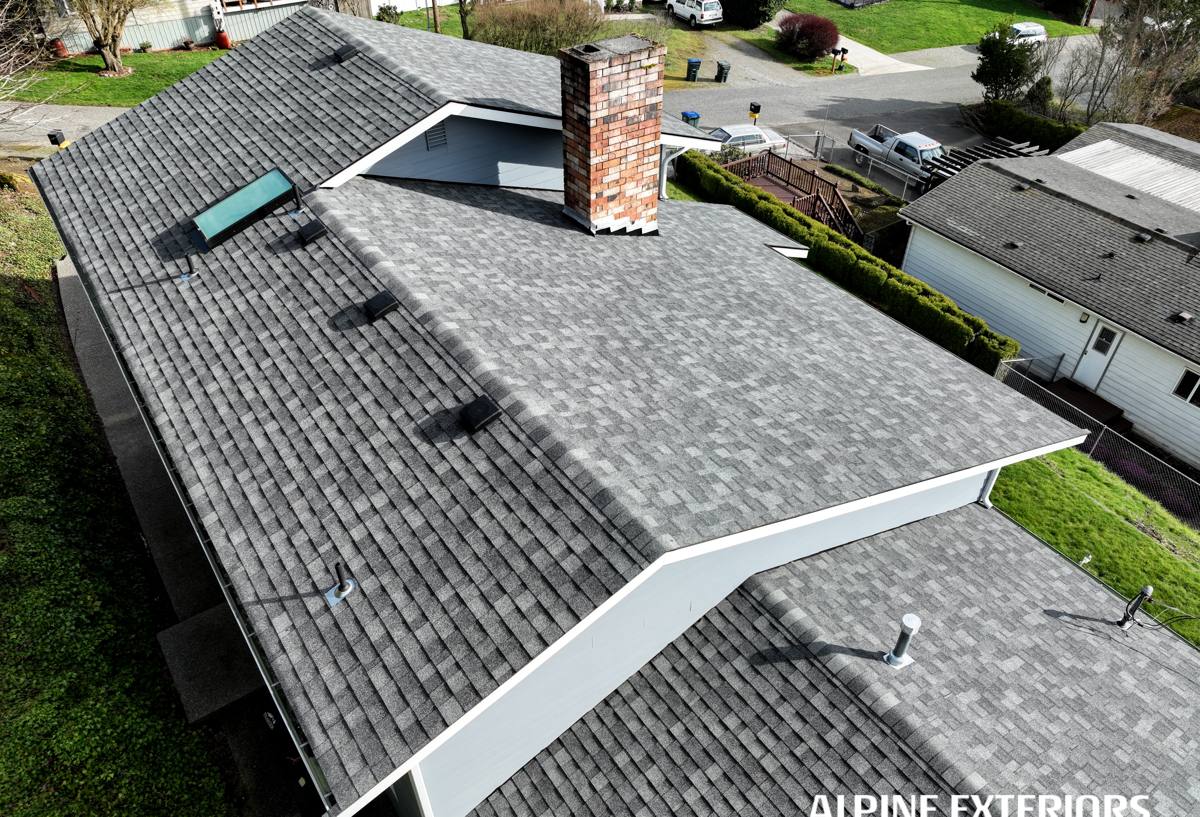
Most roof leaks don't come from the shingle field — they come from flashing: chimneys, skylights, sidewall step flashing, valleys, and vent boots. We use flashing and fasteners rated for coastal-adjacent, high-moisture conditions and detail every penetration individually rather than relying on a one-size-fits-all approach. It takes longer. It's also the difference between a roof that's dry in year twelve and one that's already been patched twice by then.
Shingle Options for Wiser Lake Homes
Not every asphalt shingle product performs the same way in wind, moss exposure, and driving rain. Here's how the common options stack up for a lake-adjacent property in this area.
| Shingle Type | Wind Rating | Moss/Algae Resistance | Best Fit For |
|---|---|---|---|
| Standard 3-tab | Lower wind rating, typically the first to lift in gusty conditions | None built in unless treated | Budget-driven projects on more sheltered lots |
| Architectural (laminated) shingle | Higher wind rating, thicker profile resists uplift better | Available with algae-resistant granules | Most Wiser Lake homes — the common-sense default |
| Algae-resistant architectural shingle | Same as standard architectural | Copper- or zinc-infused granules actively slow algae/moss growth | Shaded lots, north-facing slopes, homes with a history of moss |
| Impact-rated (Class 4) shingle | Highest wind and impact rating in the asphalt category | Often paired with algae-resistant granules | Open, wind-exposed lots near the water; may qualify for insurance discounts |
For most homes around the lake, we point owners toward an architectural shingle with algae-resistant granules as the baseline — it's a reasonable step up in cost that pays for itself in fewer moss treatments and a longer effective life. Class 4 impact-rated shingles make the most sense on lots with real wind exposure or a history of storm damage.
What Drives the Cost of a Wiser Lake Roofing Job
Every roof is different, so we don't quote off a flat per-square number without seeing the house. That said, a few factors consistently move the price up or down on jobs in this area, and it's worth understanding them before you start collecting estimates.
| Cost Factor | Why It Matters Here |
|---|---|
| Roof size and number of layers to remove | Older lake-area homes sometimes have a second layer of shingles from a past re-roof, which adds tear-off time and disposal cost |
| Pitch and roof complexity | Steeper roofs and homes with multiple valleys, dormers, or chimneys take longer to flash correctly |
| Decking condition | Moisture intrusion from a past leak often means sections of plywood or plank decking need replacing before new shingles go down |
| Shingle class chosen | Standard 3-tab, algae-resistant architectural, and Class 4 impact-rated products carry different material costs |
| Ventilation upgrades | Adding or correcting ridge and soffit ventilation is a smaller add-on cost that protects the rest of the investment |
| Access and site conditions | Tree cover, slope of the lot, and how close a dumpster or trailer can get to the house all affect labor time |
Broadly speaking, a straightforward tear-off and asphalt shingle replacement on an average-sized Whatcom County home lands somewhere in the low-to-mid five figures, with the specifics above pushing it up or down. Anyone quoting you a firm number without walking the roof and checking the attic is guessing.
Our Process, Start to Finish
Every roofing job we take on near Wiser Lake follows the same sequence. Skipping steps is usually where problems start.
- On-site inspection. We walk the roof and check the attic, looking at deck condition, existing ventilation, flashing, and any signs of past leaks before we ever talk numbers.
- Written estimate and shingle selection. We go over shingle options, wind and moss-resistance trade-offs, and what your specific roof needs — not a generic package.
- Tear-off and deck inspection. Old material comes off down to the deck, and every sheet gets checked. Soft or water-damaged decking gets replaced before anything new goes down — this isn't optional, and it's not a surprise add-on if we've done our job during the initial inspection.
- Underlayment and ice-and-water membrane. Installed to the details described above, with extra attention at eaves, valleys, and low-slope sections.
- Flashing and shingle installation. Flashing goes in first at every penetration and transition, then shingles are installed to manufacturer nailing patterns adjusted for wind exposure.
- Ventilation check and correction. Intake and exhaust airflow gets verified and adjusted if the existing setup is undersized.
- Cleanup and magnetic sweep. Full site cleanup, including a magnetic nail sweep of the yard and driveway.
- Final walkthrough. We go over the finished roof with you before calling the job done.
Keeping Moss and Algae From Shortening Your Roof's Life
Even a well-installed roof needs some basic upkeep in a moss-heavy climate like this one. None of it is complicated, and most of it doesn't require getting on the roof yourself.
- Keep gutters clear — clogged gutters hold water against the lower edge of the roof and give moss an easy foothold.
- Trim back overhanging branches where possible to cut down on shade and falling debris that traps moisture.
- Rinse visible moss growth gently from the ground or have it treated — never pressure-wash shingles, which strips protective granules and shortens shingle life.
- Watch north-facing slopes and valleys first; they dry out slowest and are usually where moss shows up before anywhere else on the roof.
- Have the roof looked at every couple of years, especially after a hard windstorm — small flashing or shingle issues are cheap to fix early and expensive to ignore.
- Avoid zinc or copper strips as a substitute for proper shingle selection — they help but work better as a supplement to algae-resistant shingles, not a replacement for them.
Repair, Patch, or Full Replacement?
Not every roofing call near Wiser Lake ends in a full tear-off. If a roof is younger than roughly two-thirds of its expected life, has isolated flashing failure, or lost shingles in a windstorm but the rest of the field is sound, a targeted repair is usually the honest recommendation. We match shingles as closely as possible and focus on the flashing or underlayment detail that actually failed, rather than treating a repair as an excuse to sell a full replacement.
Full replacement makes more sense when a roof shows widespread granule loss, multiple past patch jobs, soft decking in more than one area, or moss damage that's been going on long enough to compromise the shingle mat itself. We'll tell you plainly which category your roof falls into and why, including when a repair is the right call even though it's the smaller job.
Why It Matters That We Already Work Wiser Lake
A crew that's worked lake-adjacent homes in this part of Whatcom County isn't guessing about wind direction, which slopes hold moss longest, or how fast standard flashing corrodes out here compared to a roof twenty minutes inland. That local knowledge shows up in small decisions — which underlayment gets used where, how ventilation gets sized, which shingle class actually earns its higher price on an exposed lot — that a crew unfamiliar with the area might not think to make. It also means we're not learning on your roof. As a Lynden-based crew, Wiser Lake isn't a special trip for us; it's part of the area we already know and service regularly.
If your roof is showing granule loss, moss buildup, curling edges, or you're just planning ahead for a home near the lake, we're happy to take a look and give you a straightforward, no-pressure estimate — no obligation, and no pushy upsell. Use the form below to get started.