 Lynden Siding
 Roof Repair for Bellingham Homes: What the Climate Actually Demands
Bellingham sits close enough to the water that roofs here take a different kind of beating than roofs fifty miles inland. Salt-laden air off Bellingham Bay works on exposed metal fasteners and flashing year-round. Driving rain off the Strait pushes water sideways into laps and seams that would stay dry in a straight-down rain. And the long, mild, wet stretch that runs from fall through spring gives moss and moisture months at a time to work into a roof system before a homeowner ever sees a stain on the ceiling. None of that means Bellingham roofs fail faster than average — it means they fail differently, and a repair that doesn't account for those specific stresses tends to come back within a season or two.
We're based in Lynden, a short drive north, and we've been running crews into Bellingham and the rest of Whatcom County long enough to know which failure patterns show up where. This page is about roof repair specifically — not a full tear-off and replacement, and not siding or gutters, though those systems all interact with the roof at the edges. If your roof has a specific problem (a leak, damaged flashing, storm-lifted shingles, a soft spot near a valley), this is the service that addresses it directly.
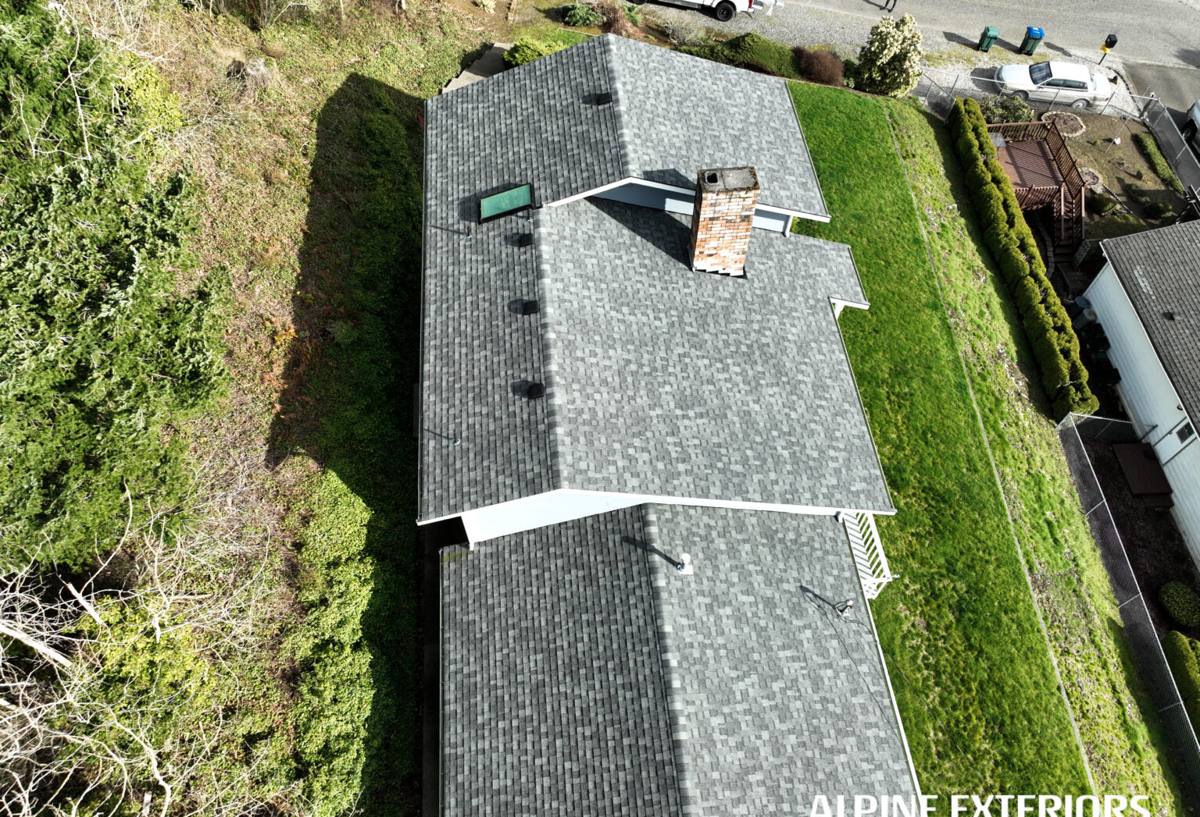
Common Roof Problems We See on Bellingham Homes
Moss and Trapped Moisture
Bellingham's tree cover and consistent damp season are ideal conditions for moss, and moss is more than a cosmetic issue. It holds water against the shingle surface long after the rest of the roof has dried, lifts shingle edges as it grows, and works its way under laps where it keeps wood sheathing damp. Left long enough, moss growth turns a simple cleaning job into a repair job, because the granule loss and lifted shingles underneath it don't recover on their own once the moss is removed.
Wind-Driven Rain at Laps and Penetrations
Storms coming off the water don't always deliver rain straight down. Wind-driven rain finds its way into places that are fine in a calm rain — chimney flashing, vent boots, skylight curbs, and the laps between courses of shingles. Repairs at these points aren't just about sealing a visible gap; they usually mean pulling back the surrounding material to see how far water has already traveled underneath.
Corrosion at Metal Components
Nail heads, flashing, and vent caps that aren't rated for coastal exposure corrode faster near the water than they would inland. Once a fastener or flashing piece starts to go, it stops doing its job as a water barrier well before it looks obviously broken from the ground.
What a Correct Roof Repair Actually Involves
A roof repair that holds up in this climate is not just replacing what's visibly damaged and moving on. There's a difference between a patch and a repair, and it shows up within the first wet season.
- Identifying the actual entry point of the leak, which is often several feet from where the stain shows up inside — water travels along the sheathing before it drips
- Checking the condition of the underlayment and sheathing under the damaged area, not just the shingles on top
- Matching or properly integrating new flashing at valleys, chimneys, and penetrations rather than just caulking over old flashing
- Confirming the repair ties into the surrounding roof system correctly, so water sheds over the new work instead of pooling at the edges
- Checking attic ventilation near the repair area, since poor airflow accelerates moisture problems and can cause a "fixed" leak to reappear as condensation
Skipping any of these steps is how a homeowner ends up paying for the same repair twice.
Our Roof Repair Process
- Inspection and honest assessment. We look at the roof from the ground and, where it's safe and useful, from the roof itself — not just the spot you called about, but the surrounding area, since related problems are common.
- Explaining what we find. We'll tell you plainly whether this is a straightforward repair, a repair with some underlying damage to address, or a situation where repair isn't the more economical choice long-term.
- A written scope and estimate. You'll know what's being fixed and roughly what it involves before work starts.
- The repair itself. This includes removing and replacing damaged materials, addressing any wet or compromised sheathing, and reinstalling flashing and shingles to shed water correctly.
- A final check. We confirm the repaired area integrates cleanly with the rest of the roof and there are no secondary issues we'd want you to know about.
Repair or Replace? What Actually Drives the Decision
Not every roof problem in Bellingham needs a full replacement, and not every leak is fixable with a simple patch. The honest answer depends on a handful of factors, not a single rule of thumb.
| Factor | Leans Toward Repair | Leans Toward Replacement |
|---|---|---|
| Age of roof | Well within expected lifespan for the material | Near or past the material's typical service life |
| Extent of damage | Localized — one section, one penetration, one storm event | Multiple areas showing granule loss, curling, or moss damage |
| Sheathing condition | Dry or minimally affected under the damaged area | Soft, delaminated, or wet sheathing found during inspection |
| Underlying material | Original underlayment still intact and dry elsewhere | Underlayment brittle or failing broadly, not just locally |
| Repair history | First repair in this area | Same spot has been patched more than once already |
We'll walk you through where your roof actually falls on this before recommending anything — the goal is the right call for your situation, not the bigger job.
Materials and Methods for Coastal-Influenced Repairs
For repair work in a marine-influenced area like Bellingham, we pay particular attention to a few things that matter more here than they would further inland:
- Using fasteners and flashing rated to hold up against salt air exposure rather than standard-grade hardware
- Sealing and lapping penetrations with the direction of wind-driven rain in mind, not just standard down-slope shedding
- Matching shingle type and, where possible, color and profile so a repair doesn't stand out as a patch job on the roofline
- Addressing moss at the repair site properly — removing it and the damaged material beneath it, not just treating the surface
We work with standard asphalt shingle roofing, which covers the large majority of homes we're called out to repair in this area. If a roof has a metal, tile, or specialty system, we'll tell you upfront whether it's something we handle or something we'd rather refer out, rather than taking on a repair outside our comfort zone.
Why a Crew That Already Works Bellingham Matters
Roof repair is diagnostic work as much as it's construction work. A crew that's already seen how moss builds up in shaded Bellingham roof valleys, how wind-driven rain gets under flashing near the water, and how fast a small leak can spread through damp sheathing during a wet Whatcom County winter is going to find the real problem faster — and fix it right the first time — compared to a crew working the area for the first time. We're not a national outfit dispatching whoever's available; we're a Lynden-based crew that knows this region because we work in it regularly, and we stand behind the repairs we make here.
Between-Visit Maintenance Checklist for Bellingham Homeowners
A few habits go a long way toward catching problems while they're still small repairs instead of bigger ones:
- Look at the roofline from the ground a couple of times a year for visible moss, dark streaking, or missing shingles
- Keep gutters clear so water isn't backing up under the roof edge, especially before the fall rains start
- Trim back overhanging branches that keep sections of the roof shaded and slow to dry
- Check the attic after a heavy storm for any signs of moisture, staining, or daylight where there shouldn't be any
- Get a professional look at the roof after any major windstorm, even if nothing looks obviously wrong from the ground
Get a Straight Answer on Your Roof
If you've got a leak, storm damage, or a spot on your Bellingham roof that's been bothering you, we're happy to come take an honest look and tell you exactly what we see — no pressure, no upsell to a replacement you don't need. Fill out the form below for a free estimate and we'll get back to you to schedule a time.