 Lynden Siding
 Deck Replacement in Laurel: Why the Climate Here Matters More Than the Design
Laurel sits in the rural stretch of Whatcom County just outside Lynden, where open farmland, mature trees, and river-valley moisture combine to create some of the toughest conditions in the Pacific Northwest for an outdoor structure. A deck out here doesn't just deal with rain — it deals with driving rain that comes in sideways during fall and winter storms, salt-laden air drifting in off the Sound, and a moss season that can stretch from October clear through April. Any one of those factors will shorten the life of a poorly built deck. Together, they're why so many decks in this area fail years before they should.
When we replace a deck in Laurel, the goal isn't just to make it look new. It's to build something that actually accounts for how water moves through this climate, where moss and algae take hold first, and how the ground itself behaves after months of saturation. A deck built to a generic national standard, without those local realities factored in, is a deck we'll likely be called back to fix in a few years.
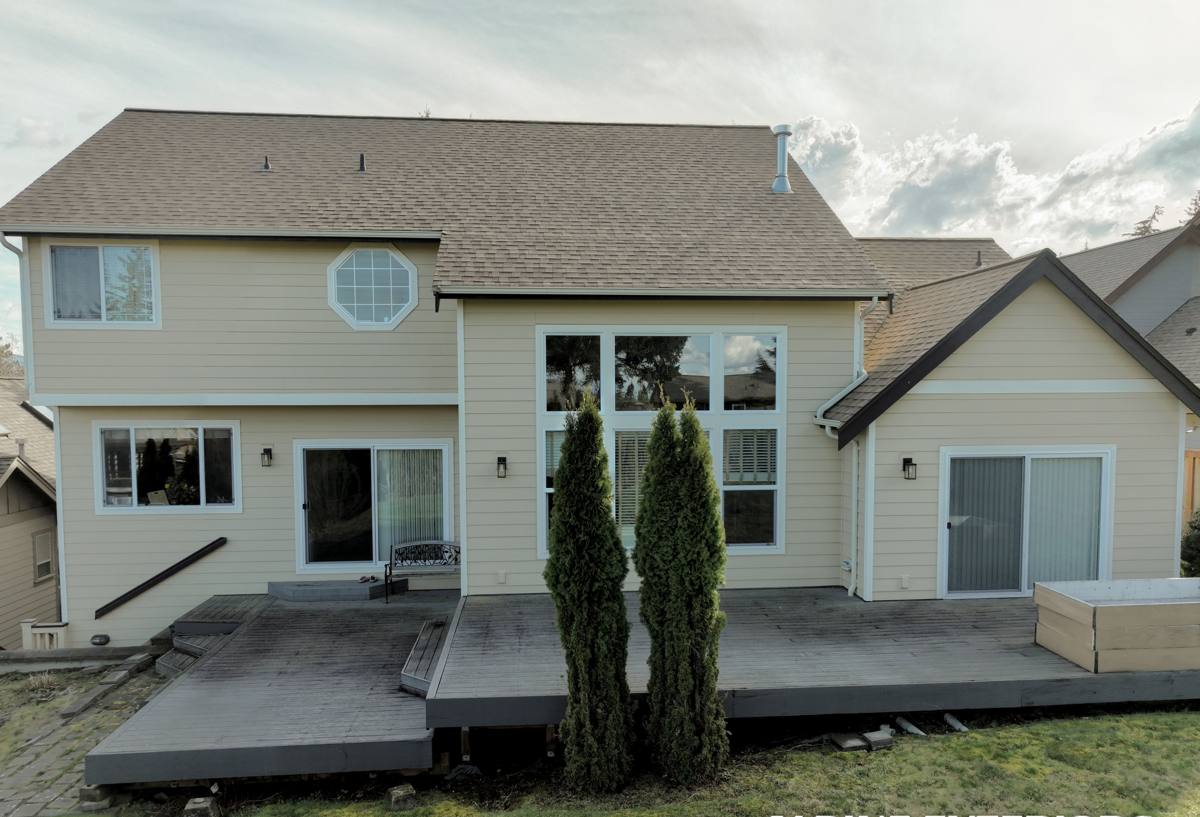
Signs a Laurel Deck Needs Replacing, Not Just Patching
Homeowners often call us for a repair and end up needing a full replacement once we get underneath the boards. Whatcom County's wet cycle hides damage well — the surface can look fine while the framing underneath is failing. Here's what usually tips a deck from "repairable" to "replace it":
- Soft or spongy decking, especially near the house where the ledger board attaches
- Persistent black or green staining on the underside of boards that won't clean off
- Visible gaps opening between boards from repeated wet-dry cycling
- Rust streaking from fasteners, a sign the hardware is corroding faster than the wood around it
- A railing that flexes or feels loose when leaned on
- Any sign of rot or soft wood where the deck meets the house siding or foundation
If two or more of these show up, patching individual boards is usually a short-term fix. The framing and ledger connection are where real failures start, and those aren't things you repair one board at a time.
Why Moss and Algae Matter More Than People Think
Moss on a deck isn't just cosmetic. It holds moisture against the wood far longer than open air would, and it grows fastest in exactly the conditions Laurel has in abundance — shaded areas near trees or the house, north-facing sections that don't get afternoon sun, and any spot where water drains slowly. Over a full moss season, that trapped moisture accelerates rot underneath a surface that might still look presentable from a few feet away.
Choosing the Right Decking Material for This Climate
There's no single "best" decking material — there's a best material for your budget, your maintenance tolerance, and how much sun or shade your specific lot gets. In a climate with this much rain and moss pressure, the differences between materials matter more here than they would in a drier region.
| Material | How It Handles Local Moisture & Moss | Maintenance | Typical Lifespan |
|---|---|---|---|
| Pressure-treated wood | Absorbs and releases moisture; moss and algae grow readily on the surface if not cleaned | Annual cleaning and re-staining/sealing recommended | 10-15 years with upkeep |
| Cedar | Naturally more rot-resistant than treated pine, but still porous; moss still takes hold without maintenance | Periodic sealing to maintain color and water resistance | 15-20 years with upkeep |
| Capped composite | Non-porous cap sheds water and resists moss staining much better than wood | Occasional washing, no sealing or staining | 25-30 years |
| PVC decking | Fully synthetic, doesn't absorb water at all, most resistant to moss and algae staining | Occasional washing | 25-30+ years |
We don't push one material on every homeowner. Wood costs less up front and has a natural look plenty of people prefer, but it asks for real annual maintenance to keep moss and rot at bay in this climate. Composite and PVC cost more initially but hold up with far less intervention — which matters if you don't want to be pressure-washing and re-sealing a deck every year for the next two decades. The honest trade-off is upfront cost versus ongoing labor, not one product being "better" in every way.
What a Correct Deck Replacement Actually Involves
The visible decking boards are the smallest part of what determines whether a deck lasts. Most of the failures we see trace back to shortcuts in the parts nobody sees once the project is done.
Ledger Board Flashing
The ledger board — where the deck attaches to the house — is the single most common failure point in this climate. If it isn't properly flashed to shed water away from the house framing, driving rain will find its way behind it over time, leading to rot in both the deck framing and the home's structure behind the siding. Correct flashing includes a water-resistant barrier, metal flashing installed shingle-style so water sheds outward, and proper fastening that doesn't puncture the flashing's protective layer.
Joist Protection
Every cut end and top surface of a joist should be protected with a self-adhering joist tape before decking goes down. This is one of the cheapest steps in the entire project and one of the most skipped, because it doesn't show up in a quick visual inspection after the job is done. It's also one of the biggest reasons framing rots from the inside out years before the decking itself shows wear.
Fasteners and Hardware
Salt air and constant moisture are hard on standard hardware. We use hot-dip galvanized or stainless fasteners and structural connectors rated for the type of decking material and framing involved, particularly with modern treated lumber, which is more corrosive to lower-grade fasteners than older treatment chemicals were. Hardware that looks fine on install day can be rusting from the inside within a couple of wet seasons if it's the wrong grade.
Footings and Ground Contact
Footings need to be set below frost depth and sized appropriately for the soil conditions on the property. Rural lots around Laurel often have heavier clay content or seasonal saturation that behaves differently than a typical in-town lot, so we check actual soil and drainage conditions on-site rather than assuming a standard footing spec will hold.
Drainage and Slope: Designed In, Not Left to Chance
A deck that doesn't shed water properly will trap it — under boards, against the house, or pooling on the surface where moss gets its first foothold. We build in a slight slope away from the house on the framing itself, not just hoping the decking boards handle it, and we account for gaps between boards that allow airflow underneath rather than sealing everything tight. Proper under-deck drainage and airflow are what actually slow moss regrowth long-term; sealing and cleaning treat the symptom, good drainage design treats the cause.
Our Process, Start to Finish
Every deck replacement follows the same sequence, whether it's a small back porch or a full wraparound deck:
- On-site assessment of the existing deck, framing, ledger connection, and soil/drainage conditions
- Honest conversation about material options and what fits your budget and maintenance preferences
- Written estimate with a clear scope — no vague allowances that turn into surprise charges
- Permit application where required, coordinated with the local building department
- Full demolition of the old deck, including inspection of the ledger area and any hidden rot in the house framing behind it
- Framing, flashing, joist protection, and footing work, all done before a single decking board goes down
- Decking, railing, and stair installation
- Final walkthrough with you before we consider the job done
Permits and Local Code
Deck replacement in this area typically requires a permit through the applicable building department, especially for anything involving structural framing changes, height above a certain threshold, or attachment to the house. Skipping this step is a common way homeowners end up with problems at resale, when an unpermitted structure gets flagged during a home inspection. We handle the permit process as part of the job rather than leaving it for the homeowner to sort out separately.
Why Hire a Crew That Already Works in Laurel
A contractor who only occasionally works this far out from town doesn't always have a feel for how this specific stretch of Whatcom County behaves — how long moss season actually runs here, how much a shaded rural lot changes drainage needs, or how the salt-air exposure this close to the Sound affects hardware choices over a decade of use. That's not a knock on general contractors; it's just the difference between someone applying a standard spec and someone who's replaced enough decks in this specific area to know where they typically fail first. We'd rather build it right the first time than get called back in five years for a problem we could have prevented at the framing stage.
Keeping a New Deck Looking Right
Whatever material you choose, a little seasonal upkeep goes a long way in this climate. Clearing leaves and debris before they sit wet against the boards, keeping gutters clear so runoff doesn't dump directly onto the deck, and an annual wash to knock back early moss growth will meaningfully extend the life of any deck out here — wood, composite, or PVC.
If your deck is showing its age, or you're just ready to stop maintaining something that was never built right for this climate to begin with, we're glad to take a look. There's no pressure and no cost to get a straight answer about what your deck actually needs — just fill out the form below and we'll set up a time to come take a look.