 Lynden Siding
 Why Bellingham Siding Wears Differently Than Siding Inland
Bellingham sits right on the water, and that changes what siding has to deal with year after year. Homes a few miles inland in Whatcom County face rain and cold, but Bellingham adds salt-laden air off the bay, wind-driven rain that hits walls sideways instead of falling straight down, and a moss season that can stretch for most of the year on shaded or north-facing walls. None of that is dramatic on its own. It's the accumulation that causes problems — years of small exposures that eventually show up as soft trim, lifted seams, or paint that won't hold anymore.
Salt Air and Coastal Exposure
Airborne salt is corrosive to fasteners and hard on painted and coated surfaces, and it doesn't take a beachfront lot for it to matter — it travels on the wind well inland from the shoreline. Over time it can accelerate corrosion on nails, flashing, and trim fasteners, and it contributes to the slow breakdown of caulk and paint films faster than you'd see in a dry inland climate. Siding materials and fastener choices that are fine in most of the country need a second look this close to the water.
Driving Rain and a Long Wet Season
Bellingham's rain doesn't always fall straight down. Coastal wind patterns push it sideways into walls, which means laps, seams, and penetrations (hose bibs, light fixtures, vents) take on water that a calmer climate would never test. Add a wet season that runs long by national standards, and any gap in the water-management layer behind the siding gets exploited early and often.
Moss, Algae, and Shade
Tree cover and cloud cover both work against fast drying. Moss and algae take hold on siding that stays damp and shaded, especially on north walls and under eaves with limited sun exposure. Beyond looking bad, moss holds moisture against the siding surface, which is exactly the condition that causes rot in wood-based products and finish failure on almost anything.
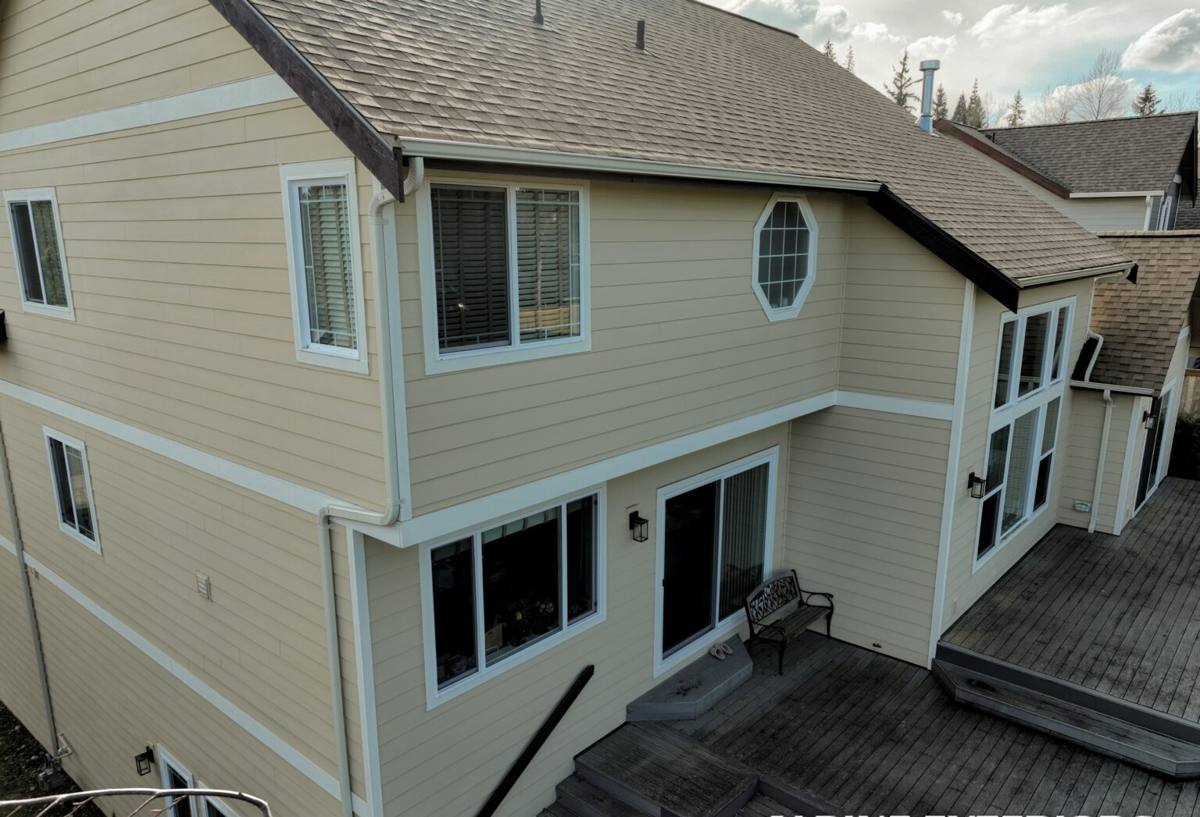
Signs Your Bellingham Home Needs Siding Repair
Most siding problems start small and stay hidden until they're not. Catching them early is the difference between a repair and a much larger project. Walk your exterior a couple of times a year and look for:
- Soft or spongy spots when you press on siding or trim, especially near the bottom courses and around windows
- Visible gaps, cracks, or separation at seams and butt joints
- Paint that's peeling, bubbling, or won't hold no matter how often it's redone in one specific area
- Dark streaking, moss, or algae concentrated on shaded or north-facing walls
- Warping, buckling, or panels that have pulled slightly away from the wall
- Swollen or crumbling trim, corner boards, or window casings
- Musty smell or visible staining on interior walls that share an exterior wall with a suspect area
- Fasteners backing out, rust streaks below nail heads, or visibly corroded trim screws
Any one of these on its own might be minor. Several together, or any sign of soft/spongy material, usually means water has already gotten past the surface and into the assembly behind it.
What a Correct Siding Repair Actually Involves
A repair that just patches the visible damage and leaves the cause in place doesn't hold up in this climate — it comes back, usually worse. A repair done right starts with figuring out why that section failed in the first place.
Diagnosing the Real Cause
Before any siding comes off, we look at what's feeding the damage: failed caulking at a penetration, a flashing detail that's letting water behind the siding, a downspout dumping water against a wall, grade or landscaping holding moisture against the base of the house, or simply a shaded wall that never gets a chance to dry between rain events. Replacing damaged boards without addressing the water source is the single most common reason a "repaired" area fails again within a year or two.
Checking What's Behind the Siding
Once damaged material is removed, we check the water-resistive barrier, sheathing, and framing underneath. If moisture has reached the sheathing or framing, that has to be dealt with before new siding goes back on — trapping damaged wood behind new material just moves the problem out of sight for a while.
Matching Materials and Fasteners
Repairs need to match the existing siding in profile, exposure, and finish as closely as possible, and they need corrosion-resistant fasteners appropriate for a coastal climate. Mismatched fastener types are a small detail that causes an outsized number of repeat failures near the water — the wrong fastener corrodes years before the siding around it does.
Proper Flashing and Sealant Detail
Every penetration and joint that gets opened up during a repair is an opportunity to correct the flashing and sealant detail, not just restore it to what was there before. If the original detail was the reason the area failed, rebuilding it identically guarantees the same result.
Common Siding Problems We See Around Bellingham
| Problem | Typical Cause in This Climate | What a Correct Fix Involves |
|---|---|---|
| Soft or rotted lower courses | Splash-back, poor grading, or long-term moisture at the base of the wall | Remove and replace affected boards, correct water flow at grade, address the drainage issue, not just the symptom |
| Cracked or lifted caulk joints | UV exposure plus repeated wet/dry cycling from driving rain | Full removal of old sealant, correct joint prep, and a sealant rated for the exposure |
| Moss and algae on north walls | Persistent shade and slow drying time | Careful cleaning, addressing nearby vegetation or airflow where possible, and material choice that resists moisture uptake |
| Corroded fasteners and rust streaking | Salt-laden coastal air accelerating fastener corrosion | Replace with corrosion-resistant fasteners rated for coastal use |
| Paint failure limited to one section | Localized moisture intrusion behind the siding at that spot | Diagnose and correct the moisture source before repainting, not just recoating |
| Warped or buckled panels | Trapped moisture or a material that reacts to repeated wet/dry cycling | Replace with a dimensionally stable material and confirm ventilation/drainage behind it |
Repair or Replace? How We Help You Decide
Not every damaged area needs a full re-side, and not every "repair" is actually worth doing. We give homeowners a straight answer based on what we find, not a default toward the bigger job.
| Factor | Leans Toward Repair | Leans Toward Replacement |
|---|---|---|
| Extent of damage | Isolated to one wall or a few sections | Recurring or spread across multiple elevations |
| Condition of sheathing/framing underneath | Sound, dry, no rot found | Moisture has reached structural material in more than one spot |
| Age and material of existing siding | Relatively young, material still performing well elsewhere | Near end of expected service life or a material with known long-term issues |
| Root cause | A single, fixable source (one bad flashing detail, one gap) | Systemic issue — poor original installation, wrong material for this climate |
| Cost over time | Repair cost is a fraction of replacement and buys meaningful remaining life | Repeated repairs are starting to add up to a significant share of replacement cost |
We'll always tell you honestly which side of that table your home falls on, even when the honest answer is a smaller job than we could have sold you.
Our Siding Repair Process
- On-site inspection. We look at the damaged area, the surrounding siding, and likely water sources — not just the spot you called about.
- Honest assessment. You get a clear explanation of what's causing the problem, whether repair or replacement makes sense, and why.
- Written estimate. Scope and cost in plain language before any work starts.
- Removal and inspection behind the siding. We check sheathing and framing condition before closing anything back up.
- Correct the cause. Flashing, sealant, drainage, or grading issues get fixed, not just covered over.
- Match and install. New material and corrosion-resistant fasteners installed to match the existing siding as closely as possible.
- Final walkthrough. We show you what was found and what was done before we consider the job finished.
Why We Repair — and Recommend — James Hardie Fiber Cement
When we're called out to a Bellingham repair, the siding material itself often explains a lot about why the damage happened. Wood-based products and some engineered wood sidings are vulnerable to exactly the conditions this climate produces: prolonged dampness, shaded walls that don't dry quickly, and repeated wet/dry cycling. Vinyl handles moisture fine but can warp or become brittle with age and temperature swings, and it isn't repairable in the same targeted way — damaged sections usually mean full panel replacement and a hunt for a discontinued color match.
This is why we install James Hardie fiber cement exclusively, and it's also why repairs on Hardie siding tend to be simpler and more successful. Fiber cement doesn't absorb moisture the way wood-based products do, it holds paint and factory finish longer, and it's dimensionally stable, so it doesn't warp or buckle the way some materials do when they take on moisture. When a Hardie-sided home does need a repair — usually from an installation detail, impact damage, or a flashing failure rather than the siding material itself failing — the repair is straightforward because the board itself isn't the weak point.
We don't repair or install LP SmartSide, vinyl, Cemplank, Allura, primed spruce, or cedar siding. That's not a knock on every homeowner who has one of those products — plenty of them are still doing fine. It's a professional standard we hold to based on what we've seen perform, and don't perform, in this specific climate over time. When a repair on one of those materials isn't going to hold, we'll tell you that directly instead of patching it and hoping.
Why Hiring a Crew That Already Works in Bellingham Matters
Siding repair is diagnostic work as much as it's carpentry. A crew that already works this part of Whatcom County has seen the pattern of damage that salt air, driving rain, and long moss seasons produce here — they're not guessing at what's causing a soft spot on a north wall, they've seen the same failure a dozen times on similar homes. That familiarity shows up in faster, more accurate diagnosis and repairs that account for the actual conditions your wall will keep facing, not just the damage that's visible today.
It also matters for something less obvious: knowing which details tend to fail first in this specific climate means those details get extra attention during a repair, even if they weren't the original complaint. A crew unfamiliar with coastal Whatcom County conditions might fix exactly what you pointed at and miss the related issue two feet away.
Get a Free, No-Pressure Estimate
If you're seeing soft spots, moss buildup, failing paint, or any of the warning signs above on your Bellingham home, it's worth having someone look before it spreads. We'll give you a straight assessment of what's going on, whether it's a repair or something bigger, and what it would take to fix it right — no pressure, no upsell. Use the form below to request your free estimate.