 Lynden Siding
 Why a Deck in Blaine Needs More Than a Standard Build
Blaine sits at the far northwest edge of Whatcom County, close enough to open water that salt-laden air, wind, and rain reach almost every property in town, not just the ones directly on the shoreline. A deck has no siding, no roof overhang, and no wall cavity to buffer any of that — it's a structure that sits fully exposed to the weather every day of the year. That's a different set of demands than most exterior work on the house itself faces, and it's why a deck built with generic materials and standard hardware tends to show problems in Blaine years before it would in a more sheltered inland town.
A custom deck built correctly for this area accounts for that exposure from the ground up — footings, framing, fasteners, decking material, and drainage all chosen for what actually happens on a Blaine lot, not for what works in a catalog photo. This page covers what that looks like in practice: what the climate actually does to a deck here, what a correct build involves, how our process runs, and why it matters to hire a crew that already works this part of Whatcom County regularly.
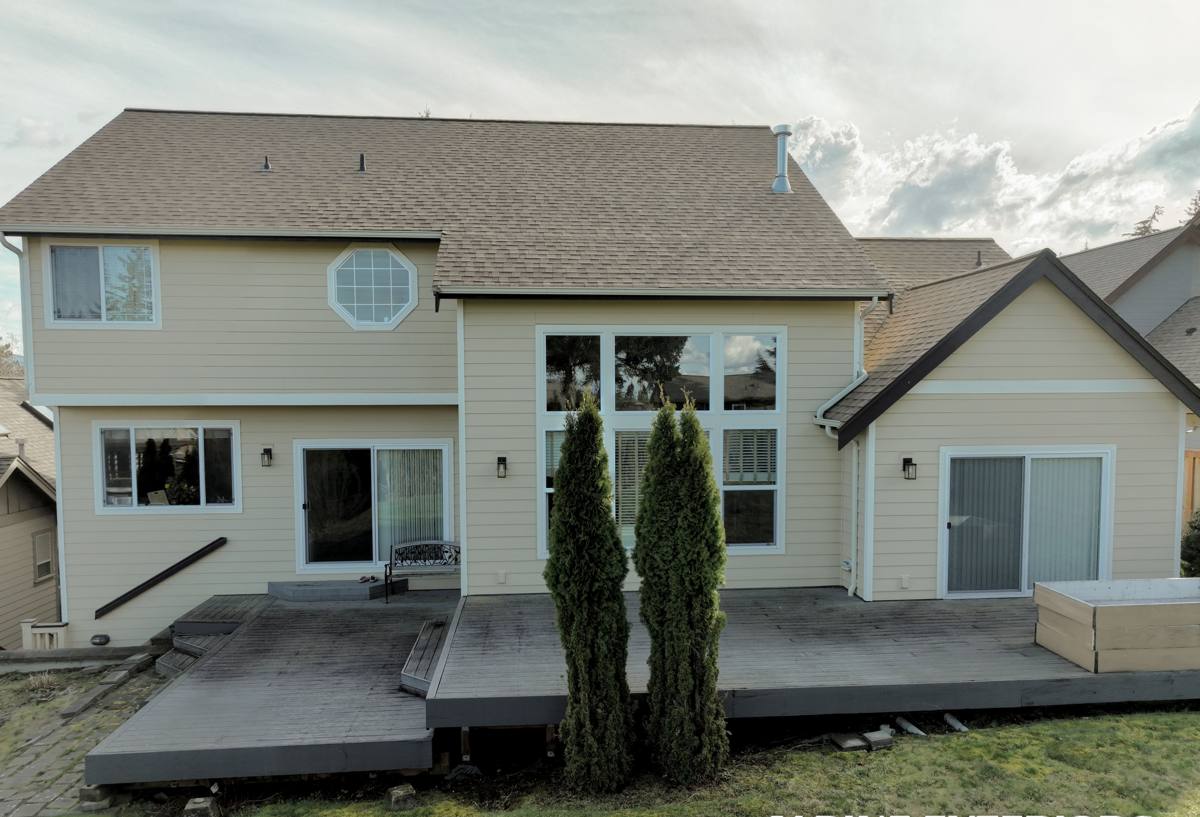
What Blaine's Climate Actually Does to a Deck
Salt Air
Persistent salt-laden air is one of the fastest ways to shorten the life of anything metal on a deck — screws, joist hangers, post brackets, and railing hardware all corrode faster here than they would twenty or thirty miles inland. The tricky part is that corrosion often starts inside a connection point long before it's visible on the surface, which means a deck can look sound while its structural fasteners are already losing holding strength.
Wind-Driven Rain
Rain in Blaine rarely just falls straight down — wind off the water pushes it sideways, driving moisture up under railings, into gaps between boards, and against the ledger connection where the deck ties into the house. A deck design that only accounts for rain falling vertically will shed water fine on a calm day and still trap it the moment wind gets involved, which in this area is most of the time.
A Long Moss Season
Mild, damp conditions give moss and mildew a growing season that runs most of the year in Blaine, and a horizontal deck surface is exactly the kind of surface moss favors — it holds moisture longer than a vertical wall and stays damp between storms. Shaded areas and north-facing sections of a deck are usually the first to show it, and any decking product with real surface porosity gives it something to hold onto.
What Holds Up a Deck Matters More Than What Sits on Top
Homeowners naturally focus on the decking boards when picturing a new deck, but in this climate the framing and connections underneath are what actually decide whether it lasts fifteen years or thirty. A correctly built deck for Blaine includes:
- Footings set to the proper depth for the site's soil and frost conditions, not a shortcut depth to save time
- Framing lumber rated for sustained ground or moisture exposure, sized correctly for the actual span and load
- Stainless steel or coated corrosion-resistant fasteners and joist hangers throughout — not standard interior-grade hardware
- Ledger board flashing done correctly where the deck attaches to the house, since that connection is one of the most common places water gets into the structure on a poorly built deck
- Board gapping sized for both drainage and material expansion, so wind-driven rain can actually drain and the surface can dry between storms
- Post and railing attachment sized for real wind exposure rather than a minimum-code assumption
- Grading and airflow underneath the deck so moisture doesn't sit trapped against the framing between rain events
None of that shows up in a walkthrough on day one — a deck built with shortcuts in any of these areas still looks fine when it's finished. The difference shows up two or three winters later, in a loose railing post, a soft joist, or rust stains bleeding through the decking boards above a corroding fastener.
Decking Material: What Actually Performs Here
Every decking material sold today can look good in a showroom. The differences that matter in Blaine show up after a few wet seasons of salt air, standing moisture, and moss pressure — and they show up faster here than in a drier, more sheltered part of the county.
| Material | Moisture & Salt Air Performance | Moss Resistance | Upkeep Required | Typical Lifespan |
|---|---|---|---|---|
| Cellular PVC | Excellent — contains no wood fiber to absorb moisture | Strong; smooth, non-porous surface | Occasional washing | 25+ years |
| Capped composite | Strong — cap layer resists moisture and staining | Good on most product lines | Occasional washing | 20-25 years |
| Uncapped composite | Moderate — some absorption at exposed fiber and cut edges | Fair; more prone to buildup over time | Periodic cleaning | 15-20 years |
| Cedar | Moderate — natural resistance, but needs regular sealing | Fair when sealed and maintained | Sealing or oiling every 1-2 years | 10-15 years |
| Pressure-treated wood | Weak against sustained salt exposure without upkeep | Poor without regular treatment | Sealing or staining every 1-2 years | 10-15 years |
Cost is usually the first question homeowners ask, and it's a fair one — wood costs less up front than composite or PVC. But in this climate, the maintenance and replacement cycle over ten or fifteen years often closes that gap, sometimes more than closes it, once you factor in sealing labor and materials versus a wash-down twice a year.
Railings, Stairs, and Permitting
Whatcom County's building requirements set the baseline for railing height, baluster spacing, and stair rail requirements on any elevated deck, and Blaine follows those same standards. Most new deck construction and many deck replacements require a permit, with the specific triggers depending on height above grade, size, and whether it's attached to the house. We handle that process as part of the job rather than leaving it for the homeowner to sort out on their own, and we design railings and stair details to actually hold up to the wind exposure a given lot sees, not just the minimum code allows.
Drainage and Design Choices That Keep Moss From Taking Hold
A deck's long-term moss resistance is decided as much by design as by material. Board orientation and gap width affect how quickly water sheets off versus pooling in low spots. Under-deck drainage systems can direct water away from the framing on a raised deck rather than letting it drip straight down onto joists and posts. Sun exposure and nearby landscaping matter too — a deck tucked under overhanging trees or shaded most of the day needs more moss-resistant material and more airflow underneath than one that gets sun most of the afternoon. These are decisions worth making at the design stage, because they're expensive and disruptive to fix after the deck is built.
How Our Process Works
- A site visit to look at existing conditions — grade, drainage, sun and wind exposure through the day, and condition of any structure being replaced
- A conversation about decking material, layout, and budget, matched to how the space will actually get used
- Design and permitting through Whatcom County, handled as part of the project rather than an extra step for the homeowner
- Construction in sequence — footings and framing first, sized and fastened for the site's real exposure, then decking, railings, and stairs
- A final walkthrough covering what the specific material chosen actually needs going forward, which is minimal for most modern decking but not nothing
What We Won't Skip
- Correct footing depth for the site's actual soil and frost conditions
- Corrosion-resistant fasteners and hardware rated for coastal exposure, not standard interior-grade hardware
- Proper ledger flashing at the house connection
- Board gapping and drainage detailing sized for wind-driven rain, not just vertical rainfall
- Railing and post attachment sized for the site's real wind exposure
Why Hiring a Crew That Already Works Blaine Matters
A builder who mostly works further inland in Whatcom County can still put together a competent deck, but Blaine's exposure brings up questions that don't come up as often elsewhere in the county — how much corrosion resistance the hardware actually needs, how a specific lot's wind exposure should shape railing and post design, and how long moss pressure realistically runs here compared to a more sheltered town. Working this area regularly means we've already seen which decking products and fastener grades hold up to Blaine's specific mix of salt air, driving rain, and moss, and which ones underperform their marketing once they've spent a few winters in it. That's the kind of judgment that only comes from doing the work here repeatedly, not from a spec sheet.
If you're planning a new deck, replacing one that's showing its age, or just want a straight answer about what a custom deck would take on your Blaine property, we're glad to walk the site with you and go over the options honestly. Reach out below for a free, no-pressure estimate.