 Lynden Siding
 Everson's Climate Is Harder on Siding Than Most Homeowners Realize
Everson sits along the Nooksack River in Whatcom County, close enough to Lynden that the two towns share almost identical weather — and that weather is not gentle on the outside of a house. This is a marine climate: long stretches of damp, overcast days, driving rain that comes in sideways off the wind, and a moss season that can run from fall through spring. Add in the salt-tinged air that moves inland off the Puget Sound region, and you have a combination that slowly works on siding in ways a drier climate never would.
None of that is dramatic on any single day. It's the accumulation that causes problems — moisture that never fully dries out between storms, organic growth that holds dampness against a wall, and coastal air that accelerates corrosion on fasteners and trim. A siding product that's merely "fine" in a mild climate can fail early here. A siding product that's engineered for exactly this kind of exposure holds up for decades. That difference is the entire reason we standardized on James Hardie fiber cement and don't install anything else.
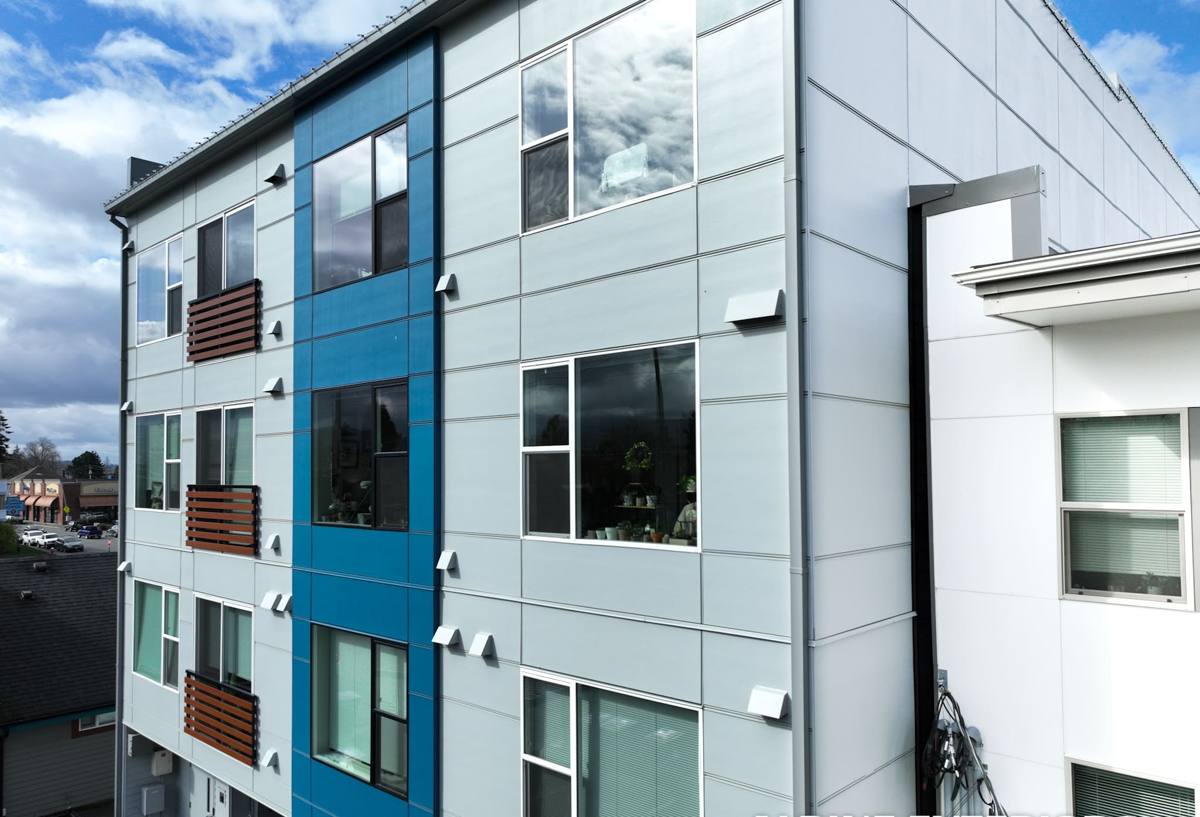
What Whatcom County Weather Actually Does to a Wall
It helps to be specific about the mechanism, not just the symptom.
Constant moisture load
Wood-based and wood-alternative sidings absorb some amount of water at seams, cut ends, and fastener penetrations. In a climate that dries out for months at a time, that moisture has a chance to escape before it causes damage. In Everson, the drying window is short and the wet season is long, so any product that isn't dimensionally stable and moisture-resistant starts to swell, cup, or delaminate at the weak points first.
Moss, algae, and organic growth
Shaded north walls, tree-lined lots, and the general dampness of the Nooksack valley area create ideal conditions for moss and algae to take hold on siding. Beyond the cosmetic issue, organic growth holds moisture directly against the surface of the siding, which is exactly the condition that causes rot in wood-based products and finish breakdown in cheaper composites.
Salt-influenced air and coastal wind
Whatcom County's proximity to Puget Sound and the Strait of Georgia means homes here deal with a mild but persistent salt component in the air, along with wind-driven rain during winter storms. Salt air accelerates corrosion of fasteners, flashing, and trim if those components aren't matched to the exposure, and wind-driven rain finds every gap in a siding system that wasn't installed with proper laps and flashing.
Why We Only Install James Hardie in This Area
James Hardie fiber cement is engineered specifically for regional climate exposure, and the company's HZ5 product line is built for exactly the marine, wet-winter conditions found throughout Western Washington. It's non-combustible, dimensionally stable when wet or dry, and finished with the factory-applied ColorPlus coating, which resists the fading and moisture intrusion that plague field-painted surfaces. We don't install LP SmartSide, vinyl, Cemplank, Allura, primed spruce, or cedar on Everson homes — not because those products can't be installed correctly somewhere, but because in this specific climate, the long-term maintenance burden and moisture risk of the alternatives don't match what Hardie delivers for a similar overall investment once you account for repainting cycles, repairs, and replacement timelines.
That's a professional standard we hold across every job we take in Whatcom County, and it's worth explaining plainly to homeowners rather than assuming they'll take it on faith.
What a Correct James Hardie Installation Involves
Fiber cement siding is only as good as the installation behind it. Hardie's own warranty terms are tied to installation matching their published specifications, and in a wet climate like Everson's, the details that get skipped on a rushed job are exactly the details that cause problems within a few years.
- Proper starter strip at the base of the wall so the first course sits correctly and sheds water outward
- Correct minimum clearance between siding and grade, decks, patios, and roof lines to prevent wicking
- Weather-resistant barrier installed and lapped correctly behind the siding, not just stapled up as an afterthought
- Flashing at every window, door, and roof-to-wall intersection — the single most common source of hidden water intrusion
- Correct fastener type, spacing, and depth, since over-driven or under-driven nails compromise both the seal and the warranty
- Proper gapping and caulking at butt joints and trim, sized for the specific product's expansion behavior
- Field-cut edges primed or sealed so cut ends don't become the first failure point
Every one of these steps matters more in Everson than it would in a dry climate, because a small installation shortcut that would take years to show up somewhere arid can show up in a single wet winter here.
Our Process for an Everson Job
We keep the process straightforward because a homeowner shouldn't have to guess what's happening to their house.
- On-site assessment: We walk the home, check the current siding and sheathing condition, and look specifically for moisture damage around windows, decks, and roof lines — the areas Whatcom County weather targets first.
- Written estimate: A clear scope covering product line, color, trim details, and any sheathing or moisture repair the assessment turns up, so there are no surprises mid-project.
- Prep and moisture barrier: Removal of failing material, repair of any water-damaged sheathing found underneath, and correct installation of the weather-resistant barrier before a single piece of siding goes up.
- Installation to spec: Hardie panels or planks installed with the clearances, flashing, and fastening called for by the manufacturer, not shortcuts to save a day of labor.
- Final walkthrough: A joint inspection so the homeowner sees the finished detailing — caulking, trim lines, flashing — before we call the job done.
Cost Factors for a James Hardie Project in Everson
Every home is different, but the variables that move the price on a Hardie project here are consistent enough to explain in general terms.
| Factor | Why It Affects Cost | What to Ask About |
|---|---|---|
| Existing wall condition | Rotted sheathing or trim found during tear-off adds repair work before new siding goes on | Whether the estimate includes an allowance for hidden damage, and how it's billed if found |
| Product line and profile | Lap, shingle, and panel profiles differ in material and labor cost; ColorPlus finishes cost more than primed-for-paint options but skip a repaint cycle | Which HZ5 product line is being quoted and why it fits this climate |
| Trim and detail work | Corner boards, window trim, and fascia detailing add labor time relative to a simple field-only install | Whether trim material and profile are specified, not just "included" |
| Home height and access | Multi-story walls and tight lot access increase scaffolding, staging, and labor time | How access and staging are factored into the bid |
| Moisture barrier and flashing scope | Full barrier replacement and correct flashing at every penetration take more time than a surface-level reside | Whether the weather-resistant barrier is being replaced, not reused |
Why Hiring a Crew That Already Works in Everson Matters
A siding crew that regularly works Whatcom County jobs already knows the local permitting expectations, has already dealt with the same drainage and moisture patterns on other homes in the Nooksack valley area, and isn't learning the region's weather behavior on your project. That familiarity shows up in small but real ways: knowing which details of a wall assembly need extra attention given the local rain patterns, having a working relationship with the local building department, and being available for a warranty callback without a long drive from out of the area.
It also matters for something homeowners don't always think to ask about: a contractor's post-installation availability. Fiber cement siding is a long-term investment, and if a caulking joint needs touch-up in year six or a piece of trim gets damaged by a storm, you want a crew that's still working in Lynden and Everson, not one that did a single job in the area and moved on.
Questions Worth Asking Before You Hire
- Do you install James Hardie exclusively, or do you also install products you'd steer me away from if I asked directly?
- Will you check the sheathing and framing for existing moisture damage before quoting the job, or only after tear-off begins?
- What clearance will the siding have from grade, decks, and roof lines, and how will that be handled where the lot doesn't allow much room?
- Is the weather-resistant barrier being replaced as part of this job, or reused?
- How do you handle flashing at windows and roof-to-wall intersections specifically?
- What does the workmanship warranty cover, separate from the manufacturer's product warranty?
What Correct Siding Buys You Long-Term
Installed to spec, James Hardie fiber cement is built to handle decades of the exact conditions Everson sees every year — sustained dampness, moss and algae exposure, and coastal-influenced wind and rain — without the swelling, delamination, or repaint cycles that come with less climate-matched materials. The ColorPlus finish is designed to hold its color far longer than field-applied paint, which matters in a climate where a fresh paint job doesn't stay fresh for long. Combined with a correctly installed moisture barrier and flashing system, the result is a wall assembly that's doing its job quietly in the background for a very long time, which is exactly what you want from something as unglamorous and essential as siding.
If you own a home in Everson and want a straight answer about what your current siding is doing and what correctly installed James Hardie siding would look like on your house, we're happy to come take a look. There's no pressure and no charge for the estimate — just a clear, honest assessment from a crew that already works this area.