 Lynden Siding
 Nooksack's Climate Is Harder on a Roof Than It Looks
Nooksack sits in the Nooksack River valley just outside Lynden, and like the rest of Whatcom County it spends a good chunk of the year under low clouds, steady drizzle, and the kind of driving rain that comes sideways during a winter front. That marine-influenced air carries real moisture and, on the stronger winter systems, salt blown inland off the Strait of Georgia. None of that is dramatic on any single day. The damage comes from repetition — roofs here get wet, dry slowly, and get wet again for months at a stretch.
Add a long moss season that can run from fall through spring, and you have a set of conditions that will find every weak point in a shingle roof: thin or missing underlayment, a nailing pattern that was rushed, ventilation that never lets the attic breathe, flashing that was caulked instead of properly lapped. A roof that would hold up fine in a drier climate can start showing problems in Nooksack within a few years if it wasn't built for these conditions from the start.
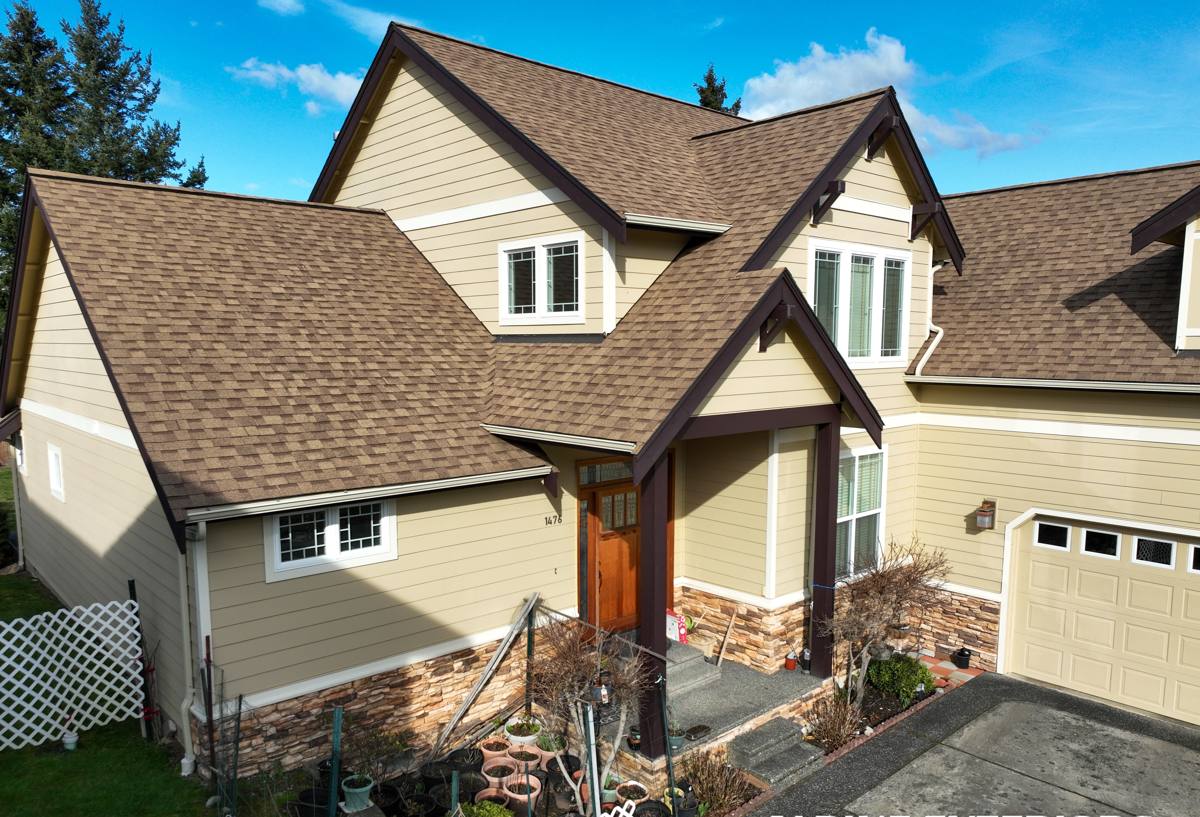
What Actually Goes Wrong With Asphalt Shingle Roofs Here
We see the same handful of failure patterns on Nooksack homes, almost all of them traceable back to installation shortcuts or a roof that's simply reached the end of what it can handle in this climate.
- Moss colonizing the shingle mat. Moss doesn't just sit on top of a roof — its rhizoids work under shingle tabs and lift them, breaking the seal and giving wind-driven rain a path underneath.
- Algae streaking on north-facing slopes. Shaded, slow-drying sections develop dark streaking that's cosmetic at first but signals a surface that's staying damp longer than it should.
- Nail pops and cracked shingles. Repeated wet-dry and freeze-thaw cycles work fasteners loose over time, especially where the original nailing pattern was too high or too sparse.
- Flashing failures at valleys, chimneys, and skylights. These are the highest-water-volume points on any roof, and they're the first place a sealant-only repair fails once the caulk shrinks and cracks.
- Ice damming during cold snaps. Whatcom County doesn't get deep snow every winter, but the freeze-thaw swings that do happen can back water up under shingles at the eaves if there's no ice-and-water membrane there.
What a Correctly Installed Shingle Roof Includes
A shingle roof is a system, not a single product, and in a climate like this every layer of that system is doing real work. When we build or replace a roof, the components below aren't upgrades — they're the baseline for a roof that's actually built for Nooksack weather.
- Ice-and-water shield at eaves, valleys, and around penetrations — the self-adhering membrane that stops water intrusion where volume and vulnerability are both highest.
- Synthetic underlayment across the full deck — a secondary water barrier that outperforms old felt paper and holds up better through a long, wet install season.
- Proper starter strip along eaves and rakes — prevents wind uplift at the edges, which is where most shingle blow-off starts.
- Correct nailing pattern and fastener count — matched to the shingle manufacturer's spec, not a generic pattern, so the seal strip activates and holds.
- Step and counter flashing, not just sealant — properly lapped metal at every wall, chimney, and skylight intersection.
- Balanced intake and exhaust ventilation — soffit vents pulling air in, ridge or roof vents letting it out, so the attic isn't trapping moisture against the underside of the deck.
Ventilation Matters More Here Than Most Places
A poorly ventilated attic is a slow-motion problem anywhere, but in a climate that's damp for most of the year it accelerates almost everything else on this list. Trapped moisture condenses on the underside of the roof deck, shortens the life of the shingles from beneath while weather works on them from above, and creates the cool, damp microclimate that moss and algae thrive in. When we inspect an older Nooksack roof, undersized or blocked ventilation is one of the first things we check, because it's often the real reason a roof is aging faster than its shingles alone would suggest.
Choosing Shingles for a Damp, Moss-Prone Climate
Not every asphalt shingle is built the same way, and in this climate the difference matters more than the price tag suggests. Algae-resistant shingles use copper or zinc granules blended into the surface that discourage algae growth over time — worth the modest upcharge on almost any roof in this area, especially shaded slopes. Architectural (dimensional) shingles are also heavier and more wind-resistant than basic three-tab shingles, which matters through winter storm season.
| Shingle Type | Typical Lifespan | Moss/Algae Resistance | Best Use Case |
|---|---|---|---|
| 3-Tab Asphalt | 15–20 years | Standard (no built-in resistance) | Budget-conscious re-roofs, secondary structures |
| Architectural (Dimensional) | 25–30 years | Standard, unless algae-resistant version selected | Most Nooksack homes — better wind and impact performance |
| Algae-Resistant Architectural | 25–30 years | Enhanced — copper/zinc granules slow algae growth | Shaded roofs, north-facing slopes, tree-covered lots |
| Impact-Rated Architectural | 25–30+ years | Enhanced (when combined with algae-resistant granules) | Homeowners prioritizing durability and possible insurance credit |
We'll walk through which option fits your roof's exposure, slope, and budget rather than defaulting to one product for every job. A steeply pitched, mostly sunny roof has different needs than a shaded, low-slope section over a porch.
Signs Your Roof Needs a Closer Look
Most roofing problems in this climate develop slowly, which is exactly why they're easy to miss until they've caused deck damage or an interior leak. Worth checking for, or having us check for you:
- Visible moss growth, especially in the shaded valleys or on the north slope
- Dark streaking that doesn't wash off with normal rain
- Granules collecting in gutters or at downspout outlets
- Shingle edges that look curled, cupped, or lifted
- Soft or spongy spots when walked (we check this, not a DIY step)
- Daylight visible through the roof deck from inside the attic
- Water stains on ceilings or in the attic after a heavy rain event
- A roof that's 18–20+ years old and has never had underlayment or flashing replaced
Our Process for a Nooksack Roofing Project
- On-site inspection. We look at the shingles, flashing, ventilation, and — where accessible — the attic and deck, not just the surface.
- Honest assessment. We tell you whether you're looking at a repair, a partial replacement, or a full tear-off, and why.
- Written estimate. Materials, scope, and timeline laid out clearly before any work starts.
- Tear-off and deck check. Old roofing comes off down to the deck, and we inspect the sheathing for rot or soft spots before anything new goes down.
- System installation. Ice-and-water shield, underlayment, flashing, shingles, and ventilation components installed to manufacturer spec.
- Site cleanup. Magnetic nail sweep and full debris cleanup before we consider the job done.
- Final walkthrough. We review the finished roof with you and answer any questions before we leave.
Maintenance Through a Long Moss Season
Even a well-built roof benefits from periodic attention in this climate. Moss and algae growth is much easier to manage early than to remove once it's established under the shingle tabs. A few habits go a long way: keep gutters clear so water isn't backing up under the eave line, trim back overhanging branches that keep sections of roof shaded and slow to dry, and have moss physically removed rather than pressure-washed, since aggressive washing can strip granules and shorten shingle life. Chemical moss treatments applied correctly can slow regrowth between cleanings. If you're not sure whether your roof needs attention or just needs monitoring, a quick inspection is a lot cheaper than finding out through a ceiling stain.
Cost Factors to Know Before You Get a Quote
Every roof is different, and we won't quote a number without seeing yours, but these are the main variables that move the price up or down.
| Factor | Why It Affects Cost |
|---|---|
| Roof size and number of planes | More square footage and more valleys/hips mean more material and labor time |
| Current layers and tear-off scope | Removing existing layers down to the deck costs more than a single-layer tear-off |
| Deck condition | Rotted or soft sheathing found during tear-off needs replacement before new roofing goes on |
| Shingle grade selected | Algae-resistant and impact-rated products cost more upfront but reduce maintenance and reroofing frequency |
| Roof pitch and access | Steep or hard-to-access roofs take longer and require more safety setup |
| Ventilation upgrades needed | Adding or correcting soffit and ridge ventilation is a smart investment but adds to scope |
Why It Matters to Hire a Crew That Already Works This Area
A roofing crew that works Nooksack and the greater Lynden area regularly isn't guessing at how to spec a roof for this climate — we've seen how moss builds up on shaded valleys here, how driving winter rain finds gaps in flashing, and how a roof with weak ventilation ages compared to one that was built right. That familiarity shapes real decisions: which underlayment goes down first, where ice-and-water shield gets extended, how much attic ventilation a given roof actually needs. It also means we're not learning Whatcom County's permitting requirements or weather patterns on your project — that groundwork is already done, so the focus stays on the roof itself.
If your roof is showing early signs of wear, due for replacement, or you just want an honest read on where it stands, we're happy to take a look. Use the form below to request a free, no-pressure estimate.