 Lynden Siding
 Why Storm Damage Hits Sumas Roofs Differently
Sumas sits right where the Fraser Valley narrows down and funnels into Whatcom County. That geography matters more than most homeowners realize. When cold air builds up over British Columbia's interior, it pushes through that gap and picks up speed on the way down — the result is wind gusts in and around Sumas that can run noticeably harder than what's happening a few miles south in Lynden or Bellingham. Add in driving rain that comes in sideways during these events, and you've got a combination that finds every weak point in a roof system: lifted shingle tabs, stressed flashing, and fasteners that back out under repeated flexing.
Between wind events, Sumas roofs deal with the same long, wet stretch that defines this part of Whatcom County — moss season that can run from fall through spring, and a steady dose of marine-influenced humidity drifting in off Puget Sound and the Strait of Georgia. That moisture-and-moss combination doesn't cause the dramatic damage a windstorm does, but it quietly softens sheathing and lifts shingle edges, which is exactly what turns a minor storm event into a real leak.
The point isn't to scare anyone about their roof — it's that "storm damage" here rarely shows up as one clean, obvious event. It's usually wind damage landing on a roof that was already a little compromised by moss and moisture, and the repair needs to account for both.
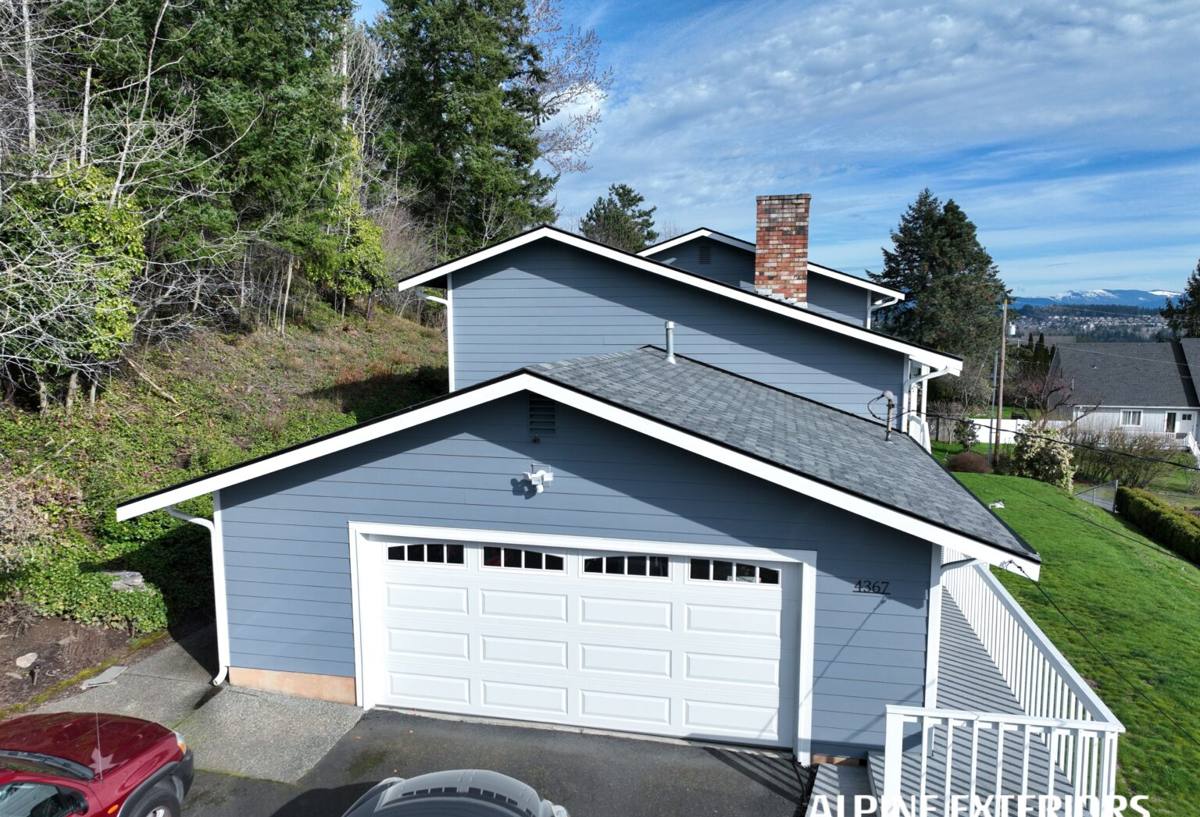
What Actually Counts as Storm Damage
Not every roof problem after a windy night is storm damage, and not every storm produces damage you can see from the ground. Here's how we sort it out:
- Wind-lifted or missing shingles — tabs that have cracked their sealant strip and popped up, or shingles torn off entirely, usually along ridges, edges, and any place the roof plane changes.
- Flashing damage — bent, loosened, or torn flashing around chimneys, vents, and valleys, often from wind working it back and forth rather than a single impact.
- Impact damage — dents, punctures, or torn shingles from branches or debris carried by wind.
- Granule loss — heavy rain and wind can strip protective granules off shingles that were already aging or moss-weakened, leaving bare asphalt exposed.
- Underlayment and decking exposure — once shingles are gone or lifted, the layer underneath is exposed to the next rain event, which is where a small storm problem turns into a real leak fast.
Moss buildup, slow granule wear from age, and gutters that were already failing aren't storm damage on their own — but they're almost always part of the story when we get called out after a windstorm, because they're what let the wind do more damage than it otherwise would have.
What a Correct Storm Damage Repair Involves
It starts with an honest inspection, not a patch job
A rushed repair covers the visible damage and calls it done. A correct one checks the decking underneath for soft spots or water staining, traces flashing runs to see if the damage is isolated or part of a bigger failure, and looks at the surrounding shingles — because wind damage often extends a few feet past what's obviously torn or missing.
Matching materials matters more than people expect
Shingle repairs should use matching or close-matching product in both style and, where possible, color batch. Mismatched patches aren't just a cosmetic issue — different shingle generations can have different profiles and seal differently, which creates a new weak point right at the repair edge.
Flashing and underlayment get replaced, not just re-sealed
Caulking over damaged flashing is a short-term cover-up. A correct repair replaces compromised flashing and underlayment in the affected area so the fix actually sheds water the way the original system was designed to.
The repair gets checked against the rest of the roof
If the storm damage exposed a roof that's otherwise near the end of its service life, moss-thinned, or has multiple failing sections, we'll say so plainly. Sometimes the honest answer is a targeted repair; sometimes it's telling you the repair is a stopgap and a fuller conversation about the roof's remaining life makes sense.
How Our Process Works
- Call or request an inspection. We'll ask what you noticed — a leak, missing shingles you can see from the ground, debris on the roof — and get out to look at it.
- On-site assessment. We inspect the damaged area and the surrounding roof, check attic access for water intrusion if there's any indication of a leak, and document what we find.
- Written scope and straight answer on repair vs. replacement. You get a clear explanation of what's damaged, what needs to happen, and why — not just a number.
- Repair work. Matching materials, proper flashing and underlayment where needed, and a cleanup that doesn't leave nails and torn shingle scraps in your yard or gutters.
- Final walkthrough. We show you what was done and what to watch for going forward, especially if moss or an aging roof surface was part of what let the damage happen.
Repair or Replace? What Actually Drives That Decision
| Factor | Leans Toward Repair | Leans Toward Replacement |
|---|---|---|
| Extent of damage | Isolated to one section or slope | Multiple sections or scattered across the roof |
| Roof age | Under roughly 10–12 years | Near or past typical shingle service life |
| Decking condition | Solid, dry sheathing under the damage | Soft spots or rot found during inspection |
| Moss history | Light, well-maintained | Heavy moss with shingle lifting in multiple areas |
| Material availability | Matching shingle still obtainable | Discontinued color/style, patch would visibly mismatch |
Most storm calls we get in Sumas are legitimate repairs — the roof was sound, wind or debris caused localized damage, and a proper fix solves the problem. Replacement only makes sense to recommend when the damage exposes a roof that was already close to the end of its usable life.
Why a Crew That Already Works Sumas Makes a Difference
A roofer who's worked storm damage across Whatcom County, and specifically in and around Sumas, has a feel for how wind behaves through this part of the valley — which roof orientations tend to take the worst of it, where flashing tends to fail first, and how moss and moisture from this climate interact with wind damage. That's not something you can fully substitute with a general inspection checklist.
There's also a practical side: a local crew can typically respond faster after a wind event, which matters when a roof is exposed to the next rain system. And when insurance is involved, a contractor who's documented storm damage in this specific area before knows what adjusters typically want to see and how to present it clearly.
What to check after a storm (safely, from the ground)
- Shingle pieces or granules collecting in gutters, downspouts, or on the ground
- Visible gaps, curling, or missing shingles when viewed from a safe distance
- Bent or displaced flashing around chimneys and vents
- New or worsening water stains on interior ceilings, especially near exterior walls
- Branches or debris resting on the roof
- Gutters pulling away from the fascia or sagging under debris weight
Never get on the roof yourself after a storm to inspect it — wet, moss-covered, or wind-damaged roofing is genuinely dangerous underfoot. If you see any of the above, that's the point to call for an inspection rather than climbing up to look closer.
Working With Insurance on Storm Claims
When damage is significant enough to involve a homeowner's insurance claim, documentation matters. We provide clear photos of the damage, a written description of what happened and what it will take to repair, and we're available to talk through the scope with an adjuster if that's useful. We won't inflate a scope to pad a claim, and we won't downplay real damage to make a job simpler — the goal is an accurate picture so the repair actually gets covered and actually gets done right.
Reducing the Next Storm's Impact
Because Sumas roofs face this wind-and-moisture combination repeatedly rather than as a one-time event, a few maintenance habits go a long way between storms:
- Keep moss growth controlled — a moss-softened shingle edge is far more likely to lift in wind than a clean one
- Clear gutters and downspouts before the wet season so water isn't backing up under the roof edge during a storm
- Trim back branches that hang over the roofline so they're not a wind-driven impact hazard
- Have an aging roof looked at before storm season rather than after damage forces the issue
None of this eliminates storm risk — you can't control the Fraser Valley outflow winds or a wet Whatcom County winter — but it reduces how much damage a given storm can actually do.
If a recent windstorm left you with missing shingles, a new leak, or just some peace of mind you'd like to have, we're happy to take a look. Fill out the form below for a free, no-pressure estimate — we'll give you a straight answer on what happened and what it takes to fix it.