 Lynden Siding
 Aldergrove sits in the Township of Langley, just north of the border, close enough to Lynden that a lot of homeowners there already recognize our trucks from other jobs in the area. The Aldergrove–Lynden border crossing puts the two towns only minutes apart, and the houses on both sides of that line deal with the same weather system, the same kind of open farmland and windbreak-dependent lots, and the same mix of older farmhouses sitting next to newer construction. Windows are where all of that weather actually meets the inside of the house, and a window that's installed or flashed even slightly wrong shows it faster here than it would somewhere drier.
We do window replacement and repair for homes throughout the Lynden area, and that service area has always included Aldergrove — it's a short drive across the border, not a special trip. We treat window work as installation-first, not product-first. A quality window with a rushed flashing job will leak in this climate. A modest window installed correctly, with the sill, jambs, and head flashing done right, generally won't. That distinction matters more here than the brand name on the frame.
Why Aldergrove Homes Need Window Replacement Done Right
A few patterns show up consistently in this area. Older farmhouses and acreages around Aldergrove often still carry original wood-framed windows, single- or early double-pane, that were never built for the sealed-glass performance standards homes are held to today. Additions and renovations create openings that don't match the original construction, which means a straightforward swap isn't always possible without some reframing. And newer builds in the area increasingly use larger window openings for light and views, which raises the stakes on flashing since there's simply more perimeter and more glass area exposed to wind-driven weather.
None of that makes a project unusual — it's routine work for a crew that's used to this corridor. It does mean the job usually starts with an honest look at the existing opening and the wall assembly behind it, not just a quote based on window count and size.
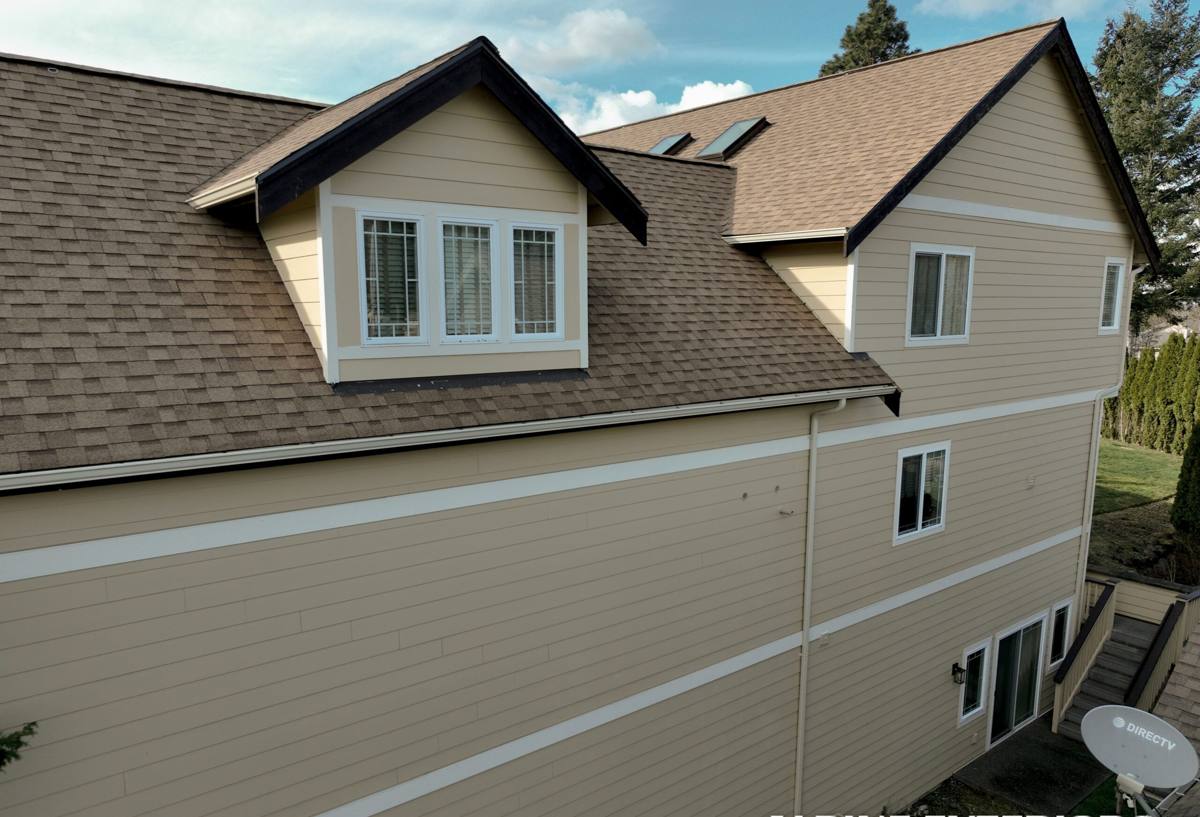
The Climate Factor: What Aldergrove Windows Face Year-Round
Aldergrove is well inland from open salt water, so homes here don't take the direct spray a waterfront property closer to Boundary Bay or the Strait of Georgia would. What they do get is the same marine-influenced weather system that shapes exterior work across the whole Fraser Valley and Whatcom County corridor — moist air pushed inland off the coast, rain that arrives sideways more often than straight down, and a mild, wet stretch of the year long enough that moss and mildew get a real head start on any surface that stays shaded or damp.
Marine Air and Hardware Corrosion
Even away from the immediate coastline, salt-carrying air moves through this valley regularly, and it accelerates corrosion on window hardware, screen frames, and lower-grade fasteners over years of exposure. It's usually the cheapest components that show it first — stiff hinges, pitted latch hardware, tracks that don't slide the way they used to.
Driving Rain and Flashing Failures
Storms in this part of the valley tend to push rain sideways into window openings rather than letting gravity do the work. That's a test of the installation, not the window itself. A sill pan that isn't pitched to shed water outward, or head flashing that isn't lapped correctly into the housewrap above it, will let water in eventually no matter how good the window is. Most of the water damage we find around older windows traces back to a flashing detail that was never right, not the window failing on its own.
Long Moss Season and Sill Rot
Shaded elevations and sills that don't drain well stay damp longer here than they would in a drier climate, and that sustained moisture feeds moss and mildew growth and, on wood-framed windows, slow rot at the sill and lower corners. It's gradual — most homeowners don't notice until paint starts failing or a sill feels soft underfoot, by which point the damage has usually been building for a while.
Signs Your Windows Are Due for Replacement, Not Repair
- Fogging or condensation trapped between panes, which means a failed seal on a double- or multi-pane unit
- A window that's noticeably drafty or cold to stand near even when it's fully closed and latched
- Soft, discolored, or spongy wood at the sill or lower frame corners
- Windows that are difficult to open, close, or lock, especially compared to how they operated a few years ago
- Peeling paint or bubbling finish concentrated around the window rather than the wall generally
- Visible daylight, gaps, or cracked caulk around the frame when viewed from inside
- Water staining on the wall or ceiling near a window after a heavy rain
One or two of these on their own can often be handled with a repair or reseal. Several of them together, especially on an older home with original windows, usually point to a replacement plan being the more honest recommendation.
What a Correct Window Replacement Job Involves
On-Site Assessment
We start by looking at the actual openings, not just counting windows off a floor plan. That means checking for square and level, looking at the condition of the framing and any existing flashing, and noting anything specific to the house — an original farmhouse window that predates standard sizing, an addition where the opening was never quite finished right, a wall orientation that takes the brunt of prevailing wind and rain.
Full-Frame vs. Insert Replacement
One of the first real decisions is whether to do an insert replacement, which fits a new window into the existing frame, or a full-frame replacement, which removes everything down to the rough opening and rebuilds the flashing from scratch. Insert replacement is faster and less disruptive, and it's the right call when the existing frame is sound and was properly flashed to begin with. Full-frame costs more and takes longer, but it's the honest answer once there's already moisture damage at the sill or jambs, or when the original flashing was never done correctly.
| Factor | Insert Replacement | Full-Frame Replacement |
|---|---|---|
| Speed | Faster, less disruption to siding and trim | Slower, more involved around the opening |
| Best fit | Sound, properly flashed existing frame | Existing moisture damage or flashing that was never right |
| Flashing | Relies on the existing flashing being intact | Rebuilt from scratch, tied into the wall assembly |
| Cost | Lower | Higher, but resolves the underlying issue |
Flashing and Weatherproofing
This is the step that decides whether a window performs for decades or starts leaking within a few wet seasons. A sill pan pitched to shed water outward instead of letting it pool, head flashing lapped correctly into the housewrap above the opening, jamb flashing tied into the surrounding wall rather than relying on caulk alone, and weep holes left clear rather than sealed shut during installation — none of it adds meaningfully to the cost of the job relative to the window itself, and all of it is what actually earns the window its expected lifespan in this climate.
Trim and Finish Integration
Once the window is set and flashed, the exterior trim needs to tie back into the surrounding siding cleanly, whether that's matching an older farmhouse's existing trim profile or finishing a newer build to look intentional rather than patched. We plan that step before the old window ever comes out, so there isn't a scramble to match materials partway through the job.
Frame Materials Worth Considering for This Climate
There's no universal right answer — budget, how long you plan to stay in the home, and how exposed a given wall is to wind and rain all factor in. What's worth understanding upfront is how each frame material actually behaves under sustained valley moisture rather than what a spec sheet promises.
| Frame Material | Moisture & Corrosion Behavior | Typical Maintenance | Realistic Lifespan Here |
|---|---|---|---|
| Vinyl | Won't rot; performance depends heavily on installation quality at seams and welds | Low | 20-30 years |
| Fiberglass | Dimensionally stable, holds up well to sustained moisture | Low | 30-40+ years |
| Wood, painted or clad | Attractive but vulnerable at joints and sills without diligent upkeep | Higher; regular finish maintenance | 15-30 years depending on care |
| Aluminum | Conducts cold and can corrode over time in marine-influenced air unless well-finished | Moderate | 20-30 years |
We'll walk through which of these fits your specific home and budget rather than defaulting to whatever's easiest to install. A shaded, north-facing wall on an older Aldergrove farmhouse and a sun-exposed wall on a newer build a mile away don't always call for the same answer.
Our Process, Start to Finish
- Assessment and quote — we look at the actual openings, discuss insert versus full-frame, and give you an honest, itemized quote before any commitment
- Scheduling across the border — for Aldergrove jobs, we plan the crew's day around the crossing and confirm materials and equipment are sorted ahead of time, so the job runs on the same timeline as work on the Lynden side
- Removal and opening prep — the old window comes out carefully, and any hidden framing or flashing issues get addressed before the new one goes in, not discovered after
- Installation and flashing — the new unit is set, shimmed level and square, and flashed to a sequence built for this climate, not a generic manufacturer minimum
- Trim and finish — exterior trim is matched to the surrounding siding and architecture
- Walkthrough — we go over the finished work with you before we call the job done
Why a Crew That Already Works the Aldergrove–Lynden Corridor Matters
Manufacturer installation guidance is written for average conditions in a moderate climate. Homes around Aldergrove rarely get that — the driving rain, the marine-influenced air, and the long wet season here all push harder on flashing and hardware than a generic install sheet accounts for. A crew that's actually done this work on both sides of the border knows which details are worth extra time even when they're not strictly required, and which shortcuts show up as a callback two winters later instead of never.
What Cross-Border Logistics Actually Involve
Serving homes on both sides of the Aldergrove–Lynden crossing isn't complicated, but it does take a crew that's comfortable with the basics of it — scheduling around crossing times so a job doesn't lose half a day, having materials and paperwork sorted before the crew shows up, and communicating clearly about how those logistics affect your specific timeline. We're glad to walk through exactly what that looks like for your project when we come out to quote it, rather than leaving it as a vague afterthought.
- Ask to see examples of work actually done in Aldergrove or the immediate area, not just a general service radius claim
- Ask how they sequence flashing for your specific window type and wall orientation
- Get a written, itemized quote before committing to anything
- Ask how scheduling and logistics work for a job on your side of the border
- Confirm what's covered under warranty — the window unit and the installation labor are usually separate
If your Aldergrove home has windows that are drafty, fogging, hard to operate, or original to a much older house, we're glad to take a look and give you a straightforward read on what it actually needs. Use the form below to schedule a free, no-pressure estimate.