 Lynden Siding
 Siding That Has to Work in Abbotsford's Climate, Not Just Look Good on Install Day
Abbotsford sits in the Fraser Valley, close enough to the Salish Sea and just across the border from our home base in Whatcom County that homes here deal with the same weather pattern we've been building against for years: damp air moving in off the water, long stretches of driving rain through fall and winter, and short, cool summers that never fully dry things out before the next system rolls in. Add a heavy moss season most of the year, and you have a climate that is genuinely hard on exterior siding — not because any one storm is severe, but because the exposure is relentless and year-round.
That combination punishes siding differently than a hot, dry climate would. It's not one big failure — it's slow, cumulative moisture intrusion, coating breakdown, and organic growth that most homeowners don't notice until trim boards are soft or paint is peeling in sheets. Choosing the right siding material and installing it correctly the first time matters more here than in most parts of the country.
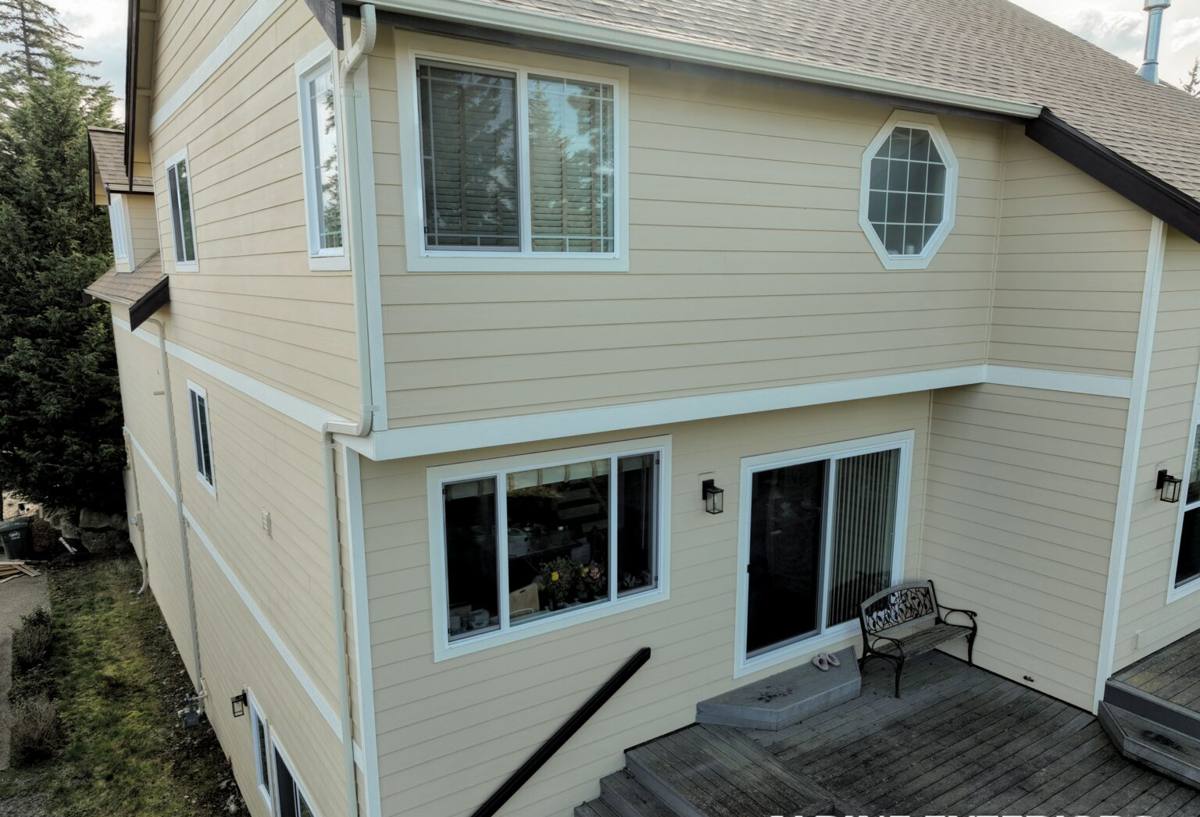
What Salt Air, Rain, and Moss Actually Do to Siding
Salt Air
Even at a distance from open saltwater, salt-laden air carried inland accelerates corrosion of fasteners, flashing, and any exposed metal trim. Over years, this can compromise the very hardware holding siding in place, especially on materials that weren't engineered with corrosion-resistant fastening in mind.
Driving Rain
Wind-driven rain doesn't just fall — it gets pushed sideways and upward into laps, seams, and butt joints. Siding systems with weak seams, poor lap coverage, or inadequate house-wrap detailing behind them will eventually let water past the face material, where it does the real damage: rot in sheathing, mold behind the wall assembly, and stains that bleed through the finish.
Moss and Organic Growth
A long moss season means anything that stays damp for extended periods becomes a growth surface. Wood-based siding and trim are especially vulnerable, since moss and algae hold moisture against the surface and accelerate decay. Even factory-finished products need a surface that resists organic growth and a finish that doesn't chalk or degrade quickly under constant damp exposure.
Why We Install Only James Hardie Fiber Cement
We made a deliberate decision as a company to install James Hardie fiber cement siding exclusively. We don't install vinyl, LP SmartSide, Cemplank, Allura, primed spruce, or cedar — not because those products have no merit, but because after years of exterior work in this exact climate, we concluded that Hardie's engineered fiber cement gives homes in this region the best combination of moisture resistance, durability, and long-term appearance retention.
Fiber cement is non-combustible, which matters for fire risk and insurance considerations, and it doesn't rely on a plastic substrate that can warp, buckle, or fade the way vinyl does under UV and temperature swings. Unlike raw or primed wood, it doesn't provide the same food source and moisture-holding surface for moss and mildew. James Hardie's ColorPlus factory-applied finish is baked on under controlled conditions, which gives a more consistent, fade-resistant coating than field-applied paint — a real advantage in a climate where repainting is disruptive and expensive to schedule around the rain.
James Hardie also engineers specific product formulations for different climate zones through its HZ5 line, designed for the freeze-thaw and moisture conditions common to the Pacific Northwest. That's a level of climate-specific engineering that the other materials we've moved away from simply don't offer.
How James Hardie Compares to the Alternatives
| Material | Moisture Behavior | Moss/Algae Resistance | Finish Longevity |
|---|---|---|---|
| James Hardie Fiber Cement | Dimensionally stable; won't swell or rot from moisture exposure | Resists organic growth better than wood-based products | Factory ColorPlus finish, long warranty period |
| Vinyl | Doesn't absorb water, but seams and laps can allow water behind panels | Moderate; can host mildew in grooves and overlaps | Color is through-body but fades and chalks over time; can warp in heat |
| LP SmartSide (Engineered Wood) | Wood-based; vulnerable to swelling and edge deterioration if seals fail | Requires intact coating to resist moisture-driven decay | Field or factory finish; edges are a common failure point |
| Cedar / Primed Spruce | Natural wood; absorbs moisture readily without diligent maintenance | Susceptible to moss, algae, and rot without regular treatment | Requires recurring painting or staining, especially in wet climates |
The James Hardie Product Lines We Use in This Region
Not every Hardie product is right for every part of a house. Matching the right profile to the right application is part of doing the job correctly.
- HardiePlank Lap Siding — the standard field siding for most walls; available in smooth and cedar-textured finishes, installed with proper lap coverage and fastener placement to shed wind-driven rain.
- HardiePanel Vertical Siding — used for accent walls, gables, or a more modern look, installed over furring or battens with correctly detailed seams.
- HardieShingle — staggered or straight-edge shingle profile for accent areas or full facades where a traditional shingle look is wanted, without the moisture vulnerability of cedar shingles.
- HardieTrim — fiber cement trim boards for corners, window and door casings, and fascia, matched to resist the same moisture exposure as the field siding.
What a Correct Installation Involves
James Hardie siding performs well when it's installed to the manufacturer's specifications — and performs poorly when it isn't. Most of the siding failures we get called out to inspect trace back to installation shortcuts, not the material itself. In a climate with this much sustained rain exposure, the details behind the siding matter as much as the siding itself.
- Weather-resistant barrier installed and lapped correctly behind the siding, with all penetrations properly flashed
- Correct minimum clearances from grade, roofing, decks, and other transitions to prevent water wicking
- Proper lap coverage on horizontal siding to shed water even under wind-driven rain
- Fasteners placed per manufacturer spec — correct type, spacing, and depth to avoid over-driving or under-driving
- Caulking and sealant used only where specified, not as a substitute for correct flashing
- Expansion gaps maintained where required, since fiber cement moves slightly with temperature and moisture changes
- All cut edges sealed or primed to prevent moisture uptake at the cut line
Our Process for Abbotsford Jobs
Serving Abbotsford as a Washington-based crew means a bit more planning than a job down the street from our shop, and we build that into how we schedule and quote the work.
1. Assessment and Estimate
We walk the exterior, check the condition of the existing siding, sheathing, and trim, and identify any problem areas — soft spots, prior water intrusion, or areas where moss and algae have taken hold. This is also where we talk through which Hardie profiles and colors fit the house.
2. Scope and Scheduling
We put together a clear, itemized scope so there's no ambiguity about what's included — tear-off, any sheathing repair, weather barrier, siding, trim, and cleanup. Cross-border logistics are factored into scheduling so material delivery and crew time are planned realistically rather than guessed at.
3. Removal and Prep
Old siding comes off, the sheathing underneath gets inspected and repaired as needed, and any compromised material is addressed before anything new goes up. This step is where hidden moisture damage from the old siding usually surfaces, and it's not a step we skip to save time.
4. Installation to Spec
Weather barrier, flashing, and Hardie siding go in following manufacturer installation requirements — not shortcuts, not "close enough." This is the step that determines whether the siding performs for decades or needs attention in a few years.
5. Final Walkthrough
We walk the finished job with the homeowner, check details up close, and make sure everything lines up with what was scoped and quoted.
Living With Hardie Siding in a Moss-Prone Climate
James Hardie siding is low-maintenance compared to wood, but "low-maintenance" doesn't mean "no maintenance" in a climate like this. A periodic gentle rinse to clear moss spores, algae, and debris from siding and trim — especially in shaded areas and near the roofline — keeps the factory finish looking like it should. Keeping gutters clear and vegetation trimmed back from exterior walls also reduces the moisture load siding has to deal with, which matters more here than in drier regions.
What Affects the Cost of a Siding Job
| Factor | Why It Matters |
|---|---|
| Home size and wall complexity | More corners, gables, and transitions mean more cutting, trim, and labor time |
| Condition of existing sheathing | Hidden moisture damage found during tear-off can require repair before new siding goes on |
| Product line and profile mix | Combining lap siding, panel accents, and shingle details costs more than a single profile |
| Trim and accessory scope | Full trim replacement adds cost but avoids mismatched old and new materials |
| Site access and logistics | Delivery and crew scheduling for an Abbotsford address factor into overall project cost |
We don't quote a job without walking it first — broad averages don't account for what's actually happening behind the old siding, and we'd rather give an honest number than a rough guess.
Why Hire a Crew That Already Works This Area
A crew that's spent years installing siding in Whatcom County and the surrounding Fraser Valley knows how this specific climate behaves — where wind-driven rain hits hardest, which details of a house tend to trap moisture, and how aggressively moss takes hold on north- and shade-facing walls. That's knowledge that shows up in the small decisions made on a job site, not just the big ones. It's also why we standardized on one product system instead of offering whatever's cheapest: consistency in material and installation method means we know exactly how a job will hold up over time, and we can stand behind it.
If you're weighing a siding replacement or repair on an Abbotsford home, we're happy to take a look and walk you through what we'd recommend and why. Fill out the form below for a free, no-pressure estimate.