 Lynden Siding
 Why Birch Bay Wears Out Siding Faster Than Most of Whatcom County
Birch Bay sits right on the Salish Sea, and that waterfront location changes what a siding job needs to survive. Homes a few miles inland in Lynden deal with rain and cold. Homes in Birch Bay deal with all of that plus salt-laden air blowing straight off the water, wind-driven rain that hits walls at an angle instead of falling straight down, and long stretches of shade and dampness that keep moss and algae established on north- and west-facing walls for most of the year. None of this is exotic — it's the normal cost of living near the water — but it means siding decisions that work fine elsewhere can underperform here.
A siding system that isn't built for this exposure shows it early: chalking and fading on the sun side, soft or swelling trim on the shaded side, streaking from moss and mildew, and fasteners that corrode faster than they should. None of that is a mystery once you understand what salt air and constant moisture actually do to a wall.
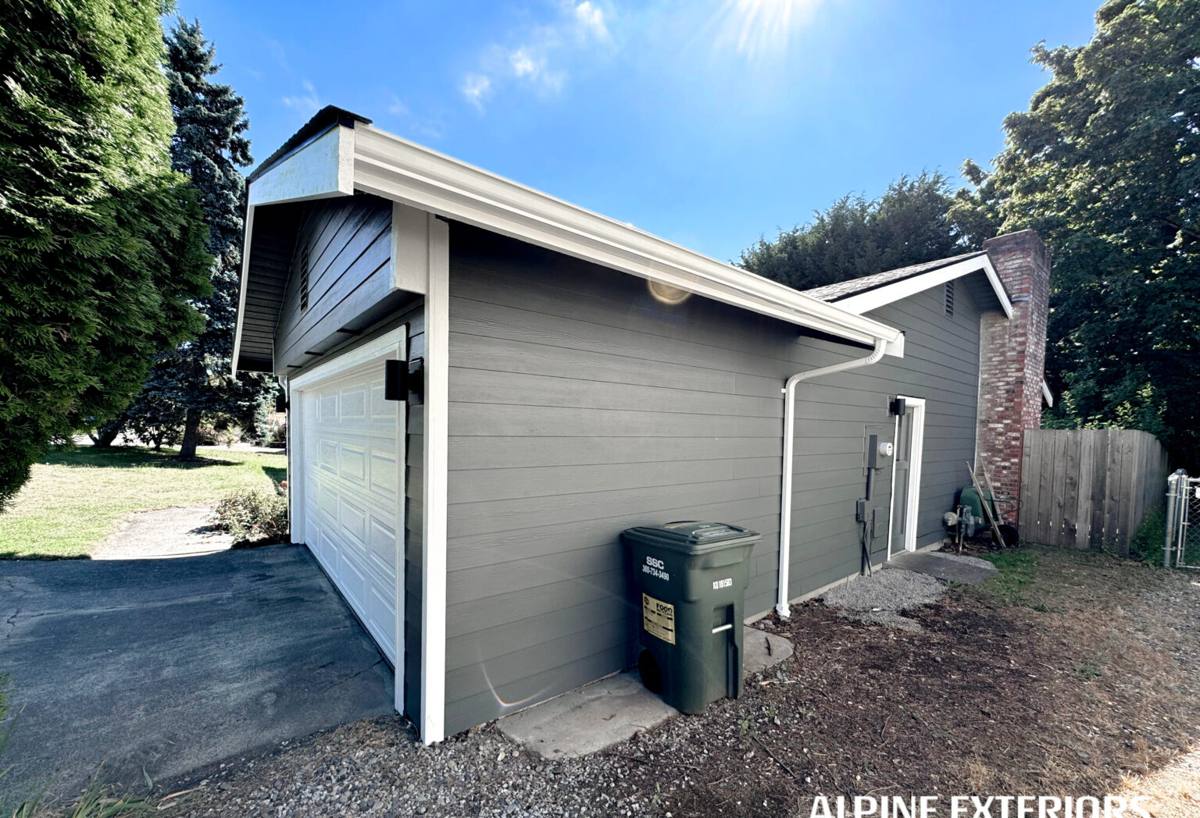
What Salt Air and Driving Rain Do to a Wall System
Salt air
Airborne salt is corrosive to metal and abrasive to finishes. Over years, it accelerates the breakdown of cheap fasteners, thin factory paint, and unsealed cut edges. It doesn't just affect siding — it's why gutters, flashing, and hardware near the shoreline age faster than the same materials a few miles inland.
Wind-driven rain
On an open shoreline, rain rarely falls straight down — wind pushes it sideways and up under laps, around trim, and into any gap that wouldn't normally see water. That means the flashing details, house wrap overlaps, and caulking joints on a Birch Bay home are doing more work than the same details on a sheltered inland lot, and any shortcut taken during installation shows up sooner here than it would elsewhere.
Shade and moss
Mature trees and marine air keep humidity high on shaded elevations. Moss and algae need moisture and shade to establish, and Birch Bay has both in abundance on north-facing walls and anywhere overhangs or landscaping block the sun. Once moss takes hold on a porous or textured surface, it holds moisture against the wall even longer, which compounds the problem.
Why We Only Install James Hardie Fiber Cement Here
We made a standard decision a long time ago: we install James Hardie fiber cement siding and nothing else, on every job, including here in Birch Bay. Vinyl can crack in cold snaps and fade unevenly on the sun-exposed side of a waterfront lot. Untreated wood and primed spruce need real maintenance discipline to survive constant moisture, and a missed repaint cycle in a salt-air environment costs more than it would inland. Fiber cement gives us a non-combustible, dimensionally stable product that doesn't rot, doesn't attract insects, and holds a factory finish instead of relying on field-applied paint that has to fight salt air and UV from day one.
That's not a claim that other products can't work anywhere — it's why we don't put our name behind them on the projects we run. Fiber cement done right is the product we're willing to warranty and stand behind on a shoreline lot.
The Hardie Product Lines That Fit Birch Bay Homes
Not every Hardie profile is the right call for every house. Here's how we typically match product to a Birch Bay project:
| Product | Best use | Why it fits this climate |
|---|---|---|
| HardiePlank lap siding | Primary field siding on most homes | Engineered HZ5 formulation resists moisture-driven damage in freeze-and-rain climates like ours |
| HardiePanel vertical siding | Accent walls, gable ends, modern styling | Fewer horizontal laps means fewer joints for wind-driven rain to test |
| HardieShingle siding | Cottage- and craftsman-style homes common near the bay | Textured look without the maintenance burden of real cedar shingles in salt air |
| HardieTrim boards | Corners, fascia, window and door trim | Resists the swelling and rot that wood trim shows first in damp, shaded areas |
All of it comes prefinished with ColorPlus Technology — a factory-applied, baked-on finish that's more consistent and more resistant to fading and chalking than field-applied paint, which matters on the sun-facing walls that take the most UV and salt exposure here.
What Correct Installation Looks Like on a Birch Bay Home
Fiber cement is only as good as the installation behind it, and in a wind-driven-rain environment the details matter more than usual. On every Birch Bay job we're careful about:
- Proper weather-resistive barrier and overlap sequencing so water that gets past the siding still drains out, not in
- Flashing at every window, door, and horizontal transition — not just caulk standing in for flashing
- Correct fastener spacing and fastener type, since corrosion-resistant fasteners matter more this close to salt air
- Manufacturer-specified gaps and clearances at trim, foundation, and roof lines so the assembly can shed water instead of trapping it
- Field-cut edges properly sealed, since an unsealed cut edge is the one place factory finish protection doesn't reach
- Rainscreen or drainage gap considerations on elevations that take the most direct wind and rain
Skipping any one of these doesn't usually cause an obvious problem in year one. It shows up in year five or ten as a soft spot, a stain, or a warranty claim that gets denied because the installation didn't meet manufacturer requirements — which is exactly the outcome correct installation is meant to prevent.
Our Process, Start to Finish
1. Walkthrough and assessment
We look at every elevation separately — the shaded, moss-prone sides get different attention than the sun- and wind-exposed sides facing the water.
2. Straightforward proposal
You get a clear scope covering product lines, color, trim details, and what tear-off or repair work (if any) is needed before new siding goes on.
3. Removal and inspection
Once old siding comes off, we check the sheathing and framing underneath for moisture damage that isn't visible from the outside — common on shaded, exposed walls that have held moss for years.
4. Installation to manufacturer spec
Weather barrier, flashing, fastening, and finish work done to James Hardie's published requirements, not shortcuts.
5. Final walkthrough
We go over the finished work with you before calling the job done.
Maintenance for a Moss- and Salt-Prone Property
Fiber cement needs far less upkeep than wood, but "far less" isn't "none," especially this close to the water. A simple seasonal routine keeps a Birch Bay home looking right for the long term:
- Rinse siding annually, more often on shaded north walls where moss and algae establish fastest
- Keep gutters clear so overflow doesn't run down and streak the siding face
- Trim back vegetation that shades walls and traps moisture against the surface
- Inspect caulking at trim and window joints every couple of years and touch up as needed
- Address any moss growth early with a gentle wash rather than letting it establish and hold moisture
Cost Factors for Birch Bay Fiber Cement Projects
Every project is different, but the same handful of factors drive most of the cost variation we see on Birch Bay homes:
| Factor | Why it matters here |
|---|---|
| Home size and number of stories | More surface area and harder access for taller waterfront homes |
| Amount of trim and architectural detail | Craftsman and cottage-style homes common here often carry more trim than a simple box |
| Condition of existing sheathing | Moisture damage found during tear-off on shaded, moss-affected walls can add repair scope |
| Product mix | Combining lap siding with shingle accents or vertical panel costs more than one uniform product |
| Site access | Waterfront lots with limited driveway or staging space can affect labor time |
We won't quote a number without seeing the house, but we're glad to walk you through where your project sits on that range once we have.
Why Local Experience in Birch Bay Matters
A crew that only occasionally works this close to the water can miss the details that matter here — the extra attention flashing needs on a wind-exposed elevation, the fastener choices that hold up against salt air, or the fact that a shaded north wall in Birch Bay behaves nothing like a sun-facing wall on the same house. Working this stretch of Whatcom County regularly means we're not guessing at what the marine climate does to a wall assembly — we're building for it from the first flashing detail to the last piece of trim.
If your Birch Bay home needs new siding, or you're just trying to figure out whether moss staining or soft trim means a bigger problem underneath, we're happy to take a look. Reach out for a free, no-pressure estimate using the form below.