 Lynden Siding
 Decking Built for This Side of the Border's Weather
Aldergrove sits just north of the line from Lynden, close enough that the weather doesn't know the difference. The same weather system that soaks Whatcom County rolls straight through the Fraser Valley — driving rain off the Salish Sea, damp air that never fully dries out between storms, and long stretches of gray where a deck stays wet for days at a time. If you're planning a composite deck for a home in or around Aldergrove, that climate is the actual design brief, not the color swatch or the board profile.
Composite decking earns its keep here precisely because it doesn't behave like wood. It won't splinter, cup, or rot the way a cedar or pressure-treated deck eventually will under constant moisture. But "composite" isn't one product, and installing it wrong will let this climate find every weak point anyway — the framing underneath, the fasteners, the spots where the deck meets the house. This page is about what actually matters for a composite deck built to hold up in Aldergrove's rain, moss, and salt-tinged air, not the generic pitch you'd get from a big-box crew passing through once.
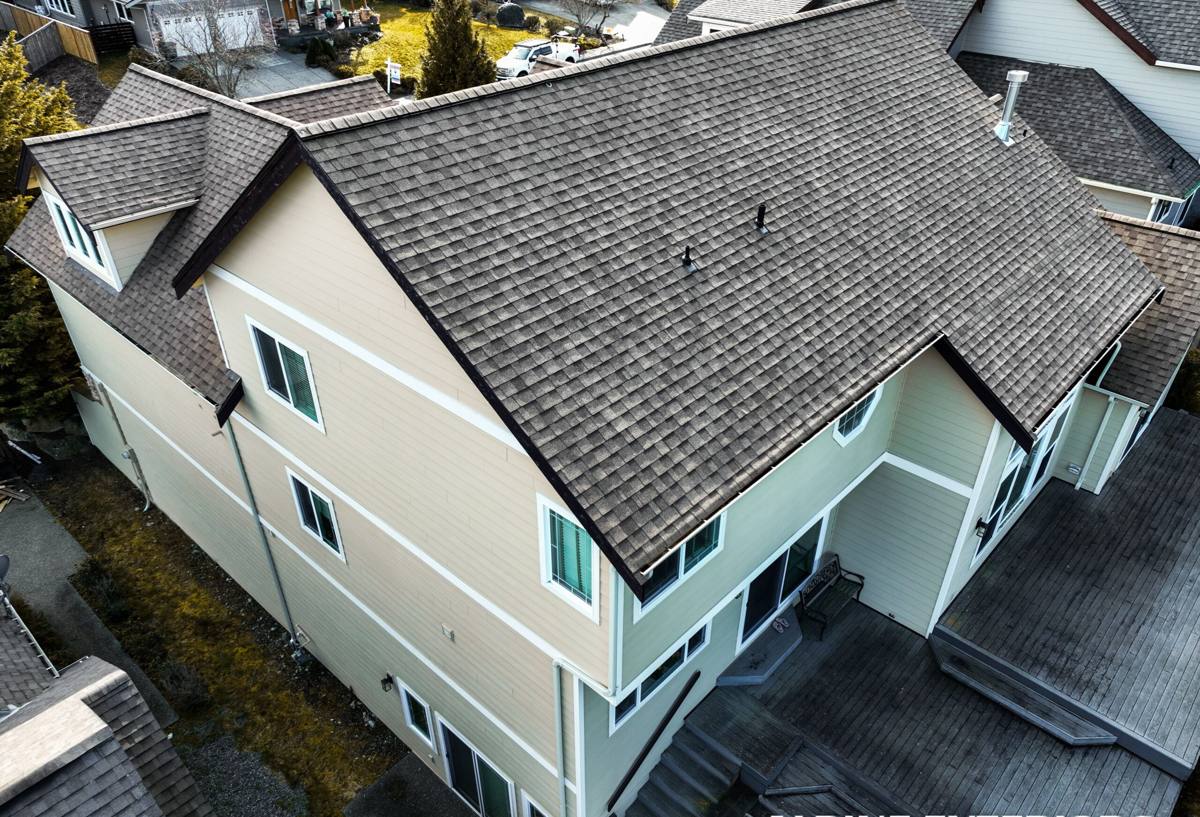
What Driving Rain and Salt Air Actually Do to a Deck
Most deck problems in this region don't show up on the top surface first — they start underneath, where nobody's looking until there's a soft spot or a rail post that wiggles.
The Ledger Board Is the Real Weak Point
The ledger board — the framing member that bolts the deck to the house — is where water intrusion causes the most expensive damage. Wind-driven rain doesn't fall straight down; it gets pushed sideways and upward under railings, behind fascia, and into any gap where the deck meets the siding. Without proper flashing and a drainage gap behind the ledger, water works its way into the house framing, and by the time it's visible from inside, the repair is a lot bigger than a deck job.
Hardware Corrodes Faster Near the Coast
Fasteners, joist hangers, and post hardware take a beating from the combination of constant moisture and the salt content in coastal Pacific Northwest air. Standard galvanized hardware can start showing rust streaks and pitting years before a deck's boards show any wear. Stainless steel or coated, corrosion-rated hardware costs more up front but is the difference between a deck that's still solid in fifteen years and one where the structure fails before the decking does.
Why Moss Season Is the Real Stress Test
Composite decking resists moss far better than wood, but "resists" isn't "immune." Moss and algae need three things to take hold: shade, standing moisture, and organic debris to root in. This region hands them all three for months at a time — low sun angles, needles and leaf litter blowing in from surrounding trees, and boards that stay damp long after a storm passes.
Where composite decks actually grow moss, it's almost always a spacing or drainage problem, not a materials problem: boards installed too tight to shed water and debris, low or nonexistent airflow underneath the deck, or a design that traps water against the house or a fascia board. A deck built with the right gapping, slope, and substructure ventilation sheds moss pressure on its own. One that isn't will need scrubbing every spring no matter what brand of decking is on it.
Choosing the Right Composite Board for This Region
Not every composite product handles constant damp the same way, and the differences matter more here than they would in a dry climate. Broadly, you're choosing between a few categories:
| Type | Moisture & Moss Behavior | Typical Lifespan / Warranty | Relative Cost |
|---|---|---|---|
| Uncapped composite | Wood fiber content can absorb moisture at cut edges; more prone to surface mold in shaded, damp spots | Shorter warranty range, often 10–25 years | Lowest |
| Capped composite | Polymer shell resists moisture and staining much better; still needs proper drainage detailing | Longer warranty range, often 25–50 years | Mid-range |
| Solid PVC / cellular PVC | No wood content at all, so it's essentially unaffected by moisture absorption; still needs airflow to shed surface moss | Among the longest warranties available, often lifetime or limited-lifetime | Highest |
For most Aldergrove-area homes, capped composite hits the right balance of upfront cost and long-term performance against this climate. Uncapped composite can still be the right call on a budget-driven project as long as expectations about maintenance and lifespan are honest from the start. Solid PVC earns its price on decks with heavy shade, low airflow, or ground-level framing where drying out between storms is harder.
Board Profile and Fastening System
Grooved-edge boards with hidden fastener clips give a cleaner look and, more importantly here, no exposed screw heads for water to pool around. Face-screwed boards are cheaper and faster to install but create dozens of small penetration points that need to be properly sealed and checked over time. In a climate this wet, hidden fastening is worth the extra labor cost on most projects.
What a Correct Composite Deck Installation Involves
The composite boards themselves are the easy part. Getting the structure underneath right is what determines whether the deck is still sound in twenty years.
Framing and Substructure
Composite decking is heavier than wood, so joist spacing has to match the manufacturer's spec for the specific board — usually tighter than a traditional wood deck, especially at angles or picture-frame borders. Pressure-treated or coated steel framing rated for ground contact and moisture exposure is standard here; anything less is a shortcut that fails first.
Spacing, Slope, and Airflow
Every deck needs a slight slope away from the house so water doesn't pool against the ledger, along with consistent board gapping to let water and debris pass through rather than collect on the surface. Underneath, the substructure needs enough clearance and ventilation to actually dry out between storms — a deck built low to the ground with no airflow underneath will hold moisture against the framing no matter how good the boards on top are.
Flashing at the House Connection
Proper ledger flashing — metal flashing integrated with the house's water-resistive barrier, not just caulk over a bolt pattern — is non-negotiable in a climate with this much driving rain. This is the single detail most likely to be rushed on a low-bid job and most expensive to fix after the fact.
Our Process, From Estimate to Final Walkthrough
A composite deck project should be predictable from the first visit to the last. Here's what that looks like:
- On-site walkthrough to assess the house connection point, drainage path, sun/shade exposure, and existing structure if it's a rebuild
- Honest recommendation on board type and fastening system based on your budget and how much shade or debris the site actually gets
- Written estimate that spells out framing material, board brand and profile, hardware grade, and railing system — no vague line items
- Permit handling where required, since deck height, guardrails, and footings are subject to local building code
- Framing and ledger flashing done first and inspected before a single composite board goes down
- Decking installed with correct spacing, slope, and fastening for long-term drainage
- Final walkthrough covering care and maintenance specific to the board you chose
Maintaining a Composite Deck in This Climate
Composite decking is lower-maintenance than wood, not maintenance-free. In a region with this much rain and moss pressure, a little seasonal attention goes a long way:
- Sweep debris off the deck regularly during fall and winter so leaves and needles don't sit and trap moisture
- Rinse or lightly scrub the surface once or twice a year, more often in shaded areas prone to moss
- Check that gaps between boards stay clear so water and debris can pass through rather than collect
- Keep gutters and downspouts near the deck clear so runoff isn't dumping extra water onto or under it
- Inspect railing posts and ledger connections periodically for movement or corrosion streaks on hardware
None of this is heavy work, but skipping it is how a good composite deck ends up looking like a neglected one within a few years.
Why a Crew That Already Works This Area Matters
Aldergrove and Lynden are close enough that the same weather, the same tree cover, and largely the same soil and drainage conditions apply to both. A crew that works this corridor regularly has already seen how ledger connections fail in this rain, which shaded yards grow moss fastest, and which framing details hold up over a decade in this climate instead of guessing from a manufacturer's spec sheet written for a drier region. That's different from a company that installs decks all over a wide territory and treats Whatcom County or the Fraser Valley as just another stop.
If your project involves paperwork on either side of the border — permits, inspections, or anything specific to your municipality — we'll walk you through what applies to your job rather than leaving you to sort it out mid-project.
Get a Free Estimate
If you're weighing composite decking options for a home in or near Aldergrove, we're happy to take a look, talk through what your specific site needs, and give you a straightforward estimate — no pressure, no upsell. Use the form below to get started.