 Lynden Siding
 Lynden sits about two miles from the Sumas-Huntingdon border crossing, which makes Abbotsford, British Columbia — the largest city in the Fraser Valley — closer to us than plenty of towns technically inside the United States. Homes on both sides of that line sit inside the same weather system: the same salt-tinged air pushing in off Georgia Strait and Puget Sound, the same wind-driven rain through fall and winter, and the same long moss season that keeps shaded surfaces damp for most of the year. A window opening doesn't know which country it's in. It just has to hold up to what this climate actually delivers, and in a lot of homes around here — whether they're older Whatcom County farmhouses or established Fraser Valley properties — the opening that needs a window isn't a standard size to begin with.
That's what "custom windows" usually means in practice. It's rarely about something exotic or architectural. Most of the time it means the rough opening in the wall doesn't match a size sitting on a shelf, and the window has to be built to fit the house rather than the other way around. Lynden Siding Company builds and installs custom windows for homes in and around Abbotsford, BC and throughout the Lynden area, and we handle siding, roofing, and decks as well, because a window is never really an isolated product — it's one piece of a wall assembly that has to work with everything around it.
What Salt Air, Driving Rain, and a Long Moss Season Do to a Window Opening
Whatcom County and the Fraser Valley share a marine-influenced climate that doesn't spare a house just because it's set back from open water. Three things wear on a window installation here more than most parts of the country:
Salt Air and Hardware Corrosion
Salt-carrying air moves inland from the Strait of Georgia and Puget Sound and works on anything metal over time — window hardware, screen frames, and lower-grade fasteners in particular. Cheaper hardware finishes usually show pitting or stiffness first, which is often the earliest sign that a window's components weren't built for the corrosion load this region delivers year after year.
Driving Rain and Flashing
Rain here rarely falls straight down. Storms push it sideways into window flashing, head trim, and the sill pan beneath the frame, which is a much tougher test of the installation than of the window product itself. A quality window with sloppy flashing will leak. A modest window installed with a correctly sequenced flashing detail usually won't. Most of the water damage we find around windows traces back to how the opening was flashed, not to the window that was installed in it.
A Long Moss Season
Mild, wet weather gives moss and mildew most of the year to work on shaded sills, north-facing walls, and any spot that doesn't dry out between storms. On a wood-framed window, that moisture eventually shows up as soft, slowly rotting material at the sill and lower corners — usually well before it's visible from inside the house.
Why Custom Windows Come Up So Often Around Here
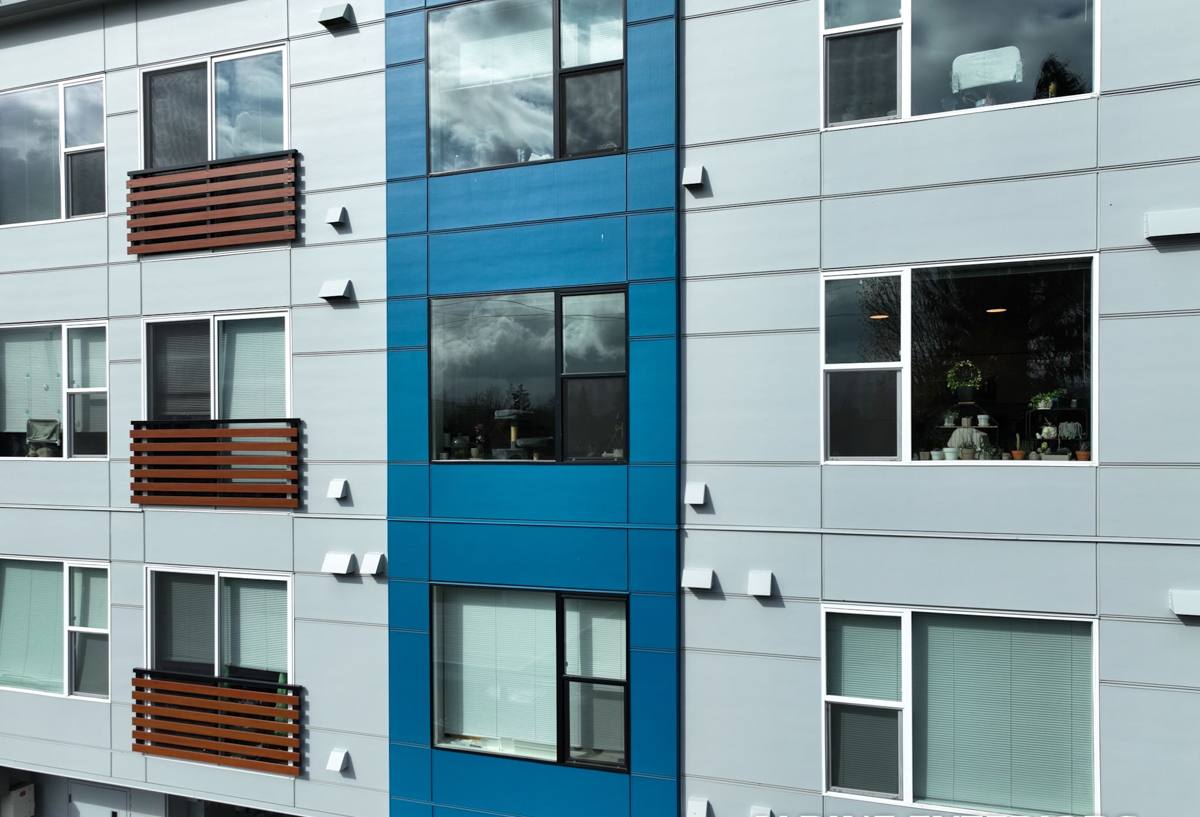
A few things stack up in this part of Whatcom County and the neighboring Fraser Valley. Older farmhouses were framed long before window manufacturers agreed on standard dimensions, so a straight swap often runs into an opening that's an inch or two off — close enough to tempt a shortcut, far enough off that a stock unit won't seal properly without reframing. Additions, converted outbuildings, and dormer conversions common on rural and semi-rural properties on both sides of the border create openings that were never standard to begin with. And plenty of older homes have at least one window — a stairwell, a farmhouse kitchen nook, a converted loft — that was custom to start with and needs to stay that way on replacement.
The Age Factor
The older the house, the more likely the rough opening has settled or shifted slightly out of square over the decades. Building a custom window to fit that exact, imperfect opening — instead of forcing a standard size into it with extra shimming and caulk — is usually the more durable fix, even though it takes longer to source.
Daylight Basements and Converted Spaces
Basement and lower-level living space is common on both sides of the border, and a lot of it was finished after the house was originally built. Egress windows for those spaces often need to be sized to current code minimums, which rarely lines up with whatever opening was there before, if anything was there at all.
Custom Window Situations We See in This Area
- Non-standard replacement sizes — matching an opening in a home built before modern sizing standards existed
- Bay and bow windows — common on older farmhouse-style construction, requiring their own roof, support, and flashing plan
- Egress windows for basement conversions — sized to code minimums for finished lower-level living space
- Arched or specialty-shaped units — original architectural details worth preserving on an older home
- Matched sets for additions — new windows sized and proportioned to sightline with the original house
- Outbuilding and shop conversions — barns, shops, and outbuildings turned into living or working space rarely have standard rough openings
What a Correct Custom Window Job Involves
A custom window is only as good as the opening it goes into and the flashing detail around it. On a job in this area, that generally means:
- Removing the old window carefully and inspecting the framing and sheathing underneath for rot or old water damage before anything new goes in
- Taking precise measurements of the actual opening, not the nominal size of the window being replaced
- Repairing or replacing any damaged framing, sheathing, or old flashing found during removal
- Installing new flashing — sill pan, side, and head flashing — sequenced so water sheds outward at every layer, not just caulked over gaps
- Setting and shimming the new unit square and plumb, since an out-of-square opening on an older home rarely lines up on its own
- Sealing and insulating the gap between frame and rough opening with appropriate materials, not just spray foam and caulk as the only line of defense
- Finishing exterior trim so water is directed away from the new seams instead of pooling against them
Skip steps four through six and the window itself can be excellent quality and still leak or rot the surrounding framing within a few wet seasons.
Custom vs. Stock: Cost and Trade-Offs
| Factor | Stock Window | Custom Window |
|---|---|---|
| Lead time | Often available quickly | Built to order — plan for weeks, not days |
| Fit | Standard sizes only — reframing needed if the opening doesn't match | Matched to the exact opening or original design |
| Flashing complexity | Straightforward, well-documented rectangular details | Shape- and age-specific — older openings need extra care |
| Structural review | Rarely needed for a like-for-like swap | Sometimes needed for bay windows or altered rough openings |
| Cost | Lower, especially for common sizes | Higher — reflects manufacturing and labor complexity |
| Best fit | Simple replacements in standard, newer openings | Older farmhouses, additions, converted spaces, period details |
Frame Materials for This Climate
Frame material matters more on a custom unit, since a larger or older opening has more surface area exposed to sustained moisture and less forgiveness if something is installed wrong. We'll walk through the honest trade-offs for your specific opening rather than defaulting to whatever's fastest to install. Vinyl and fiberglass frames generally hold up to this region's driving rain and salt-tinged air with less ongoing maintenance than an all-wood exterior finish, which is why we lead with them on weather-exposed replacements — though a wood interior with a durable exterior cladding can still be the right call on an older home where the interior look matters and the exterior is properly protected.
Crossing the Border: What's Different About a Project in Abbotsford, BC
Working on both sides of the Sumas-Huntingdon crossing adds a few practical steps that don't come up on a job that stays inside Whatcom County. Special-order window units can take longer to clear customs than a straightforward material delivery, so we build that into the schedule up front rather than promising a lead time we can't hold to. Wait times at the crossing itself can shift a crew's start time on a given day, which we plan around rather than treat as a surprise. And permitting requirements differ between Whatcom County and the City of Abbotsford, so a project on the Canadian side needs its own look at what's required before work starts, rather than assuming the same paperwork applies on both sides of the line. None of that makes a custom window project in Abbotsford any less doable — it just means the planning conversation up front matters more than it would for a job a few miles down the road in Lynden.
Why Local, Cross-Border Experience Matters
Manufacturer installation instructions are written for a standard, newer-construction opening. A lot of the housing stock in this area — older Whatcom County farmhouses, established Fraser Valley properties, converted outbuildings — doesn't match that description, and this climate doesn't leave much room for error when it doesn't. A crew that has actually opened up older walls on both sides of the border, found what's really behind the siding, and reframed or flashed around it knows which parts of the manufacturer's guidance are non-negotiable here and where extra time is worth spending even when it's not strictly required.
That experience shows up in decisions that rarely get discussed up front: how much lap a flashing course needs on an old, uneven sill, when a header needs extra support because the original opening was never built to hold a heavier modern unit, and whether an old opening needs partial reframing rather than a shim-and-caulk fix. Those choices decide whether a custom window in this area is still performing cleanly in fifteen years or showing rot and drafts in five.
A Practical Checklist Before You Start
- Get the actual rough opening measured before assuming a stock size will work
- Ask whether any rot or old water damage was found — and get it fixed before the new window goes in, not after
- Confirm the flashing sequence being used, not just the window brand
- If your property is in Abbotsford, ask how customs and border logistics factor into the delivery and installation timeline
- Get a clear, realistic lead time for custom units before committing to a schedule
- Ask how labor and the window unit itself are each warrantied — they're often separate
Ready When You Are
If you're dealing with an odd-sized opening in an older home, converting a basement or outbuilding, or trying to match new windows to an addition — on either side of the border — it's worth having someone look at the actual opening before pricing anything. Lynden Siding Company offers free, no-pressure estimates for custom window projects in Abbotsford, BC, Lynden, and the surrounding area. Use the form below to get a time on the schedule.