 Lynden Siding
 Why Decks Near Abbotsford Wear Out Faster Than People Expect
Homeowners in and around Abbotsford, BC are often surprised at how much faster a deck ages here compared to drier parts of the country. It isn't bad luck or bad carpentry — it's the climate. This corner of the Pacific Northwest, straddling Whatcom County and the Fraser Valley, combines three things that are hard on outdoor wood structures: salt-laden air moving in off the Salish Sea and Georgia Strait, long stretches of driving rain through fall and winter, and a moss season that can run from October well into spring. Any one of these on its own is manageable. Together, they shorten the practical life of an under-built or aging deck considerably.
We're based just south of the border in Lynden, and we've built and replaced decks in this exact climate for years. That matters because the right deck replacement here isn't just "pull the old boards, nail down new ones." It's a set of decisions — framing, fasteners, ledger flashing, material choice, drainage — that either hold up to this specific weather pattern or quietly fail in three to five years.
What the Climate Actually Does to a Deck
- Salt air accelerates corrosion on fasteners, joist hangers, and any exposed metal hardware, especially the closer a property sits to open water or wind corridors.
- Driving rain gets pushed sideways under railings, around post bases, and behind ledger boards where standard flashing details fall short.
- Moss and algae hold moisture against decking boards for months at a time, which is what really rots wood — not rain itself, but rain that never gets a chance to dry.
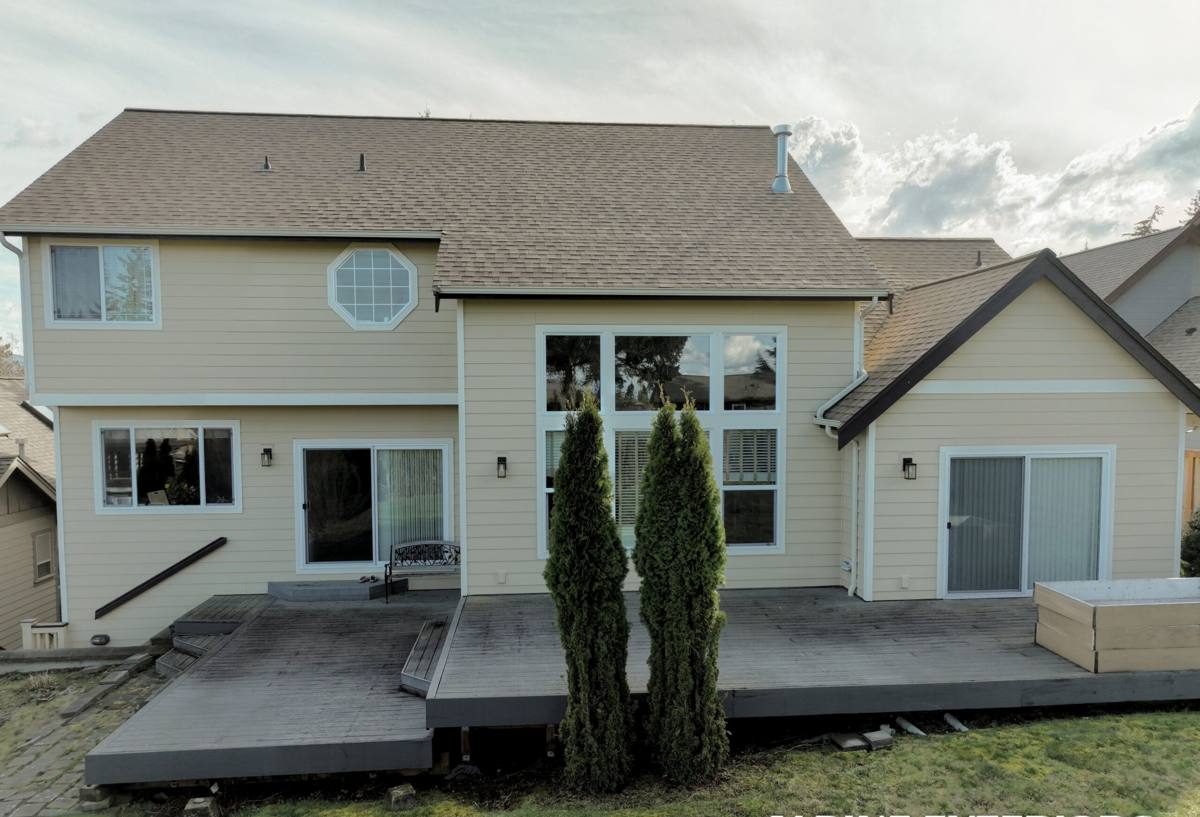
Signs Your Deck Needs Replacing, Not Just Repairing
Not every tired-looking deck needs a full teardown. But there's a point where patching individual boards is just delaying a bigger, more expensive failure. We look at a few things when we assess a deck in this area:
- Soft, spongy, or springy spots when you walk across the surface — usually a sign of rot in the joists below, not just the decking boards.
- Rust streaks running down from fasteners or hardware, which usually means the metal is failing faster than the wood around it.
- A ledger board (where the deck attaches to the house) that's dark, swollen, or separating slightly from the siding.
- Persistent green or black staining on the underside of boards that comes back within weeks of cleaning.
- Railings or posts that wobble at the base — often a sign the post-to-frame connection has been compromised by moisture.
- A deck older than 15–20 years that was built to older, less rain-resistant framing standards.
If you're seeing two or more of these, repair usually ends up costing nearly as much as replacement once you account for labor, and you're still left with an older frame underneath.
What a Correct Deck Replacement Involves Here
A deck replacement done properly in this climate goes well beyond swapping the visible boards. The parts nobody sees are the parts that actually determine how long the deck lasts.
Framing and Structure
We replace joists, beams, and posts that show any sign of moisture damage rather than building new decking on top of a compromised frame. Framing lumber gets treated for ground contact and moisture exposure appropriate to this region, not a lighter-duty grade meant for drier climates.
Ledger Flashing
The ledger board connection to your house is the single most common failure point we see on older decks in this area. Correct flashing — a proper metal flashing detail integrated with the house's water-resistive barrier, not just caulk — keeps driving rain from working its way behind the siding at that joint.
Fasteners and Hardware
Given the salt air exposure common to this area, we use stainless or heavy-duty coated fasteners and connectors rated for coastal exposure, not standard interior-grade hardware that will streak and weaken within a few seasons.
Drainage and Airflow
Proper board spacing and joist spacing let air move underneath the deck so it can actually dry out between rain events. This one detail does more to prevent moss buildup and rot than any coating or sealant applied after the fact.
Choosing the Right Decking Material
There's no single "best" decking material — it depends on your budget, how much maintenance you're willing to do, and how much moss and moisture exposure your specific property gets. Here's how the common options compare for a property in this climate:
| Material | Upfront Cost | Maintenance | Moisture/Moss Resistance | Typical Lifespan |
|---|---|---|---|---|
| Pressure-Treated Wood | Lowest | Annual cleaning and re-staining/sealing recommended | Fair — needs upkeep to stay ahead of moss | 10–15 years |
| Cedar | Moderate | Regular sealing to hold color and resist moisture | Good natural rot resistance, but still needs care | 15–20 years |
| Composite/PVC | Highest | Occasional washing, no staining or sealing | Very good — engineered to resist moisture and moss staining | 25+ years |
Our professional standard is to walk homeowners through these trade-offs honestly rather than pushing whatever has the best margin. Composite costs more up front but essentially eliminates the sealing cycle that wood requires in a climate this wet. Wood costs less initially but only performs well if you're committed to the maintenance schedule. Neither is objectively "correct" — it depends on what you'd rather spend: money now or time every year.
Our Deck Replacement Process
- On-site assessment — we inspect the existing deck, ledger connection, and framing to determine what's salvageable versus what needs to come out.
- Straightforward estimate — a written scope covering materials, framing work, hardware, and timeline, with no vague allowances.
- Permitting — deck replacements of most sizes require a building permit; we handle the paperwork so it isn't a surprise later or an issue when you sell.
- Demolition and disposal — full removal of the old structure, including hauling away old lumber and hardware.
- Framing and flashing — the structural work that determines whether the new deck lasts 10 years or 25.
- Decking, railing, and finish work — installed to the manufacturer's spacing and fastening specs, not shortcuts to save a day of labor.
- Final walkthrough — we go over the finished deck with you, including basic care guidance specific to the material you chose.
Permits and Local Considerations
Deck replacements typically require a permit, both because of structural safety and because an unpermitted deck can complicate a home sale down the road. Requirements vary depending on which side of the border a property sits on and its local jurisdiction, so we confirm the specifics for your address before work starts rather than assuming one standard set of rules applies everywhere we work. If your property sits close to a property line, water feature, or slope, that can also affect setback requirements — something worth flagging early rather than discovering mid-project.
Why Hire a Crew That Already Works in This Area
A deck built to a generic national spec sheet often underperforms here within a few years, because that spec sheet wasn't written with this much rain, this much moss pressure, or this much salt air in mind. Working regularly across Whatcom County and into the Fraser Valley means we're not guessing at how a ledger flashing detail or a fastener grade will hold up in this specific environment — we're building based on what we've actually seen fail, and why.
It also means straightforward logistics: material delivery, scheduling around this region's wet-season windows, and crews who understand that a two-week forecast here can turn on short notice. A deck replacement scheduled without accounting for that ends up dragging out or getting rushed at the wrong moment.
Caring for Your New Deck Through the Wet Season
Even a well-built deck benefits from a little seasonal attention, especially given how long the wet, low-sun months run here. A short annual routine goes a long way:
- Sweep debris and fallen leaves off the deck regularly in fall — trapped organic material is what feeds moss growth.
- Rinse off surface algae or green staining before it has a chance to set in, ideally before the heaviest rains start.
- Check railing posts and stair connections once a year for any looseness.
- For wood decking, plan on cleaning and re-sealing on the schedule recommended for your specific product — skipping a cycle is when moisture problems start.
- Keep gutters and downspouts near the deck clear so runoff isn't dumping extra water directly onto or under the structure.
Get a Straightforward Estimate
If your deck is showing its age or you're planning ahead before it becomes a safety issue, we're happy to take a look and give you an honest read on repair versus replacement. There's a free, no-pressure estimate form below — fill it out and we'll follow up to schedule a time that works for you.