 Lynden Siding
 Deming's Climate Is Harder on Siding Than It Looks
Deming sits back from the open flats around Lynden, tucked into the tree line on the way toward Mount Baker. That position changes what your siding deals with day to day. Whatcom County as a whole takes a beating from three directions: salt-laden air that moves inland off the Sound on windy days, driving rain that comes in sideways during fall and winter storms, and a moss and algae season that can stretch eight months or more in shaded, tree-covered spots like Deming. Homes here sit under more canopy, get less direct sun to dry out after a storm, and hold moisture longer than siding on an open lot in town.
None of that is dramatic on its own. It's the accumulation that causes problems — siding that never fully dries between rain events, paint that fails early because it's sitting on wet substrate, and moss that gets a foothold in joints and laps and just doesn't let go. A siding product and installation that would hold up fine on an open, sunny lot can struggle in a wooded Deming yard if it isn't matched to the conditions.
What This Means for a Siding Choice
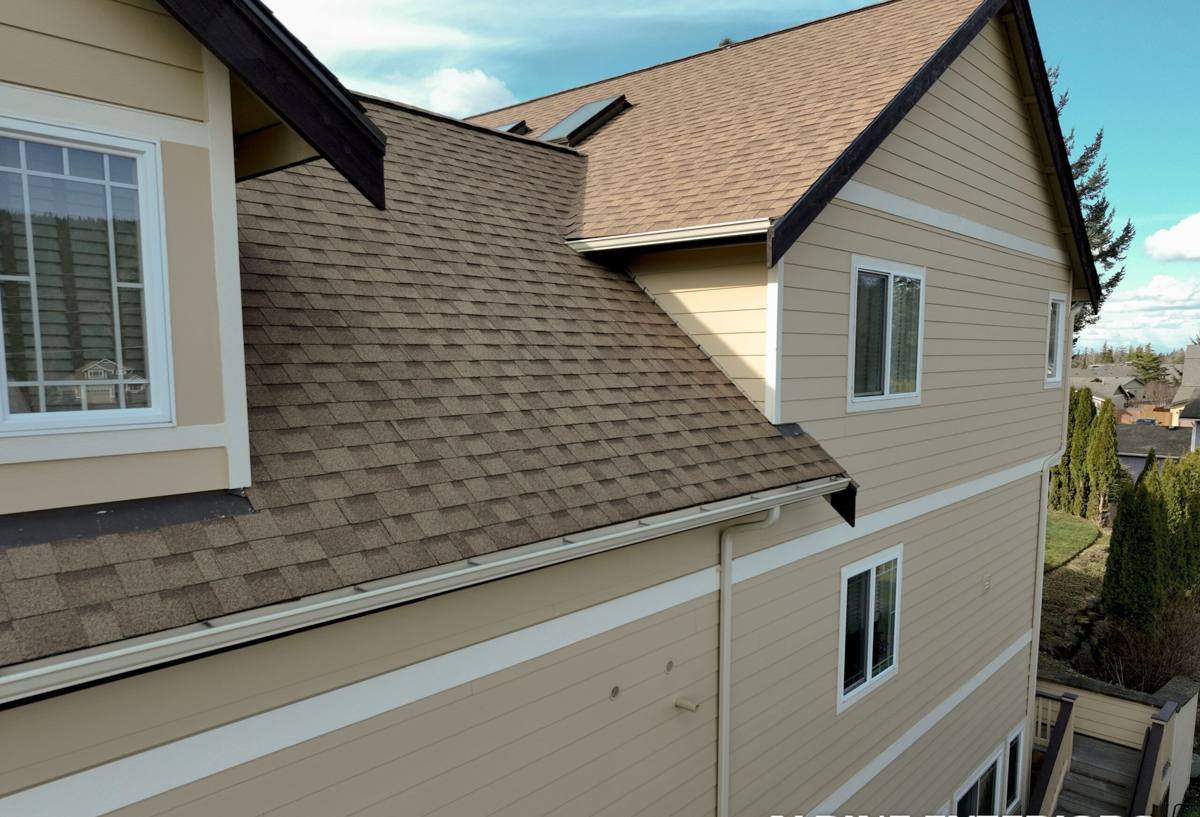
We install James Hardie fiber cement exclusively, and Deming is one of the clearer cases for why. Hardie's HardiePlank and HardiePanel products are engineered specifically for climates like this — they're non-combustible, dimensionally stable when they take on moisture, and don't rely on a factory paint film alone to keep water out the way some other siding materials do. The HZ10 formulation, which is what we use in this region, is built for exactly the freeze-thaw and high-moisture cycling that Deming sees.
We don't install vinyl, LP SmartSide, primed spruce, or cedar lap on these jobs, and it's worth being straight about why. Vinyl expands and contracts more than fiber cement and can warp or crack under UV and temperature swings; it also traps moisture behind it if house wrap and flashing aren't perfect. Engineered wood products like LP SmartSide use a wood-strand substrate that is more vulnerable to moisture intrusion at cut edges and butt joints — a real risk in a spot that stays damp as long as Deming does. Primed spruce and cedar look good going up, but they need active maintenance — recoating, caulking, moss treatment — on a schedule most homeowners don't keep up with, and shaded lots accelerate that decay. None of these are "bad" products in every setting. They're just not the standard we're willing to put our name on for a climate that punishes any weak point in the water management.
How the Products Compare for This Climate
| Factor | James Hardie Fiber Cement | Vinyl | Engineered Wood / Cedar |
|---|---|---|---|
| Moisture behavior | Won't rot; stable when damp | Doesn't rot but traps water behind panels if wrap fails | Vulnerable at cut edges and joints |
| Moss/algae resistance | ColorPlus finish resists staining, cleans easily | Moss grows on surface, harder to pressure-wash safely | Moss holds moisture against the substrate |
| Maintenance in shaded lots | Periodic wash; no recoating needed | Low, but cracks/fading aren't repairable | Recoat and caulk on a recurring schedule |
| Fire rating | Non-combustible | Combustible, can deform near heat | Combustible |
| Typical lifespan when installed to spec | 30+ years before repaint needed with ColorPlus | 20-30 years, brittle with age | 10-20 years with diligent upkeep |
What a Correct Hardie Installation Involves
Hardie siding is only as good as the installation underneath it. Most of the failures we get called out to inspect on older homes in this area weren't a product problem — they were water finding its way behind the siding because of a shortcut during installation. On a Deming home, where siding stays damp longer between dry spells, those shortcuts show up faster.
- Correct weather-resistive barrier (house wrap) installed and lapped properly before any siding goes up
- Rigid flashing at every window, door, and roof-to-wall transition — not just caulk
- Proper starter strip and clearance at the foundation so siding never sits in standing water or splashback
- Butt joints staggered and flashed, not just butted and caulked
- Correct fastener type, spacing, and depth per Hardie's published installation specs
- Minimum clearance maintained from roofing, decks, and grade per manufacturer requirements
- Factory-primed cut edges resealed on site with the specified sealant
Every one of those steps is in Hardie's published installation guidelines, and every one of them affects the warranty. Skipping any of them doesn't usually cause a problem in year one — it shows up in year five or six as staining, soft trim, or paint failure at a joint that was never properly sealed. In a climate that gives siding fewer chances to dry out, those small gaps compound faster than they would somewhere sunnier and drier.
How We Approach a Deming Job
Assessment
We start by walking the home and looking at where moisture is actually collecting — which sides get the least sun, where trees overhang the roofline, where old caulk or trim has already started to fail. On a shaded, tree-lined lot like a lot of Deming properties, this tells us more than a generic measure-and-quote visit would.
Prep and tear-off
Existing siding comes off down to the sheathing so we can actually inspect the wall assembly, not guess at what's underneath. Any soft sheathing, compromised flashing, or prior water damage gets addressed before anything new goes up — installing new siding over a wet or damaged wall just hides the problem for a few more years.
Water management first
House wrap, flashing at every penetration, and correct laps go in before a single piece of Hardie touches the wall. This is the step that actually determines how the siding performs in Deming's wet season, more than the siding material itself.
Installation to spec
Fastening, clearances, joint treatment, and cut-edge sealing follow Hardie's published requirements exactly — this is also what keeps the manufacturer's warranty intact if you ever need to use it.
Walkthrough
We go over the finished work with you, including what routine care looks like for your specific lot — sun exposure, tree cover, and drainage all affect how often a wash-down is worth doing.
Why a Crew That Already Works This Area Matters
Siding installation isn't one-size-fits-all across a county with this much variation in exposure. A crew that mostly works open, sunny lots can do a technically correct install and still miss details that matter more in a shaded, damp spot — how much clearance to leave for a lot that never fully dries, where moss is likely to start, which sides need extra attention to flashing because they get direct wind-driven rain off the foothills. A crew that regularly works in and around Lynden and out toward Deming has already seen how these homes weather over time, not just how they look going up.
There's also a practical side: local crews know the permitting expectations in Whatcom County, aren't guessing at drive time when scheduling a multi-day tear-off, and can respond quickly if something needs a follow-up look after a storm.
Maintenance That Actually Matters Here
One advantage of ColorPlus-finished Hardie siding is that it doesn't need the recoating schedule that wood or primed siding does. But "low maintenance" isn't "no maintenance," especially under tree cover.
| Task | Why it matters in Deming | Rough frequency |
|---|---|---|
| Soft wash to remove moss/algae | Shaded lots grow moss faster than open ones | Every 1-2 years, more often under heavy canopy |
| Gutter and downspout check | Overflow drives water directly onto siding and trim | Twice a year, especially before fall storms |
| Caulk inspection at trim and joints | First place water gets behind siding if it fails | Annually |
| Clearance check at grade and plantings | Landscaping grows up and closes clearance over time | Annually |
Signs It's Time to Replace, Not Patch
- Soft or spongy spots when you press on the siding, especially near the bottom courses
- Paint or finish failing in the same spots repeatedly no matter how often it's recoated
- Persistent moss or dark staining that comes back within months of cleaning
- Visible gaps, warping, or separation at butt joints and corners
- Musty smell or staining on interior walls that back up to exterior siding
Any one of these on its own might just need a repair. Several together, especially on a home with older wood or engineered-wood siding, usually means the water management behind the siding has been compromised for a while — and that's a full-replacement conversation, not a patch job.
Getting Started
If your Deming home is due for new siding, or you're seeing early signs of moisture trouble on the shaded side of the house, we're happy to take a look and give you a straight assessment — no pressure, no upsell to a product we don't stand behind. Reach out using the form below for a free estimate.