 Lynden Siding
 What Kendall's Climate Does to Exterior Siding
Homes in Kendall sit out in the open weather of rural Whatcom County, and that weather is harder on siding than most homeowners realize until they've lived with the wrong material for a decade. Salt-tinged marine air moves through this part of the county and works steadily on anything metal or poorly finished. Rain here rarely falls straight down — it gets pushed sideways by wind and forced up under trim, into laps, and behind poorly flashed edges. And the moss season runs long, months at a stretch, settling into shaded walls and north-facing elevations where siding stays damp far longer than it would in a drier climate.
None of that is unusual for this region. What it means practically is that siding material choice and installation quality matter more here than they would in a milder, drier part of the country. A product that performs fine in Arizona or a landlocked Midwest suburb can struggle in Kendall's combination of moisture, wind, and shade. This page covers fiber cement siding specifically for Kendall homes — what the climate demands of it, what a correct installation actually involves, and why we install James Hardie fiber cement exclusively rather than offering a menu of siding materials.
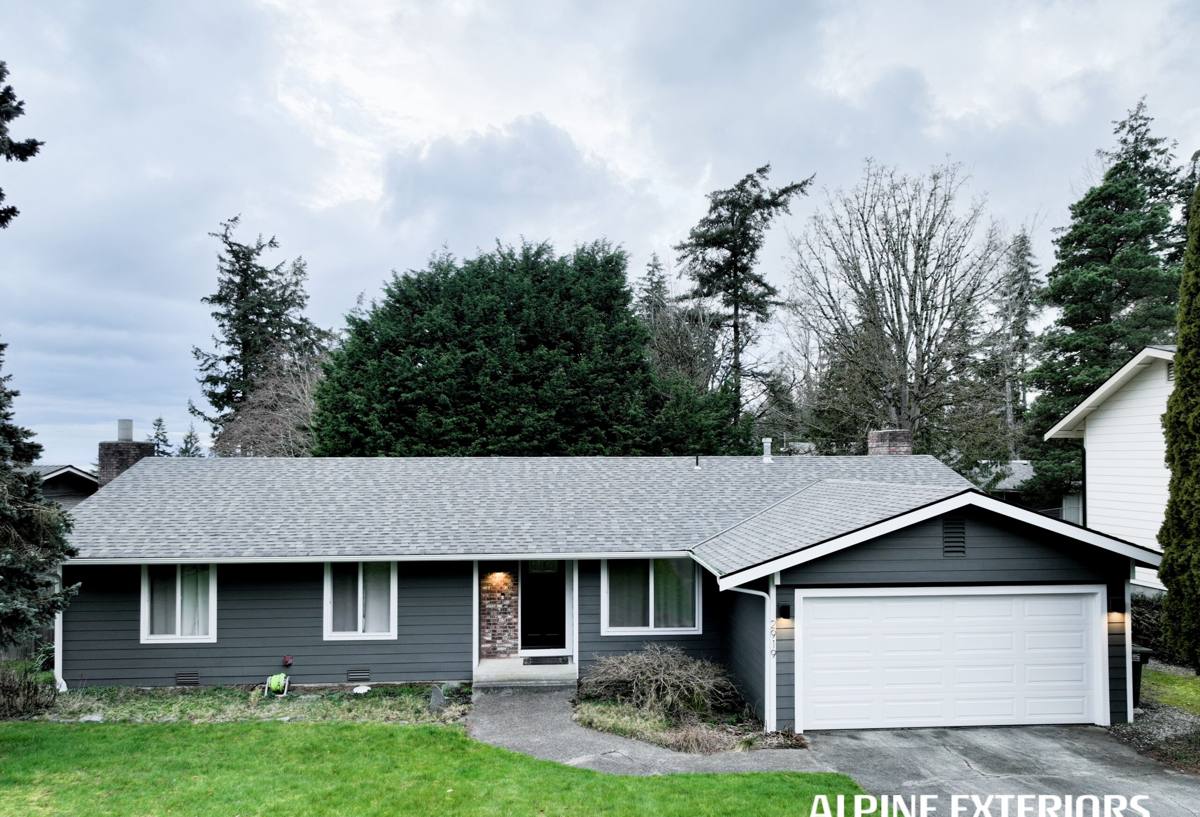
Why Fiber Cement Fits This Climate
Fiber cement is a cement, sand, and cellulose fiber composite, engineered specifically to resist the things that wear down other siding materials in a wet, marine-influenced climate. It doesn't rot the way wood-based products can when moisture gets behind them. It's non-combustible, which matters during the dry, wildfire-smoke-prone stretches of late summer that have become more common in this part of Washington. And it holds paint and factory finish far longer than wood or engineered wood products, which matters directly in a climate where a siding surface spends a large share of the year damp.
That doesn't mean fiber cement is maintenance-free or forgiving of bad installation. It's a dense, heavy material that has to be cut, fastened, and flashed correctly, and it still needs proper clearance from grade, roof lines, and decks to perform the way it's designed to. But among the common siding materials available to a Kendall homeowner, it's the one best matched to what this climate actually throws at a house year after year.
Moss, Shade, and North-Facing Walls
Shaded elevations on Kendall properties — walls facing north, walls shadowed by trees or neighboring structures — stay damp longer after every rain event, which is exactly the condition moss and mildew need to establish themselves. Fiber cement's factory finish resists staining and biological growth far better than raw or field-primed wood siding, and it doesn't provide the same food source for mold and mildew that wood-based products can. That doesn't mean a shaded wall never needs cleaning, but it means the siding material itself isn't working against you.
Driving Rain and Lap Performance
Wind-driven rain finds its way into any gap left by careless installation, regardless of material. Fiber cement's dimensional stability — it doesn't swell, shrink, or cup the way wood and some engineered products can with repeated wet-dry cycling — means the laps and joints a crew cuts and fastens on install day stay tight for the life of the siding, rather than opening up as the material moves with the seasons.
Salt Air and Fastener Corrosion
The siding board itself isn't the only thing exposed to salt-tinged air — the fasteners, flashing, and trim around it are too. A correct fiber cement install uses corrosion-resistant fasteners and flashing throughout, because a board that outlasts its own fastening hardware just means a different failure a few years down the road.
James Hardie Only: Our Standard for Kendall Homes
We install James Hardie fiber cement siding exclusively. We don't offer LP SmartSide, vinyl, Cemplank, Allura, primed spruce, or cedar as alternatives, and that's a deliberate professional standard, not a lack of options. Each of those products has genuine strengths and a place in the market — this isn't a claim that they're poorly made. It's that after weighing moisture behavior, maintenance burden, installation sensitivity, and warranty structure against what Kendall's climate demands over decades, not just years, Hardie is the product we're willing to put our name behind and stand behind with our own workmanship warranty.
Hardie's HZ5 product line is engineered specifically for the freeze-thaw and moisture-cycling conditions common to the Pacific Northwest, which is the version we spec for Kendall installs. The ColorPlus factory finish is baked on under controlled conditions rather than field-applied, which gives it a more consistent, longer-lasting bond than site-painted siding — and in a climate where a fresh paint job doesn't always get the dry cure time it needs, that factory-controlled finish is a real practical advantage, not just a marketing point. Hardie also backs its products with a strong transferable warranty, which matters if you ever sell the home.
What a Correct Fiber Cement Installation Involves
Fiber cement performs exactly as well as it's installed, and cutting corners on any of the following steps is where problems start, usually a few wet seasons after the crew has already left.
Weather-Resistive Barrier and Flashing First
Before a single board goes up, the wall needs a correctly lapped weather-resistive barrier and flashing at every window, door, and penetration. The siding is the visible layer, but the drainage plane behind it is what actually keeps water out of the wall assembly — siding alone, no matter how good the material, isn't a complete water management system on its own.
Rainscreen Gap
Given how much wind-driven rain and prolonged dampness this climate produces, a rainscreen gap between the WRB and the siding gives any moisture that does get past the outer layer a path to drain and dry out, rather than sitting trapped against the back of the board. It's a detail that costs more in labor and materials than nailing siding directly to the sheathing, and it's one we don't skip.
Clearance From Grade, Roof Lines, and Decks
Hardie's own installation instructions call for specific clearance between the bottom of the siding and grade, roofing, decks, and patios. Skipping that clearance is one of the most common installation mistakes we see on homes we're asked to re-side, and it's a direct path for splashback moisture and standing snow or debris to sit against the bottom course of siding.
Fastening Pattern and Fastener Choice
Fiber cement has to be fastened at the correct spacing and depth, with corrosion-resistant fasteners appropriate for this coastal-influenced climate. Overdriven or underdriven fasteners, or the wrong fastener spacing, can compromise both the weather seal and the long-term hold of the siding.
Caulking and Joint Treatment
Butt joints, trim intersections, and penetrations need the right sealant, applied correctly, not just a bead of whatever caulk happens to be on the truck. Hardie publishes specific guidance on which joints should be caulked and which should be flashed instead, and following that guidance is part of what separates a correct install from one that looks fine on day one.
Comparing Siding Materials for Kendall Homes
Homeowners comparing bids sometimes see very different materials proposed at very different price points. Here's an honest look at how the common options stack up for a property in this climate.
| Material | Moisture & Moss Behavior Here | Maintenance Burden | Realistic Lifespan |
|---|---|---|---|
| James Hardie fiber cement | Dimensionally stable; factory finish resists staining and biological growth | Low; periodic washing, no repainting for years | 30-50 years with correct install |
| LP SmartSide (engineered wood) | Treated to resist moisture, but still wood-based; edge and cut-end sealing is critical | Moderate; field-applied or touch-up finish over time | 20-30 years, install-dependent |
| Vinyl | Won't rot, but can warp or fade; seams and laps can let wind-driven rain track behind it | Low, but limited repair options if damaged | 20-30 years |
| Cedar | Attractive, but absorbs moisture and is a food source for mildew in shaded, damp conditions | High; regular refinishing and moisture monitoring | 15-25+ years, heavily maintenance-dependent |
| Primed spruce | Softwood prone to swelling and paint failure in prolonged damp conditions | High; repainting on a shorter cycle | 10-20 years, climate-dependent |
We'll walk you through this comparison honestly rather than just pointing at the most expensive option. For a Kendall property dealing with this specific mix of salt air, driving rain, and long-season moss, fiber cement's combination of low maintenance and moisture resistance is what makes it the material we recommend and the only one we install.
How Our Process Works
Every Kendall siding job follows the same sequence, whether it's a single wall repair or a full re-side.
- On-site assessment: We walk the property, check the condition of the existing siding and sheathing, and look specifically at grade clearance, shaded elevations, and any signs of past moisture intrusion.
- Written estimate: You get a detailed, itemized estimate specifying Hardie product line, color, and the scope of WRB, flashing, and rainscreen work — not just a lump-sum number.
- Tear-off and sheathing check: Old siding comes off and the sheathing underneath gets inspected for hidden rot or damage before anything new goes on. This is often the point where a homeowner learns whether a previous install had a moisture problem building behind the old siding.
- WRB, flashing, and rainscreen installation: The drainage plane goes in correctly at every window, door, and penetration before siding starts.
- Hardie siding installation: Boards are cut, fastened, and lapped to manufacturer specification, with correct clearance maintained from grade, roofing, and decks throughout.
- Trim, caulking, and final detailing: Joints and penetrations get the correct sealant or flashing treatment, and trim is finished to match the specified Hardie color and profile.
- Final walkthrough: We go over the completed job with you, point out anything you should know for long-term care, and make sure you have your warranty paperwork.
A Practical Checklist for Comparing Siding Bids
- Does the bid specify the exact Hardie product line, profile, and ColorPlus color, not just "fiber cement siding"?
- Is a rainscreen gap included, or is siding going directly against the WRB?
- Does the estimate call out grade, roof, and deck clearance explicitly?
- Is fastener type specified, and is it corrosion-resistant for this climate?
- Does the contractor separate Hardie's material warranty from their own workmanship warranty in writing?
- Can they point to real, verifiable local work in or near Kendall?
- Do they carry current WA contractor licensing, liability insurance, and workers' compensation?
Maintaining Fiber Cement Siding in a Long Moss Season
Fiber cement's low maintenance burden doesn't mean zero maintenance. A yearly rinse-down with a garden hose or low-pressure wash, focused on shaded and north-facing walls where moss and mildew are most likely to establish, keeps the factory finish looking the way it should and prevents organic growth from getting a foothold. Keep gutters clear and downspouts directed away from the wall base so splashback and overflow don't sit against the bottom courses of siding. And if you notice a caulked joint starting to crack or pull away, get it resealed before the next wet season rather than after water has already found its way behind it. These are simple habits, and they matter more in Kendall's climate than they would somewhere drier.
Why Hiring a Crew That Already Works Kendall Matters
A crew that regularly installs Hardie siding on Kendall homes has already seen which elevations need extra rainscreen attention because of shade, how far salt-tinged air travels inland in this part of the county, and where past installers commonly skipped grade clearance or rainscreen detailing on homes we're now asked to fix. That's practical knowledge that shows up in dozens of small decisions on install day — decisions a crew unfamiliar with this specific climate might not think to make at all. It also means working with a contractor who's still reachable years later if a warranty question comes up, rather than a crew that worked the area once and moved on.
If you're considering fiber cement siding for a Kendall home, we're glad to take an honest look at your property and walk you through exactly what a correct install would involve. Use the form below to request a free, no-pressure estimate.