 Lynden Siding
 Why Windows in Kendall Take More Punishment Than People Expect
Kendall sits in the foothill country northeast of Lynden, where Whatcom County's weather doesn't let up for long. Wet systems roll in off the Salish Sea and stack up against the Cascade foothills, and by the time they reach Kendall they've dropped a lot of rain and left the air heavy with moisture. Add the driving, wind-pushed rain that hits exposed rural properties from the west and south, and you get a climate that's genuinely hard on windows year-round, not just in the wettest months.
Then there's moss season, which around here isn't really a season — it's most of the year. Moss and algae need shade, moisture, and time, and Whatcom County gives them plenty of all three. On windows, that shows up as green or black staining below sills, slow buildup in corners that never fully dry out, and trim that stays damp long after a storm has passed. None of that is cosmetic only. Constant dampness against wood trim, failing caulk lines, or gaps behind old flashing is exactly how water finds its way into wall framing.
Custom windows done right for a Kendall home aren't just about a nicer look or a tighter seal on the glass. They're about managing water at the one point in the wall where it's easiest to get wrong — the rough opening — in a climate that gives you very little margin for a sloppy install.
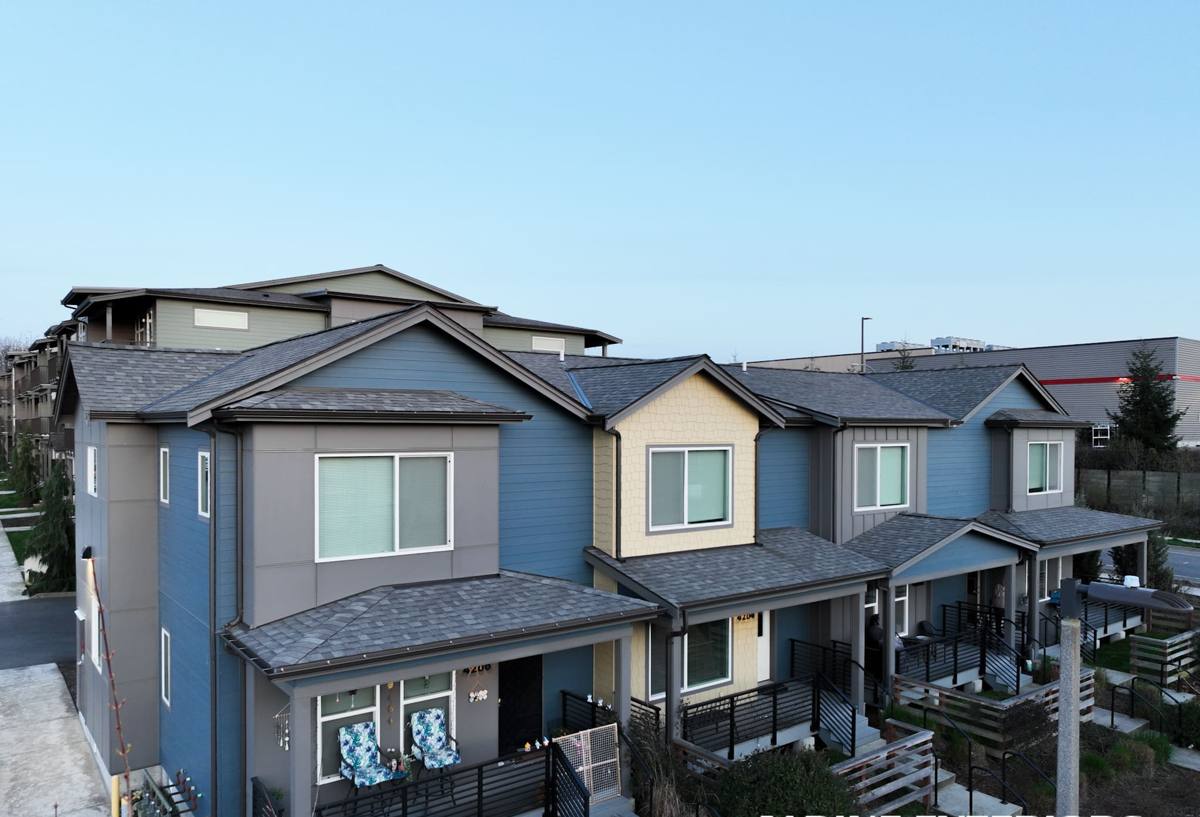
What a Correct Custom Window Installation Actually Involves
Most window failures we see aren't glass failures. They're water management failures around a window that was otherwise a fine product. A correct install treats the window as part of the wall's drainage plane, not as a separate box dropped into a hole.
The details that actually matter
That means a sloped sill pan flashing with a back-dam so any water that gets past the glazing or trim drains back outside instead of pooling on the sill. It means integrating the window flange with the house wrap or weather-resistive barrier in the correct shingle-lap order — never taped in a way that traps water behind the siding. It means using low-expansion foam or backer rod and sealant around the frame instead of just caulk, so the gap is insulated and sealed without bowing the frame. And it means shimming the unit square, level, and plumb before anything is fastened, so the sash operates correctly and the weatherstripping actually compresses evenly for the life of the window.
Skip any one of those steps and the window itself can be a good product and still leak, fog, or rot out the surrounding trim within a few years. This is the part of the job that a homeowner can't see once the trim goes back on, which is exactly why it has to be done right the first time.
Choosing the Right Frame Material for a Kendall Home
Frame material drives how a window handles constant moisture, temperature swings, and years of Whatcom County weather. There's no single right answer for every house — it depends on the home's age, exposure, and budget — but the trade-offs are consistent.
| Frame Material | Moisture & Rot Resistance | Insulation Performance | Maintenance | Best Fit |
|---|---|---|---|---|
| Vinyl | Excellent — won't rot or corrode | Good, multi-chamber designs improve it further | Low — occasional cleaning | Most Kendall homes on a practical budget |
| Fiberglass | Excellent, very stable in temperature swings | Very good, low expansion/contraction | Low | Homes wanting a slimmer profile or paintable finish |
| Wood-clad | Good on the exterior clad side, but interior wood needs care | Very good | Higher — interior finish upkeep, sealant checks | Homes prioritizing a traditional wood interior look |
| Aluminum | Prone to condensation and cold-transfer without a thermal break | Weakest unless thermally broken | Moderate | Limited use cases; we're selective about where we recommend it here |
We're honest with Kendall homeowners about aluminum in particular. Without a thermal break, it conducts cold straight through the frame, which in a humid climate like this means condensation on the interior frame edges during cold, damp stretches. That's not a defect in the material so much as a mismatch with this specific climate, and it's why we steer most of our recommendations here toward vinyl or fiberglass unless there's a specific design reason to do otherwise.
Glass and Performance Options Worth Understanding
The glass package matters as much as the frame in a climate that's more about cloud cover and moisture than intense sun. A few decisions worth understanding before you pick a window:
Double-pane vs. triple-pane
Double-pane with a good Low-E coating and argon fill is the standard that performs well for most Kendall homes. Triple-pane adds another layer of insulation and can help on colder, more exposed lots, but it adds weight and cost — worth discussing for a specific room rather than assuming it's needed everywhere.
Low-E coatings and spacers
Low-E coatings are tuned differently depending on climate goals. In a mostly overcast, moisture-heavy area like Whatcom County, the priority is usually a coating that manages heat loss (U-factor) rather than one built primarily to block strong solar gain. Warm-edge spacers between the panes also matter more here than people expect — they reduce the cold edge effect that causes condensation to form right at the glass perimeter during damp, chilly stretches.
Our Process, From First Look to Final Walkthrough
- On-site assessment — we check existing framing, sills, and trim for rot or moisture damage before anything is measured, since hidden damage changes the scope of the job.
- Measuring and product selection — we walk through frame material, glass package, and grille or trim style options based on the home and budget, not a one-size pitch.
- Ordering and lead time — custom sizes and finishes take time to manufacture; we give you a realistic timeline up front.
- Careful removal — old windows come out with attention to what's behind them. If we find soft sheathing or rot, we flag it before closing the wall back up rather than covering it over.
- Flashing and installation — sill pan, WRB integration, shimming, and insulation done in the correct order, every time.
- Trim and sealing — interior and exterior finish work sealed to shed water, not just look clean.
- Final walkthrough — we operate every window with you, check locks and weatherstripping, and confirm everything closes and seals correctly.
What We Commonly Find Replacing Older Windows Around Kendall
Older homes in this area tend to show the same handful of problems when we start removing existing windows. Rot at the bottom corners of the sill is the most common, usually from years of water sitting rather than draining. Moss and algae staining below the sill is a visual clue to a bigger pattern of constant dampness against the trim. Wood sashes that have swelled and warped so they no longer latch tightly are common on original single-pane units. Fogged or hazy glass on older double-pane windows means the seal between the panes has failed and the insulating gas is gone. And on aluminum-frame windows, we regularly find condensation staining or minor corrosion at the frame edges from years of cold-transfer in a humid climate.
None of these are unusual for the area — they're just what this climate does to windows over enough years, especially units that were never flashed correctly to begin with.
Keeping New Custom Windows Performing Long-Term
A correctly installed window still benefits from a bit of seasonal attention, especially given how much moisture this area sees:
- Check exterior caulk lines each fall, before the heavy rains set in, and touch up any cracking or gaps
- Clear weep holes at the bottom of the frame so water can drain instead of pooling
- Wipe down moss or algae buildup with a soft brush and mild cleaner — avoid pressure washing directly at seals or weep holes
- Watch for condensation forming between the panes, which signals a failed seal rather than a cleaning issue
- Operate locks and hardware each season so the compression seal keeps working as intended
- Confirm screens fit snugly, since a loose screen can let wind-driven rain reach the sill
Why It Matters to Hire a Crew That Already Works in Kendall
Window work and siding work are really the same job — managing water at the building envelope — done at two different scales. A crew that handles both on the same property can carry one continuous flashing and drainage plan from the siding down through the window openings, instead of two separate contractors each assuming the other one handled the transition. That gap between trades is where a lot of Kendall's water intrusion problems actually start.
Working regularly in and around Lynden and the surrounding Whatcom County communities also means we've seen how homes of different eras out here are actually built — from older farmhouses to newer construction — and what tends to go wrong first in each. We hold every window install to the same flashing and sealing standard whether it's one replacement window or a full house, because that standard is what actually determines whether the job holds up through a normal Kendall winter, not just how the trim looks the day we finish.
If you're weighing custom windows for a home in Kendall, we're glad to take a look and give you a straightforward, no-pressure estimate — just fill out the form below.