 Lynden Siding
 Siding Repair for Maple Falls Homes
Maple Falls sits up in the wooded, higher-rainfall part of Whatcom County, closer to the foothills than the flat farmland around Lynden proper. That difference matters more than most homeowners realize when it comes to siding. More tree canopy means more shade, more standing moisture on north-facing walls, and a longer window every year where siding simply doesn't get a chance to fully dry out between storms. Add in the driving rain that blows through this part of the county most of the fall and winter, and you have conditions that will find every weak point in a home's exterior faster than they would in a drier, more open lot.
We're a Lynden-based crew and we already work this area regularly, which means we've seen how siding actually fails out here — not in a showroom, but on real houses tucked into real tree lines. This page covers what siding repair should actually involve for a Maple Falls home, what causes most of the damage we get called out for, and how we approach a repair job so it holds up instead of becoming a repeat visit.
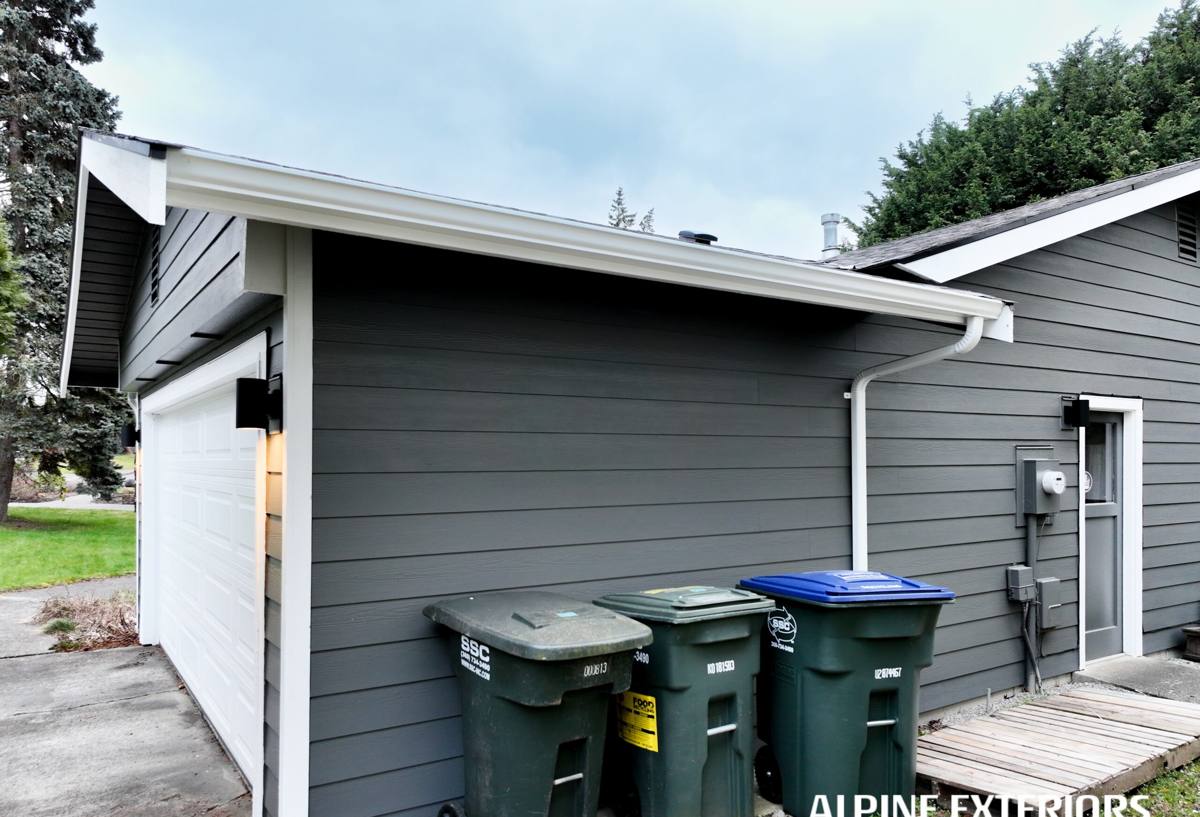
What the Local Climate Does to Siding
Whatcom County gets a long wet season, and Maple Falls gets more of it than the lowland parts of the county thanks to elevation and tree cover. A few specific things happen to siding here that are worth understanding before you decide what kind of repair you actually need:
- Moss and algae take hold fast. Shaded walls, gutters that don't drain quickly, and damp air combine to grow moss on siding surfaces, trim, and butt joints within a season or two if a home isn't maintained.
- Driving rain finds gaps. Wind-driven rain doesn't just run down a wall — it gets pushed sideways into seams, nail penetrations, and butt joints that aren't sealed correctly. Once water gets behind siding, the damage is often hidden until it's significant.
- Wet-dry cycling stresses old caulk and trim. Repeated soaking and drying breaks down sealant and causes wood trim to swell, crack, and separate from the siding it's supposed to protect.
- Debris and moisture collect at grade. Homes tucked near trees accumulate leaf litter, needles, and moss at the base of walls, which holds moisture against the bottom courses of siding — usually the first place we find rot or delamination.
None of this means siding here is doomed — it means siding here needs to be installed and repaired correctly the first time, with materials that are actually built for a wet, shaded climate.
Signs a Maple Falls Home Needs Siding Repair
Most homeowners don't think about their siding until something is visibly wrong, but the earliest signs are usually small. Catching them early is the difference between a patch repair and a much bigger job.
What to look for
- Soft or spongy spots when you press on siding near the bottom of walls or under windows
- Visible moss or dark streaking that keeps coming back after cleaning
- Cracked, peeling, or bubbling paint on wood-based siding or trim
- Gaps opening up at butt joints, corners, or where siding meets window and door trim
- Warping, cupping, or boards that no longer sit flat against the wall
- Water stains on interior walls near exterior corners — often the first sign homeowners actually notice
- Nail heads popping or streaking with rust
Any one of these on its own might be minor. Several showing up in the same area of the house usually means water has been getting behind the siding for a while, and the repair needs to address what's underneath, not just what's visible.
What a Correct Repair Actually Involves
A siding repair that just swaps a damaged board for a new one, without checking what's behind it, is a short-term fix. Done right, a repair on a Maple Falls home should include:
1. Finding the actual water path
Damaged siding is a symptom. Before we replace anything, we trace back to where water is actually getting in — a failed seam, missing flashing, a gap at a penetration, or a drainage problem at grade. Replacing the board without fixing the entry point means the same spot fails again.
2. Checking the water-resistive barrier and flashing
Once siding is off, we inspect the house wrap or building paper underneath and the flashing around windows, doors, and any wall penetrations. If that layer is compromised, patching siding over it doesn't solve anything — it just hides the problem again.
3. Matching material and finish correctly
This is where a lot of repairs go wrong. If the original siding is James Hardie fiber cement with a factory ColorPlus finish, the repair needs to use matching Hardie product and the correct fastening, joint, and caulking details — not a mismatched patch that stands out or behaves differently in weather. We only work in Hardie fiber cement, so on homes that already have it, matching plank profile, exposure, and color is straightforward. On homes with older wood, vinyl, or other siding, we'll be upfront about what a like-for-like patch can and can't achieve versus a broader repair using Hardie.
4. Sealing and finishing to spec
Proper caulking at butt joints and trim, correct nail placement, and factory-matched touch-up paint (for Hardie's ColorPlus system) close the job out so the repaired section performs — and looks — like the rest of the wall.
Repair vs. Replacement: How We Help You Decide
Not every siding problem needs a full re-side, and not every repair is worth doing instead of replacing a section outright. The right call depends on how much of the wall is affected, what's underneath, and the age and condition of the rest of the siding.
| Factor | Leans toward repair | Leans toward replacement |
|---|---|---|
| Extent of damage | Isolated to one board or small area | Spread across multiple walls or elevations |
| Underlying sheathing | Dry, sound wood behind the damaged siding | Soft, rotted, or delaminated sheathing found |
| Siding material | Existing Hardie fiber cement, matchable | Older wood, vinyl, or discontinued product |
| Age of siding | Relatively recent installation | Original siding is decades old and failing broadly |
| Cause of damage | One-time event (impact, isolated flashing failure) | Systemic moisture issue affecting the whole install |
We'll always tell you honestly which side of that table your home falls on. If a patch repair is genuinely the right call, that's what we'll recommend — we're not trying to sell a full re-side to every homeowner who calls about one bad board.
Why We Only Repair and Install James Hardie
We made a decision as a company to work exclusively in James Hardie fiber cement siding — no vinyl, no LP SmartSide, no cedar or primed spruce, no other fiber cement brands. For a climate like Maple Falls', that decision comes down to a few practical points:
- It's non-combustible. Fiber cement doesn't burn, which matters in a wooded area with wildfire risk during dry summer stretches.
- It's engineered for wet climates. Hardie's HZ5 product line is built specifically for the moisture and freeze-thaw conditions common to the Pacific Northwest — this isn't a generic product adapted after the fact.
- The factory finish holds up. ColorPlus finish is baked on at the factory and resists the fading and peeling that field-applied paint struggles with under constant damp-and-dry cycling.
- Warranty coverage that transfers. Hardie backs its product with a strong, transferable warranty — useful if the home ever sells.
That said, this isn't a knock on every other product on the market — it's why, after years of installing and repairing exteriors in this climate, Hardie is the only material we're willing to put our name behind long-term.
How We Handle a Repair Job
- On-site inspection. We walk the exterior, check the damaged area and anything nearby that shows early warning signs, and look at drainage and grading around the foundation.
- Honest assessment. We tell you plainly whether you're looking at a targeted repair, a larger section replacement, or if the damage points to a bigger moisture issue worth addressing now.
- Written scope and estimate. No verbal promises — you get a clear scope of what's being repaired and why, with a free, no-pressure estimate.
- Repair to spec. Matching Hardie product, correct flashing and sealant details, and factory-matched finish work where applicable.
- Walkthrough. We show you what we found and what we did before we consider the job finished.
Why Hiring a Crew That Already Works Maple Falls Matters
Siding repair is a trade where local experience actually shows up in the work. A crew that's done repairs on homes in this specific pocket of Whatcom County already knows:
- Which wall orientations and tree-shaded spots tend to hold moisture and moss longest
- How driving rain patterns off the foothills tend to expose weak flashing details
- What correct Hardie repair looks like on homes that were originally installed by different crews with varying levels of care
- Realistic timing around the wet season, so repairs aren't rushed into weather that won't let sealant or paint cure properly
That local familiarity means fewer surprises once we start pulling siding, and a repair plan that accounts for how this specific area behaves — not a generic approach copied from a drier part of the state.
A Quick Homeowner Checklist
- Walk your exterior once or twice a year, especially after the wettest months, and press-test any soft-looking areas
- Keep gutters clear so water isn't overflowing down the siding
- Clear moss, leaves, and debris away from where siding meets grade
- Watch for recurring moss or algae in the same spot — it usually means that area stays wet longer than it should
- Address small gaps in caulking or trim before winter rather than waiting until spring
- Get a professional opinion before assuming a small issue is "just cosmetic"
If you're seeing any of the warning signs above, or just want a second opinion on a repair someone else quoted, we're happy to take a look. Fill out the form below for a free, no-pressure estimate — we'll tell you honestly what your siding needs, whether that's a small patch or something bigger.