 Lynden Siding
 Windows Take a Different Kind of Beating in Nooksack
Nooksack sits in a part of Whatcom County where the weather doesn't do anything halfway. Wind off the Salish Sea and the Strait of Georgia carries fine salt and moisture well inland, driving rain comes in sideways more often than straight down, and the wet season here isn't a few weeks — it's most of the year. Add the shade and dampness that settles into yards near the Nooksack River corridor and you get a near-permanent moss season that coats north-facing trim, sills, and anything that holds standing moisture.
Windows are one of the first things on a house to show what that environment is doing to it. A window is a hole in your building envelope with moving parts, glass, and a seal that has to hold against wind-driven water for decades. When that seal or the installation around it isn't right for this climate, the failure shows up as fogged glass, soft trim, drafts, or water stains on the wall below the sill — usually years before the rest of the house shows any wear.
That's the difference between a generic window job and one built for Nooksack specifically. The glass package, the frame material, and — most of all — the flashing and sealing details around the rough opening all need to account for what this particular stretch of Whatcom County throws at a house.
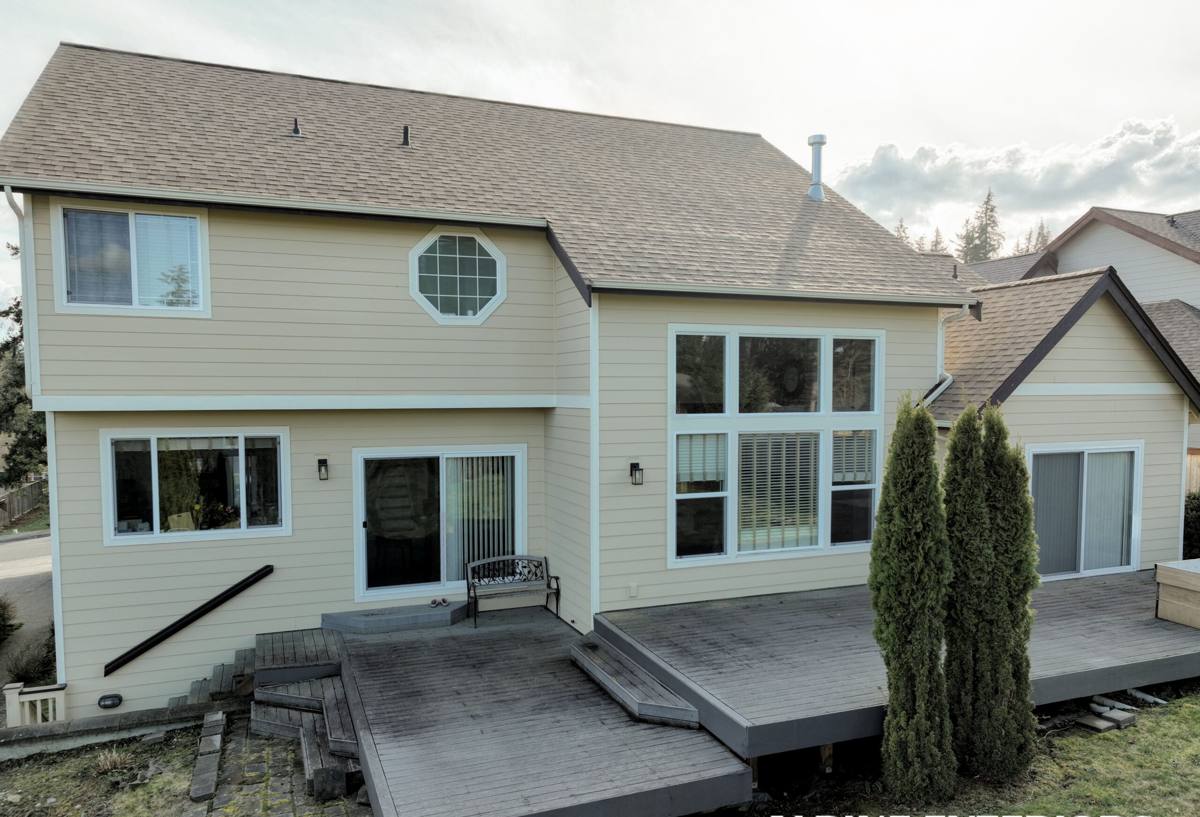
Signs Your Current Windows Are Already Losing the Battle
Most homeowners don't replace windows because they woke up wanting new windows. They replace them because something told them the old ones were failing. Here's what that usually looks like in this area:
- Fogging or a cloudy haze between the panes — the seal on the insulated glass unit has failed and moisture is trapped inside
- Soft, discolored, or spongy wood trim around the frame, especially on the sides that face prevailing wind and rain
- Visible moss or black-green streaking on sills and lower trim that comes back within weeks of cleaning
- A noticeable draft near the frame edges when wind picks up, even with the window fully latched
- Difficulty opening, closing, or locking — frames swell and warp as they take on moisture
- Water staining on interior drywall or the wall cavity below a window after a hard rain
- Higher heating bills in winter with no other explanation, which often traces back to failed seals or thin glass
Any one of these on its own might just mean a repair. Several of them together, especially on the weather-facing side of the house, usually mean the window and its installation have reached the end of what they can do.
What a Correct Custom Window Installation Actually Involves
"Custom" doesn't just mean the window is built to fit a non-standard opening, though that's part of it in older Nooksack homes where openings are rarely perfectly square anymore. It means the whole installation is treated as a system, not just a box dropped into a hole.
Flashing and Water Management
This is the part that actually determines whether a window survives driving rain. Water has to be directed out and away from the rough opening at every layer — sill pan flashing at the bottom, house wrap integration at the sides, and head flashing at the top that overlaps correctly with the weather barrier above it. Skip or shortcut any one of these and water finds its way behind the trim, where it does damage you won't see until the wall is already rotting.
Sizing and Fit
Older homes in this area often have openings that have shifted slightly over decades of wet-dry cycling. A correct install measures the actual opening, not the nominal size, and either orders the window to fit or corrects the opening itself rather than forcing a stock size in with excess shim and caulk.
Insulation and Air Sealing
The gap between the window frame and the rough opening needs to be filled with a material that stays flexible and doesn't compress or shrink away over time, then sealed on the interior and exterior with the right sealant for the substrate. Overfilling with rigid foam can actually bow the frame and cause the window to operate poorly.
Glass Package Selection
Whatcom County's overcast, moisture-heavy climate calls for a different glass strategy than a dry inland climate would. Low-E coatings tuned for heat retention, warm-edge spacers that resist condensation at the glass edge, and gas-filled insulated units all matter more here than they would somewhere drier.
Frame Material: What Actually Holds Up Here
The frame material decision matters as much as the glass. In a marine-influenced, high-rainfall climate like this one, some materials simply age better than others.
| Material | Moisture Behavior | Maintenance | Typical Lifespan Here |
|---|---|---|---|
| Vinyl | Won't rot or absorb water; seams are the main weak point if welded poorly | Low — occasional cleaning | 20–30+ years |
| Fiberglass | Dimensionally stable, resists swelling and warping in wet-dry cycles | Low | 30+ years |
| Wood-clad | Good insulation, but the cladding must be flawless or moisture reaches the wood core | Moderate to high — cladding seams need monitoring | 20–25 years if maintained well |
| Aluminum | Doesn't rot, but conducts cold and can condense heavily in this climate without a thermal break | Low | 20–30 years |
We don't push one material on every job. A vinyl or fiberglass frame is usually the lower-maintenance, more moisture-tolerant choice for most Nooksack homes, and it's what we recommend by default. Wood-clad has real appeal for certain architectural styles, but we're upfront that it asks more of the homeowner over time — the cladding has to stay intact, because once moisture gets past it into the wood core, that damage is hidden and expensive to fix. That's a maintenance trade-off, not a knock on the product; it's just not the lowest-effort option for this climate, and we'd rather you know that before you commit than find out in year twelve.
Our Process, Start to Finish
- On-site assessment: We look at every opening individually — actual measurements, condition of the existing trim and sheathing, and any signs of past water intrusion.
- Honest recommendation: You get options that fit your home and budget, with the trade-offs of each explained plainly, not just the option with the best margin for us.
- Custom order: Windows are built to the actual opening size and your chosen glass, frame, and hardware specs — not forced from a stock inventory.
- Removal and inspection: When we pull the old window, we check the sheathing and framing behind it for hidden rot or water damage before anything new goes in.
- Correct flashing and installation: Sill pan, side flashing, head flashing, air sealing, and insulation are done in the right order, every time — not shortcuts even where they wouldn't be visible.
- Interior and exterior finish: Trim, caulking, and paint or stain are finished to match the rest of the house.
- Final walkthrough: We test every window's operation and go over care basics with you before we consider the job done.
Cost Factors Worth Understanding Before You Budget
Window pricing varies a lot based on real factors, not just window count. Understanding what drives cost helps you budget realistically instead of guessing from a number you saw online.
| Factor | Why It Affects Cost |
|---|---|
| Frame material | Fiberglass and higher-end vinyl generally cost more upfront than basic vinyl or aluminum |
| Glass package | Triple-pane, upgraded Low-E coatings, and specialty spacers add cost but improve comfort and condensation resistance |
| Opening condition | Hidden rot or out-of-square framing found during removal adds repair time before the new window can go in |
| Custom sizing or shape | Non-standard openings, arches, or specialty shapes cost more than stock rectangular sizes |
| Number of openings | Whole-house replacement typically has a lower per-window cost than replacing one or two at a time |
| Access and site conditions | Second-story windows, tight landscaping, or difficult access add labor time |
We'll give you a broad range once we've actually looked at your home — we won't quote a firm number sight unseen, because opening condition alone can shift the cost of a job significantly.
Why It Matters That We Already Work This Area
A crew that regularly works in Nooksack and the surrounding Whatcom County communities has already seen how local homes age — which directions take the worst weather, which older construction methods need extra attention during removal, and how moss and moisture typically show up on window trim before they cause real damage. That local pattern recognition shortens the guesswork on your job and helps catch problems before they're buried behind new trim.
It also means we're not driving in from outside the region to do a one-off install and disappear. If a caulk line needs a look after the first hard winter, or you have a question about how a window is performing, you're calling a crew that's still working in your area and stands behind the job.
Living With Custom Windows Through Moss Season
Even a correctly installed window benefits from a little seasonal attention in a climate like this one. A few habits go a long way:
- Clear debris and moss buildup from sills and tracks a couple of times a year, especially on shaded or north-facing windows
- Check exterior caulk lines annually for cracking or separation, particularly after a hard freeze
- Keep gutters and downspouts clear so overflow doesn't run directly down the wall above a window
- Operate every window a few times through the wet season so tracks and hardware don't seize up from disuse
- Watch for any new fogging between panes — it's an early, reliable sign a seal has failed
None of this is heavy maintenance. It's the kind of basic attention that lets a correctly installed window actually reach the lifespan it's built for, instead of quietly failing behind trim that looks fine from the yard.
Get a Straight Answer About Your Windows
If your windows are fogging, drafting, sticking, or just past their years in this weather, it's worth having someone look before you decide what to do. We'll walk your home, tell you honestly what we see, and give you options and a real range — no pressure, no upsell. Request a free estimate using the form below and we'll get a look at what your Nooksack home actually needs.