 Lynden Siding
 Roof Repair Built for This Corner of the Border
Homes in and around Abbotsford, BC sit in a climate that's harder on a roof than most homeowners realize. You're close enough to the Salish Sea and the Fraser Valley's damp air to deal with salt-laden moisture working into fasteners and flashing, driving rain that comes in sideways during winter storms, and a moss season that can run eight or nine months out of the year. None of that shows up as one big dramatic failure. It shows up as a slow leak nobody notices until there's a stain on the ceiling, or a shingle edge that curls up just enough to let wind-driven rain underneath.
We work this area regularly out of Whatcom County, and the roofs we get called out to repair almost always have the same story: a small, ordinary problem that sat too long because it wasn't obvious from the ground. Roof repair done right isn't about slapping sealant on the spot that's dripping. It's about finding why water got in, fixing that specific failure with the right materials, and leaving the rest of the roof alone if it doesn't need touching.
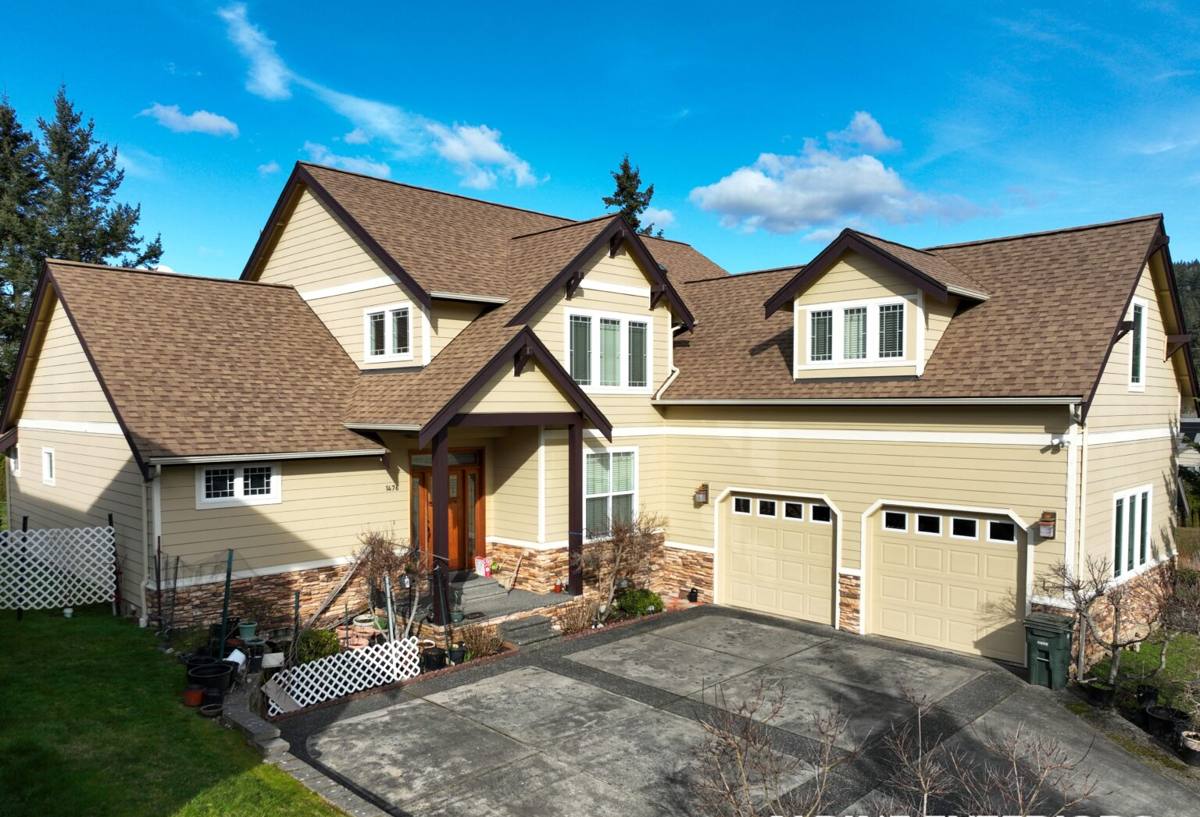
Signs Your Roof Needs Repair, Not a Full Tear-Off
Most roofs don't need to be replaced just because they're leaking. A full replacement makes sense when the decking is compromised over a wide area, when there have already been several patch jobs, or when the roof is past its expected service life. Short of that, a well-targeted repair is usually the honest answer. Here's what typically points to a repair being the right call:
- Water stains on an interior ceiling or wall that trace back to one specific area, not multiple spots
- Missing, cracked, or lifted shingles after a windstorm, with the surrounding roof still in good shape
- Moss buildup concentrated on the north-facing or shaded slopes rather than the whole roof
- Flashing that's pulled away or rusted around a chimney, vent pipe, or skylight
- Granules collecting in gutters from one section of roof rather than uniformly
- A soft or spongy spot underfoot in one localized area, rather than throughout the roof
If several of these are happening at once across most of the roof, or the roofing material itself is brittle and failing broadly, that's a different conversation — but we'll tell you that honestly rather than push a repair that won't hold.
What Typically Goes Wrong First on Local Roofs
The failures we see repeatedly in this area tend to trace back to the same handful of causes. Knowing the pattern helps explain why a proper repair looks the way it does.
| Problem | Typical Cause Here | Why It Matters |
|---|---|---|
| Leak near a chimney or vent | Flashing that's rusted, lifted, or was never step-flashed correctly | Flashing failures account for a large share of the leaks we're called to fix — the shingles around them are often fine |
| Moss ridges along shingle edges | Long stretches of shade and moisture, especially on north slopes | Moss holds water against the shingle surface for months, breaking down the granule layer underneath |
| Rusted or failing metal flashing | Salt-influenced coastal air accelerating corrosion on lower-grade metal | Once flashing rusts through, it stops shedding water even if it looks intact from a distance |
| Leak in a valley | Worn or improperly lapped valley material under heavy rain volume | Valleys carry more water than any other part of the roof, so a small gap here fails fast |
| Wind-lifted shingle tabs | Aging adhesive strips or nails set too high, exposed during winter storms | A lifted tab is a small fix now — left alone, it becomes a soaked deck later |
What a Correct Repair Actually Involves
Finding the real source, not just the visible symptom
Water travels. A stain on your ceiling might be directly below the failure, or it might show up several feet away after running along a rafter or down a piece of underlayment. A rushed repair patches the spot that's obviously wet. A correct repair traces the path back to where water is actually getting past the roofing system, which is sometimes a foot or more from where the damage shows up inside.
Matching materials, not improvising
Repairs hold up when the new material is compatible with what's already there — same or comparable shingle profile and color, correct-gauge flashing metal, and underlayment rated for the exposure. Mixing incompatible materials, or using surface caulking as a substitute for proper flashing, tends to fail again within a season or two, especially with the volume of rain this area gets.
Tearing back far enough
A repair that only addresses the exact square foot that's leaking often misses saturated decking or underlayment just outside that area. Doing it right means pulling back shingles far enough to reach dry, sound material, then rebuilding the layers — deck, underlayment, flashing, shingles — in the correct order and lapped the correct direction for water to shed downhill, not pool.
Our Roof Repair Process
- Inspection. We get on the roof (or use a camera where access is limited) and look at the whole roof, not just the reported problem area, since one leak often points to a second issue that hasn't shown up inside yet.
- Diagnosis and written estimate. You get a clear explanation of what's actually failing, what it will take to fix it, and a written scope before any work starts — no verbal ballparks that change later.
- Material matching. We source shingles, flashing, and underlayment that match or closely complement what's already on your roof.
- The repair itself. Tear-back to sound material, correct flashing and underlayment work, new shingles installed and nailed to spec.
- Cleanup and haul-away. Old material, nails, and debris go with us — we don't leave a magnet-sweep job for you.
- Walk-through. We show you what was done and explain any maintenance that will help the repair last.
Repair vs. Replacement — How We Actually Decide
This is the question that matters most for your budget, and it deserves an honest answer rather than a sales pitch in either direction.
| Factor | Leans Toward Repair | Leans Toward Replacement |
|---|---|---|
| Roof age | Well within expected service life for the material | At or past the material's typical lifespan |
| Extent of moss/algae | Concentrated on one or two slopes | Widespread across most of the roof |
| Repair history | First or second repair on this roof | Multiple prior patch jobs in different areas |
| Decking condition | Sound, dry decking found once we open the area up | Soft, delaminated, or repeatedly wet decking |
| Shingle condition overall | Granules intact, tabs flat, flexible material | Widespread curling, cracking, or brittle shingles |
We'll always tell you if a repair is genuinely enough — plenty of roofs that look concerning from the ground turn out to need a much smaller fix than expected once we're actually up there.
Materials We Use for Repairs — and Why
For most repairs on homes in this area, that means standard asphalt shingles matched to your existing roof's color and profile, since that's what the large majority of roofs here are built with. For flashing, we use metal suited for the coastal, salt-influenced air rather than the lightest-gauge option available, because thin flashing is exactly what corrodes first in this climate. In valleys and around chimneys and vents — the spots that take the most water — we install a self-adhering waterproof underlayment as extra insurance under the flashing, not as a replacement for it.
We generally don't recommend surface sealants as a stand-alone repair method. They can look like a fix on the day they're applied, but sealant shrinks, cracks, and loses adhesion with temperature swings and constant moisture, which means the "repair" often needs to be redone within a year or two. Where flashing or a shingle needs replacing, we replace it — sealant gets used the way it's meant to be used, as a supplement to correct flashing work, not instead of it.
Why It Matters That We Already Work Abbotsford, BC
A crew that only occasionally crosses into the area is working from a general playbook. A crew that's already familiar with Abbotsford homes — the age and construction common in the area, how the local weather pattern behaves through the wet season, and the logistics of getting a job scheduled and supplied across the border — spends less of your time figuring things out and more of it actually fixing the roof. We handle the cross-border logistics on our end so it's a normal part of scheduling, not something you have to coordinate. Being a crew that returns to this area regularly also means if something about the repair needs a follow-up look, we're not a one-time visit from out of the region.
Simple Maintenance That Extends a Repair's Life
A good repair holds longer when the rest of the roof is kept up between visits. None of this requires getting on the roof yourself — most of it is worth having done as part of a service visit.
- Clear moss and debris from shaded slopes at least once, ideally twice, a year
- Keep gutters and downspouts clear so water isn't backing up under the roof edge
- Trim back branches that keep a section of roof shaded and damp
- Check attic ventilation — poor airflow traps moisture that shortens shingle life from underneath
- Have the roof looked at after any significant windstorm, even if nothing looks obviously wrong from the ground
- Address a small leak as soon as it's noticed rather than waiting to see if it happens again
If you're dealing with a leak, missing shingles, or just want an honest read on whether your roof needs a repair or something more, we're happy to take a look and give you a straight answer. Reach out for a free, no-pressure estimate using the form below.