 Lynden Siding
 Roofing in a Salt-Air, Rain-Heavy Corner of the Pacific Northwest
Aldergrove sits just across the line from Lynden, close enough that we treat it as part of our regular service area rather than a special trip. The climate here doesn't care which side of the border a roof is on. Homes in Aldergrove deal with the same three things that wear out roofs all along this stretch of Whatcom County and the southern Fraser Valley: salt-tinged marine air, driving rain that comes in sideways more often than straight down, and a moss season that can run eight or nine months out of the year in shaded, north-facing sections of roof.
None of that means a roof here needs to be exotic or over-built. It means the details that get skipped on a rushed job — proper underlayment, correct flashing, balanced ventilation, moss-resistant materials — matter more here than they would in a dry climate. A roof that's installed correctly for this area will handle decades of wet winters without drama. A roof that's installed with shortcuts will show leaks, rot, and moss damage years before it should.
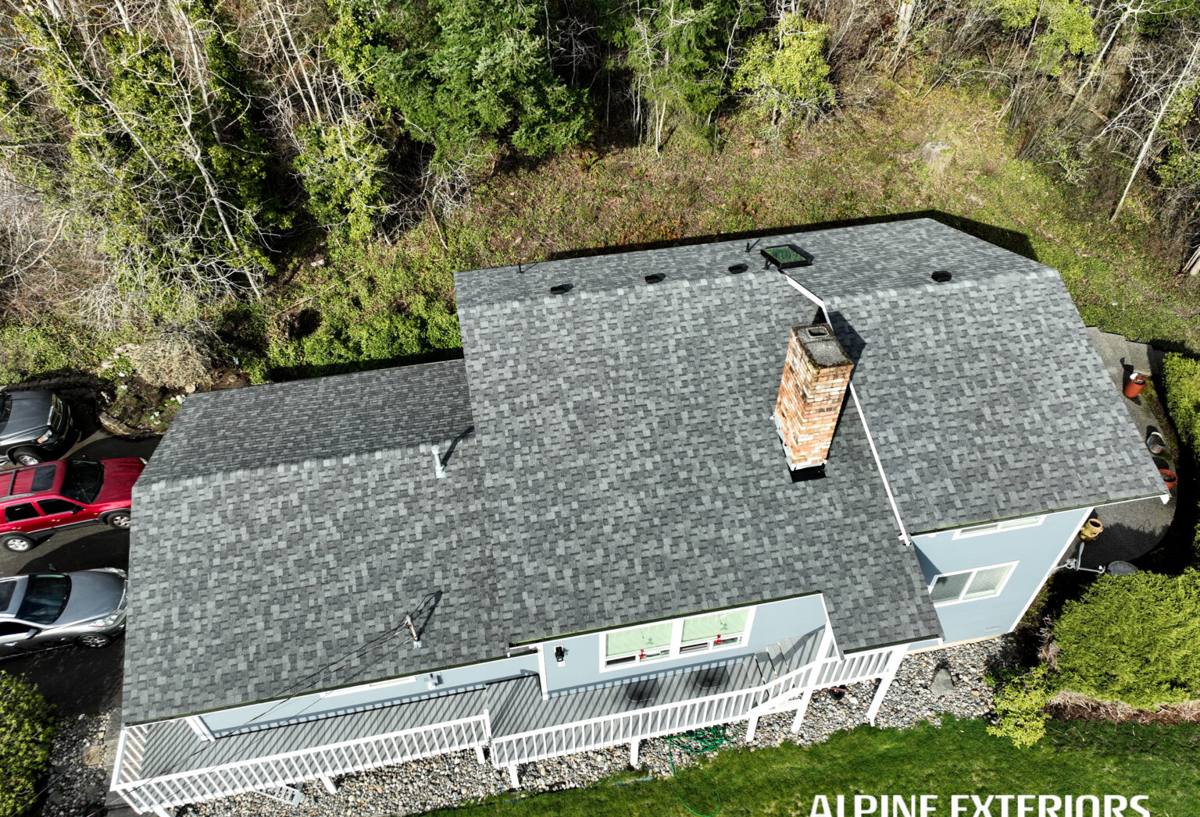
Signs Your Aldergrove Roof Is Due for Replacement
Most roofs don't fail all at once. They give warning signs for a year or two before a leak actually shows up inside the house. If you're seeing more than one or two of these, it's worth having someone look at the roof before the wet season, not during it.
- Shingles that are curling, cupping, or losing their granules — you'll often see the granules collecting in the gutters
- Moss or dark algae streaking that keeps coming back within months of being cleaned off
- Soft or spongy spots when you walk the roof, or sagging visible from the ground
- Daylight visible through the roof sheathing from inside the attic
- Water stains on interior ceilings or in the attic, even small or intermittent ones
- Flashing around chimneys, vents, or skylights that's rusted, lifted, or cracked
- A roof that's 20+ years old on standard asphalt shingles, or 15+ years with heavy moss history
What a Correct Roof Replacement Actually Involves
"Roof replacement" gets used loosely. A lot of what determines whether a roof lasts 15 years or 30 years happens in layers you never see once the job is done. Here's what should happen, in order, on any full tear-off replacement.
Tear-Off and Deck Inspection
Old roofing comes off down to the bare deck — never layered over. That's the only way to actually see the plywood or OSB sheathing underneath, which is where moisture damage from a failing roof usually shows up first. Any soft, delaminated, or rotted sheathing gets cut out and replaced before anything new goes down. Skipping this step is one of the most common shortcuts in the trade, and it's the one most likely to cause problems within a few years.
Underlayment and Ice-and-Water Protection
A synthetic underlayment goes down over the full deck as the primary water barrier beneath the shingles. In eaves, valleys, and around penetrations — the spots that take the most direct hit from wind-driven rain — a self-adhering ice-and-water membrane goes down first. This region doesn't see much ice buildup, but the same membrane does the job that matters here: sealing around fasteners and stopping wind-driven rain from working its way sideways under the shingles.
Flashing
Flashing around chimneys, skylights, vent stacks, and roof-to-wall transitions is where most roof leaks actually originate — not the shingle field. Correct flashing is step-flashed and counter-flashed properly, not just caulked over old metal. Caulk is a maintenance item, not a flashing method, and relying on it is a sign of a job done fast rather than done right.
Ventilation
Balanced intake and exhaust ventilation keeps the attic dry and close to outdoor temperature. Without it, moisture from everyday household use gets trapped in the attic, condenses on the underside of the sheathing, and rots it from the inside — often years before the shingles above it show any wear. In a climate this wet, ventilation isn't optional; it's part of what keeps the whole system dry.
Choosing Roofing Materials for This Climate
Most homes in this area end up on architectural asphalt shingles, and for good reason — but it's worth understanding the trade-offs against the alternatives before deciding.
| Material | Moss / algae resistance | Wind-driven rain performance | Typical lifespan here | Ongoing maintenance |
|---|---|---|---|---|
| Architectural asphalt (algae-resistant) | Good with AR granules; still needs periodic cleaning in shaded areas | Strong when properly nailed and flashed | 25-30 years | Occasional moss treatment on shaded slopes |
| Standard 3-tab asphalt | Weaker granule package, moss takes hold faster | Adequate but less wind resistance than architectural | 15-20 years | More frequent moss removal |
| Metal roofing | Excellent — moss struggles to grip a smooth metal surface | Very strong, minimal seams for water to find | 40-50+ years | Low; occasional fastener/seam check |
| Cedar shake | Poor without diligent upkeep — organic material moss favors | Good when installed with proper spacing/venting | 20-25 years with upkeep | High; regular treatment and inspection required |
We install cedar shake when a homeowner specifically wants that look and understands the maintenance commitment, but we don't default to it in this climate. Wood shake is organic material sitting in near-constant dampness for much of the year, and moss and moisture management on a shake roof is a recurring job, not a one-time treatment. For most Aldergrove homes, an algae-resistant architectural shingle gives the best balance of upfront cost, appearance, and how little attention it needs afterward. Metal is worth a serious look for anyone planning to stay in the home long-term or who's tired of dealing with moss altogether.
Ventilation and Moisture: The Part Homeowners Don't See
We bring up ventilation twice on purpose, because it's the single most under-discussed part of a roof replacement and the one most likely to get shortchanged by a crew trying to save time. In this climate, an attic that can't breathe properly turns into a slow-motion moisture problem: condensation forms on the underside of the roof deck overnight, soaks into the wood, and eventually shows up as soft sheathing, mold, or mildew smell — sometimes years after the shingles were installed.
The fix is straightforward on most homes: intake vents low (soffit or eave vents) balanced against exhaust vents high (ridge vent, or box vents where a ridge vent isn't practical), sized to move air across the full attic rather than short-circuiting near one end. It's not glamorous work, and it doesn't show up in a photo of the finished roof, but it's a major factor in whether that roof is still performing well in year 20.
Our Process, From Estimate to Cleanup
- On-site inspection of the current roof, decking condition (where visible), attic ventilation, and any known leak history
- A written estimate that spells out materials, scope, and price — no vague allowances
- Material selection walk-through, including color and shingle-type samples
- Scheduling around weather windows, since a roof shouldn't go on in the middle of a heavy rain system
- Tear-off, deck inspection and repair, and full underlayment installation
- Flashing, ventilation work, and shingle installation
- Full site cleanup, including a magnetic sweep for stray nails in the yard and driveway
- Final walkthrough so you can see the finished work before we consider the job done
Why a Crew That Already Works Aldergrove Matters
Aldergrove isn't an afterthought stop tacked onto a route for us — it's part of the same weather system, the same building stock era, and often the same suppliers as Lynden. That matters in a few concrete ways. We're not learning this area's wind patterns, moss hot spots, or typical home construction on your job; we already know what a roof here is up against because we've replaced others like it nearby. We can schedule around the border crossing and local traffic patterns without it turning into a logistics headache that adds days to your timeline. And because we're a short drive away rather than based somewhere far off, a warranty callback or a question six months after installation gets a fast, in-person answer instead of a phone-tag runaround.
Cross-border service also means we're used to homeowners on both sides comparing notes — asking what a neighbor a few miles away paid, or what held up and what didn't. We'd rather earn that comparison honestly than avoid it.
Maintenance After Your New Roof
A new roof isn't maintenance-free, especially here. A few habits go a long way toward getting the full lifespan out of it:
- Clean gutters at least twice a year — clogged gutters back water up under the roof edge
- Have shaded, north-facing slopes checked for moss buildup annually, even with algae-resistant shingles
- Trim back overhanging branches that keep sections of roof damp and shaded
- After any major windstorm, do a visual check (from the ground, with binoculars if needed) for lifted or missing shingles
- Address small flashing or caulking issues right away — they're cheap to fix small and expensive to ignore
If your roof in Aldergrove is showing its age, or you just want an honest read on how much life it has left, we're happy to come take a look. The estimate is free, there's no pressure attached to it, and you'll get a straight answer about whether replacement makes sense now or repairs can buy you more time — you can start with the form below.