 Lynden Siding
 Roofing in Everson: A Different Set of Demands
Everson sits in the Nooksack River valley in Whatcom County, close enough to Bellingham Bay and the Salish Sea that salt-laden air is a real factor in how roofing materials age here, and far enough inland that fall and winter storms funnel through the valley with steady, driving rain rather than the occasional downpour. Add a long, damp moss season that stretches from fall through spring, and you have a roofing environment that is genuinely harder on a roof than what you'd find in a drier part of the state. A roof replacement here isn't just about swapping old shingles for new ones — it's about building an assembly that can shed constant moisture, resist wind-driven rain intrusion, and stand up to moss and algae without losing its structural integrity over the years.
We work on homes throughout Lynden and the surrounding Whatcom County communities, including Everson, and this page is about what a roof replacement should look like for a home in this specific area — not a generic overview of roofing in general.
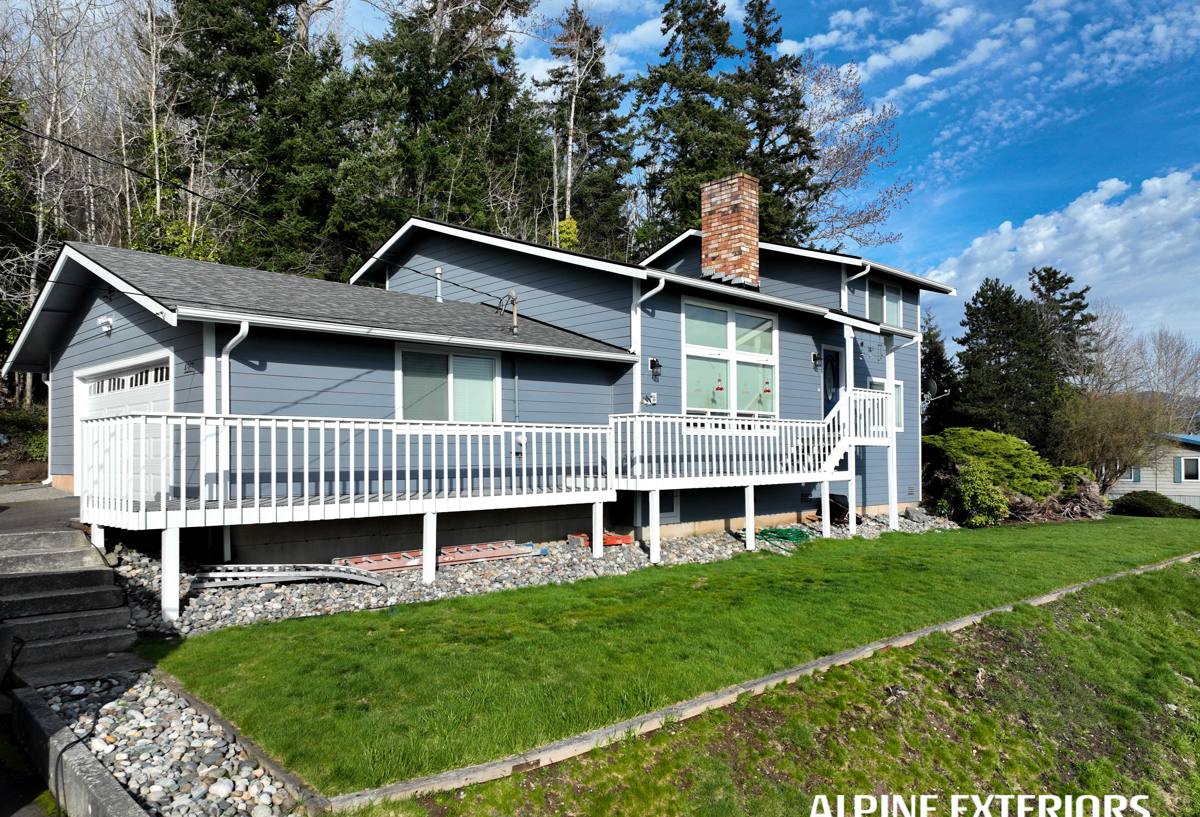
What Driving Rain and Salt Air Actually Do to a Roof
Rain alone isn't usually what causes roof failures. It's rain combined with wind, and rain that lingers. Whatcom County storms frequently push moisture sideways under normal wind loads, which means flashing details, underlayment laps, and fastening patterns matter more here than they would in a calmer climate. A roof that's technically watertight in still conditions can still leak during a driving rain event if the details weren't built for wind-driven water.
Salt air, meanwhile, is a slower process. It accelerates corrosion on exposed metal — flashing, fasteners, vents, and any metal roofing components — and can shorten the working life of lower-grade hardware. It's not usually dramatic; it just means the margin for using budget-grade metal components is smaller here than it would be further inland.
Where the Damage Shows Up First
- Flashing around chimneys, skylights, and roof-to-wall transitions, where wind-driven rain finds gaps
- Valleys, where water volume concentrates during heavy rain events
- Fastener heads and exposed metal, where corrosion starts as surface rust before it becomes a real problem
- Eaves and low-slope sections, where moss holds moisture against the roofing material longest
The Moss Season Problem
Moss doesn't just look bad — it holds water against shingles or shakes for months at a time, which accelerates granule loss on asphalt roofing and can encourage rot on wood-based materials. In a climate where the moss season runs long, a roof that isn't detailed and maintained with that in mind will age faster than its rated lifespan suggests. Proper attic ventilation, the right underlayment, and material choices that resist moss growth all play a role in slowing this down. Zinc or copper strips near the ridge, adequate roof pitch where possible, and periodic gentle cleaning all extend the practical life of a roof in this environment — but none of that matters if the replacement itself wasn't installed correctly to begin with.
Signs a Roof Needs Replacing, Not Just Patching
Not every roof problem calls for a full replacement, and we'll tell you honestly when a repair is the right call. But there are signs that point toward replacement being the more sensible long-term decision:
- Granule loss heavy enough that shingles look patchy or the roof is visibly thinning
- Multiple layers of prior roofing already in place, limiting repair options
- Soft spots or sagging in the roof deck, which usually means moisture has reached the sheathing
- Repeated leaks in different locations rather than one isolated spot
- Moss or algae staining that keeps returning shortly after cleaning
- The roof is at or past its material's expected service life for this climate
If a roof is showing one or two of these signs in isolation, a targeted repair may still make sense. When several show up together, replacement is usually the more cost-effective path — patch work on a roof that's fundamentally aged out tends to cost more over time than it saves.
What a Correct Roof Replacement Actually Involves
A roof replacement is more than the visible layer. The parts that don't show are usually what determine whether the roof performs well in Whatcom County's weather for its full expected lifespan.
Tear-Off and Deck Inspection
We remove the existing roofing down to the deck and inspect the sheathing for soft spots, rot, or delamination — issues that are common on older roofs that have dealt with years of trapped moisture. Any damaged decking gets replaced before anything new goes down; installing new roofing over a compromised deck just hides a problem instead of fixing it.
Underlayment
Given how much rain this area sees, we treat underlayment as a real second line of defense, not a formality. Ice-and-water shield or comparable self-adhering membrane at eaves, valleys, and vulnerable transitions gives the roof a backup layer in the spots most likely to see wind-driven water.
Flashing
New flashing at every penetration — chimneys, vents, skylights, and wall transitions — rather than reusing old flashing. Flashing is inexpensive relative to the whole job, and it's one of the most common failure points on roofs in this region, so we don't cut corners here.
Ventilation
Balanced intake and exhaust ventilation keeps the attic from trapping the moisture this climate throws at a house. Poor ventilation is one of the quieter causes of premature roof aging — it doesn't cause dramatic failures, it just shortens the roof's useful life year after year.
Fastening and Material Installation
Correct nail placement and pattern, manufacturer-specified exposure, and proper sealing at ridges and edges. This is standard trade practice, but it's also the part most likely to be rushed on a low-bid job — and the part that shows up as problems years later, not immediately.
Material Options for This Climate
There's no single "best" roofing material for every home — the right choice depends on budget, roof pitch, architectural style, and how much long-term maintenance a homeowner wants to take on. Here's how the common options stack up specifically for Whatcom County's rain-and-moss climate:
| Material | Moisture & Moss Behavior | Maintenance | Typical Lifespan |
|---|---|---|---|
| Asphalt composition shingle | Good with proper underlayment and ventilation; moss-resistant granule options available | Occasional cleaning; watch for granule loss over time | 20-30 years, product dependent |
| Metal roofing | Sheds water and moss very effectively due to smooth surface | Low; check fasteners and coating over time, especially near salt air exposure | 40-60+ years |
| Cedar shake | Attractive but holds moisture longest of common options; requires diligent moss control | Higher; regular cleaning and inspection needed | 20-30 years with upkeep |
| Synthetic/composite shingle | Good moisture and moss resistance; consistent performance | Low to moderate | 30-50 years, product dependent |
We'll walk through these trade-offs honestly during an estimate — including where a given product's warranty structure, installation sensitivity, or long-term maintenance burden might make it a better or worse fit for a specific roof.
Our Roof Replacement Process
- On-site assessment. We inspect the current roof, attic ventilation, and any visible problem areas, and talk through what we're seeing in plain terms.
- Written estimate. A clear scope of work and pricing, with material options explained so you understand what you're choosing between and why.
- Scheduling. We plan around weather windows — in this climate, timing tear-off and dry-in around forecasted rain is part of doing the job right.
- Tear-off and deck repair. Old roofing removed, deck inspected, and any damaged sheathing replaced.
- Underlayment, flashing, and installation. Built in the order and to the standard described above.
- Final walkthrough. We review the completed roof with you before considering the job done.
What Drives the Cost
Every roof is different, and we don't publish blanket prices because roof size, pitch, tear-off complexity, deck condition, and material choice all move the number. But these are the main factors that typically drive cost up or down on a project like this:
| Factor | Why It Matters |
|---|---|
| Roof size and pitch | More surface area and steeper pitches mean more material and labor time |
| Number of layers to remove | Multiple existing layers add to tear-off and disposal time |
| Deck condition | Rot or soft spots found during tear-off require sheathing replacement |
| Material choice | Asphalt, metal, cedar, and composite products carry different material and labor costs |
| Roof complexity | Valleys, dormers, chimneys, and skylights all add flashing detail and labor |
| Ventilation upgrades | Adding or correcting intake/exhaust ventilation adds modest cost but extends roof life |
We'd rather walk your roof and give you an honest number than throw out a broad range that doesn't reflect your actual home.
Why a Crew That Already Works Everson Matters
A roofing crew that regularly works homes in and around Everson and greater Whatcom County has already seen how local weather patterns affect roofs over time — which flashing details tend to fail first, how moss behaves on different pitches and orientations, and which materials hold up honestly versus which ones look good on paper but struggle here. That kind of familiarity isn't something you get from a crew that mostly works a different climate zone and treats every job the same way regardless of region. Local availability also matters practically: if a storm causes damage or something needs a follow-up look, a crew already working in the area can respond faster than one dispatching from further away.
Questions to Ask Before Hiring a Roofing Contractor
- Are you licensed and insured to work in Washington State, and can you provide proof?
- What underlayment and flashing details do you use specifically for wind-driven rain?
- How do you handle deck repair if rot is found during tear-off — is it included or billed separately?
- What ventilation approach do you recommend for this specific roof?
- What's the manufacturer's warranty, and what's your own workmanship warranty?
- Can you provide a written, itemized estimate rather than a verbal ballpark?
If your roof in Everson is showing its age or you just want an honest opinion on whether repair or replacement makes sense, we're happy to take a look. The estimate is free, there's no pressure, and you'll get a straight answer either way — just fill out the form below to get started.